
What if the most valuable acre on your property isn’t the one with the house, but the one where the bluff meets the river bottom? In the heart of Wisconsin’s Bluff Country, a premier dunn county waterfront property offers a rare convergence of world-class hunting habitat and pristine shoreline recreation. You’ve likely felt the frustration of browsing listings only to find ‘waterfront’ that turns out to be inaccessible marsh or restricted by confusing shoreline regulations. It’s a common fear, especially when you’re looking for a legacy property that needs to perform as both a sanctuary for trophy whitetails and a high-quality fishery.
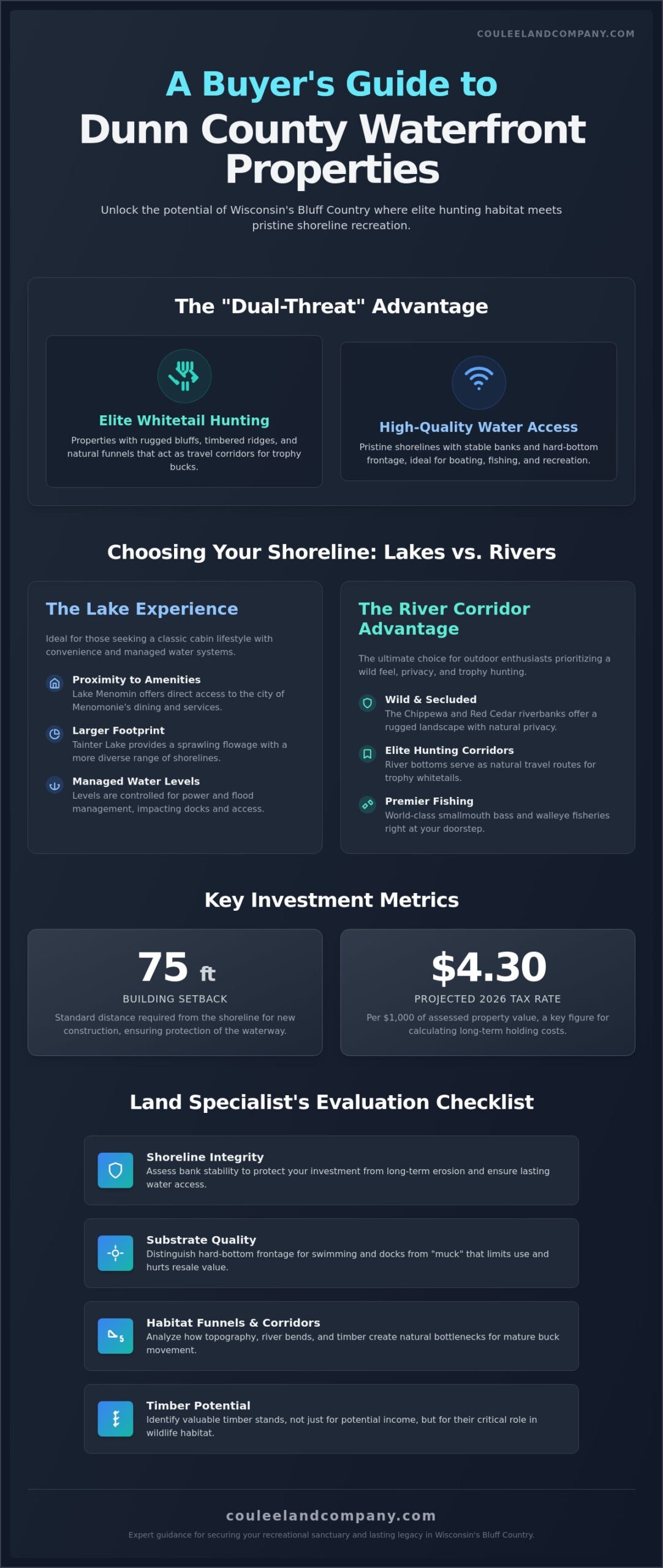
We’re here to help you cut through the uncertainty and secure a piece of land that truly delivers. This guide provides the expert roadmap you need to evaluate shoreline quality, understand the 75-foot building setbacks, and capitalize on the county’s projected 2026 tax rate of $4.30 per $1,000 of value. We will explore the specific nuances of Tainter Lake versus the rugged Chippewa River corridor, ensuring you find a dual-threat property that stands the test of time. From identifying high-quality frontage to leveraging new rules for accessory dwelling units, you’ll gain the insider knowledge required to make a confident investment in the land you love.
Key Takeaways
- Identify the specific geographic zones where the prairie meets the coulees, creating the region’s most productive river corridors.
- Learn to evaluate a dunn county waterfront property for “dual-threat” potential, balancing elite whitetail hunting with high-quality water access.
- Gain professional techniques for assessing shoreline integrity and bank stability to protect your long-term investment from erosion.
- Discover how specialized land brokers leverage deep regional networks to find off-market Bluff Country acreage that residential realtors often miss.
- Master the nuances of property stewardship to ensure your waterfront land serves as both a recreational sanctuary and a lasting legacy.
The Landscape of Dunn County Waterfront: Lakes, Rivers, and Coulees
Dunn County’s topography isn’t your typical flat Midwestern landscape. It’s a place where the fertile prairie meets the steep, timbered ridges of Western Wisconsin. This unique collision creates the coulees that define the region. For the savvy buyer, a dunn county waterfront property represents more than just a place to park a boat; it’s a strategic investment in some of the state’s most diverse terrain. The land here offers a ruggedness that provides natural privacy, a feature often missing in the crowded lake districts further north.
The primary arteries of the region are the Red Cedar and Chippewa River corridors. These waterways carved the deep valleys and high-relief bluffs that offer superior views and secluded building sites. While much of Dunn County, Wisconsin provides easy access to the Interstate 94 corridor, the river bottoms feel remarkably wild. This accessibility makes the area a powerful alternative to the Northwoods, offering shorter drive times without sacrificing the “up north” atmosphere.
To better understand this concept, watch this helpful video:
Lake Menomin vs. Tainter Lake: Choosing Your Shoreline
Lake Menomin serves as the heart of Menomonie, offering deeper water and immediate access to city amenities. Tainter Lake, a sprawling flowage to the north, provides a more classic cabin experience with varied shoreline depths. Buyers should understand that water levels on these flowages are managed for power and flood control, which impacts dock placement and shoreline maintenance. If you value consistent water levels and proximity to dining, Menomin is the choice. For those seeking a larger footprint and more diverse shorelines, Tainter offers more options.
Riverine Properties: The Chippewa and Red Cedar Advantage
The real prize for the outdoor enthusiast lies along the river banks. Properties along the Chippewa River offer a wild feel that’s hard to find elsewhere. These river bottoms are natural travel corridors for trophy whitetails, making them elite waterfront-properties for those who prioritize hunting. High-relief bluffs provide safe building sites well above the floodplain while maintaining direct access to world-class smallmouth bass and walleye fishing. It’s a dual-threat landscape where you can hunt big timber in the morning and kayak a premier fishery in the afternoon.
Evaluating Dunn County Waterfront Property for Recreation and Investment
Unlike standard residential listings that focus on bedroom counts, a premier dunn county waterfront property is defined by its land-to-water ratio and recreational utility. We look for “dual-threat” acreage. This means land that doesn’t just offer a view, but acts as a functional corridor for trophy whitetails while providing high-quality water access. Understanding this synergy is vital; it’s the same logic used in our Buffalo County hunting guide when evaluating regional whitetail prestige. A property with fifty feet of frontage and forty acres of timber is often worth significantly more to a legacy buyer than a small lot on a crowded shore.
Long-term value depends on shoreline integrity. If the bank is eroding or the water is “mucky” and shallow, your recreational options are limited. The Dunn County Land and Water Conservation Division provides resources for maintaining these shorelines, which is essential for protecting your investment. High-quality frontage should be stable and offer easy access for docks or kayaks without constant dredging or mitigation.
The Land Specialist’s Checklist for Waterfront Buyers
- Substrate Quality: Distinguish between hard-bottom frontage for swimming and “muck” that complicates boat access and reduces resale value.
- Habitat Funnels: Analyze how river bends and shoreline timber create natural bottlenecks for mature bucks moving through the coulees.
- Timber Potential: Identify areas where Timber Stand Improvement (TSI) can enhance both aesthetics and wildlife bedding near the water’s edge.
Zoning and Shoreline Regulations in Dunn County
Navigating Wisconsin DNR regulations is a non-negotiable step in the buying process. You must understand building setbacks, which typically require structures to be at least 75 feet from the ordinary high water mark. On sloped bluff properties, this footprint becomes even more critical to ensure a stable, buildable site. In Wisconsin property rights, the ordinary high water mark is defined as the point on the bank where the presence and action of water is so continuous as to leave a distinct mark or change in the character of the soil or vegetation. If you’re ready to find a property that meets these rigorous standards, consider reviewing our current waterfront-properties for elite opportunities.
Securing Your Legacy: Why a Land Specialist is Essential
Finding the right dunn county waterfront property requires a different lens than buying a home in town. A residential realtor focuses on the house, but a land broker evaluates the dirt, the water, and the wildlife. We analyze habitat connectivity, timber maturity, and long-term privacy, which are the factors that determine the true value of Bluff Country acreage. Our team, led by experts like Mike Law and Bryan Lemke, understands that you aren’t just buying a view; you’re securing a legacy. We identify off-market opportunities through deep local networks, often connecting buyers with elite river frontage before it ever hits a public database.
Evaluation goes far beyond standard MLS data. We look at the “bones” of the land, assessing how a river corridor acts as a natural funnel for mature bucks or how a specific bluff side provides a thermal advantage for wintering wildlife. This specialized knowledge ensures you don’t overpay for “mucky” frontage while missing a high-value ridge just a few hundred yards away. We bridge the gap between professional real estate and outdoor sportsmanship.
From Purchase to Stewardship: Managing Your Waterfront Land
The relationship doesn’t end at the closing table. We help buyers transition into active land management, ensuring their dunn county waterfront property reaches its full potential for wildlife. In the river bottoms of Dunn County, this often involves strategic food plot placement and the development of thick thermal cover to hold trophy whitetails during the late season. Understanding the specific needs of hunting properties in this region is what separates a casual owner from a successful steward of the land.
Your Next Steps in Dunn County
The market for high-quality shoreline is competitive, and the best tracts move quickly. We recommend setting up a custom property alert to stay ahead of new listings that meet your specific criteria for depth, frontage, and acreage. You shouldn’t make an offer without walking the land with a specialist who can identify boundary nuances and habitat quality. When you’re ready to start your search, you can browse our exclusive waterfront listings or contact a specialist to begin your journey in the coulees.
Claim Your Stake in the Wisconsin Coulees
Owning a dunn county waterfront property is about more than just finding a place to dock a boat. It’s about securing a piece of the Bluff Country where the river bottoms provide elite whitetail habitat and the ridges offer unmatched seclusion. We’ve explored how the intersection of the Red Cedar and Chippewa Rivers creates a unique recreational value that often outperforms standard residential investments. By focusing on shoreline integrity and habitat connectivity, you move beyond buying a simple lot and start building a multi-generational legacy.
Our team is specialized in Bluff Country whitetail habitat and endorsed by industry leaders in land management. We bring deep expertise in complex recreational land transactions to every search, ensuring you avoid the pitfalls of “mucky” frontage or restrictive zoning. Whether you’re chasing trophy walleye or world-class bucks, the right land is out there. Take the next step toward your dream today.
View Exclusive Dunn County Waterfront Listings
The coulees are calling. It’s time to find the shoreline that fits your vision of the great outdoors and your goals for the future.
Frequently Asked Questions
What is the best lake in Dunn County for a year-round waterfront home?
Lake Menomin is the premier choice for year-round living due to its consistent water depths and immediate proximity to Menomonie city services. While Tainter Lake offers a more traditional “cabin” feel with varied shorelines, Lake Menomin provides the infrastructure and maintained road access required for a primary residence. It’s the ideal location for buyers who want a dunn county waterfront property that balances recreational access with the convenience of nearby amenities.
Are there specific hunting regulations for waterfront properties in Wisconsin?
Hunting on waterfront land is governed by a combination of state wildlife laws and local municipal ordinances regarding the discharge of firearms or bows. While the water itself is public, your right to hunt from the shoreline is restricted by safety setbacks from neighboring dwellings and public high-water marks. We specialize in identifying river-bottom tracts where the acreage is deep enough to allow for legal, private hunting of trophy whitetails away from restricted zones.
How do Dunn County property taxes compare for waterfront vs. inland land?
Waterfront land typically carries a higher assessed value than landlocked parcels because of the high demand for shoreline frontage. The projected 2026 tax rate for the region is $4.30 per $1,000 of property value, which represents a decrease from previous years. While the rate is the same across the county, the premium placed on water access means your annual bill will be higher than a comparable inland tract. The median annual tax bill in the county sits at $3,029, but premier bluff-side estates often see higher assessments.
Can I build a dock on any riverfront property in Dunn County?
You cannot install a dock without first ensuring it meets Wisconsin DNR pier standards and local shoreland zoning requirements. Every dunn county waterfront property is subject to specific regulations regarding navigation and habitat protection. On river systems like the Chippewa or Red Cedar, current speeds and bank stability often dictate whether a dock is feasible or if a permit for a more permanent structure is required. You must verify your shoreline’s ordinary high water mark before beginning any construction.