
A trophy whitetail doesn’t care where your property line starts; he cares how your 80 acres integrate into the larger West-Central Wisconsin ecosystem. If you’re looking at acreage in 2026, you’re likely feeling the pressure of rising land values, which hit an average of $7,324 per acre in this region. You don’t want to sink your capital into a “dead” property with stagnant deer movement or discover hidden legal easements after the closing. Utilizing a comprehensive Dunn County hunting land buying checklist is the only way to ensure your investment translates into a legacy of successful seasons.
As expert land brokers with a deep understanding of local timber and topography, we know the dream of owning a piece of Bluff Country is often tempered by the fear of poor neighbor management or low wildlife density. You deserve a framework that provides absolute confidence in a tract’s long-term value. This guide delivers a professional-grade strategy for evaluating everything from tillable income potential to QDM history. We’ll break down the nuances of terrain, local regulations, and the specific property attributes that distinguish a premier trophy tract from a standard woodlot.
Key Takeaways
- Map the regional potential of Dunn County by identifying core habitat zones and their proximity to major river systems like the Red Cedar and Hay River.
- Execute a tactical physical inspection to pinpoint primary bedding areas and the specific hillside benches where mature bucks transition.
- Utilize this Dunn County hunting land buying checklist to navigate the nuances of the Managed Forest Law (MFL) and ensure your property’s tax status aligns with your goals.
- Protect your investment by performing rigorous due diligence on property boundaries and uncovering hidden easements that could compromise your privacy.
- Master the art of identifying “buck nests” and other high-value topographic features that signal a premier trophy property.
Strategic Pre-Scouting: Evaluating Dunn County’s Regional Potential
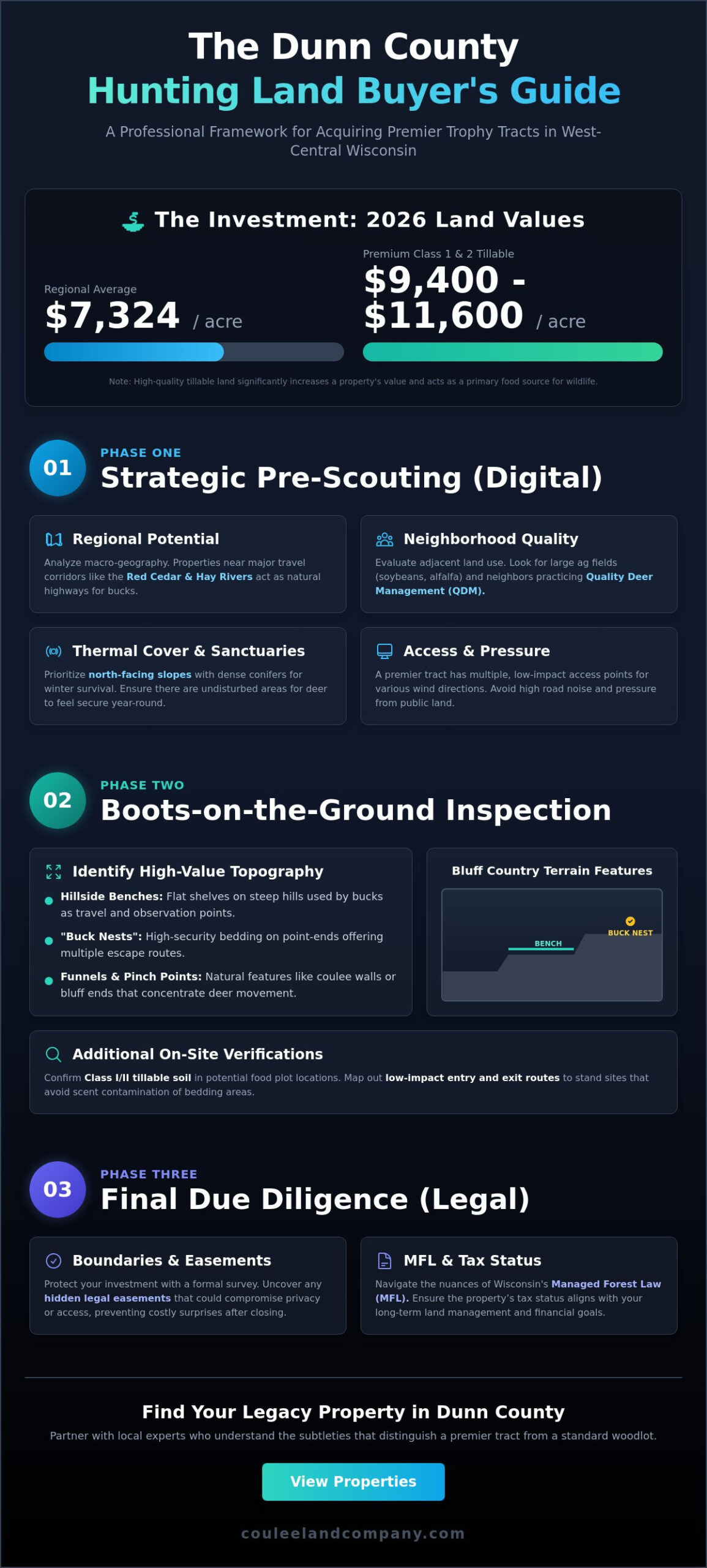
Successful acquisitions start long before you set foot on the soil. When building your Dunn County hunting land buying checklist, your first priority is understanding the macro-geography of Dunn County, Wisconsin. The northern tier is defined by rolling oak ridges that provide massive mast crops, while the southern reaches offer dense, river-bottom thickets. You need to analyze how a property interacts with major travel corridors like the Red Cedar River and Hay River systems. These waterways act as natural highways for mature bucks during the pre-rut when movement is at its peak.
To better understand the nuances of digital scouting and land selection, watch this helpful video:
Effective pre-scouting requires a deep dive into local land use maps. Look for bordering agricultural ground that provides high-protein supplemental feed like soybeans or alfalfa. High-quality Class 1 and 2 tillable land in the county is currently commanding between $9,400 and $11,600 per acre as of Q1 2026, and these tracts often serve as the primary food source for an entire section. A property’s “Neighborhood Quality” is just as vital as the land itself. Use aerial tools to determine if adjacent tracts are managed for Quality Deer Management (QDM) or if they are highly fragmented parcels. We specialize in identifying hunting properties within elite neighborhoods where neighbors share a vision for trophy potential.
The Role of Thermal Cover and Bedding
Winter survival in West-Central Wisconsin depends on thermal cover. Prioritize north-facing slopes with dense conifer stands that shield deer from biting winds. A premier tract must also have “sanctuary potential,” meaning areas that remain completely undisturbed throughout the season. Evaluate the ratio of timber to tillable acreage; you want enough cover to hold deer year-round without sacrificing the drawing power of food plots. Refining this phase of your Dunn County hunting land buying checklist ensures you don’t waste time on properties lacking foundational trophy elements.
Accessibility and Wind Direction
A property is only as good as your ability to hunt it. Look for multiple access points that allow you to slip into stands regardless of wind direction. Analyze road noise and human pressure from nearby public access points. High-traffic corridors can push deer into nocturnal patterns, so choosing a tract with internal road systems and quiet entry points is essential for consistent success.
The Boots-on-the-Ground Inspection: A Physical Property Checklist
Digital scouting provides the blueprint, but a physical walk-through reveals the soul of a property. When you transition from aerial maps to the timber, your Dunn County hunting land buying checklist must prioritize the specific topographic features that define “Bluff Country” hunting. Mature bucks in West-Central Wisconsin are masters of terrain. They utilize subtle benches, those flat shelves carved into steep hillsides, to transition between bedding and feeding while maintaining a visual advantage over the valley below. Walking these ridges allows you to identify “buck nests,” which are specific, high-security bedding spots on point-ends that offer a buck multiple escape routes.
Terrain dictates movement. You must locate natural funnels and pinch points created by steep coulee walls or sharp bluff endings. These features force deer into predictable travel lanes, creating high-percentage stand locations. Don’t overlook the soil. Even in the timber, you should assess the quality of potential food plot locations. If you find Class I or Class II tillable soil in a hidden valley, you have the foundation for a premier feeding destination. If you are ready to walk these ridges with an expert, our team of specialized land brokers can help you identify these subtle topographic advantages.
Topography and Deer Movement
Success on a small tract depends on low-impact access. Map out routes that allow you to enter and exit stand sites without blowing your scent into primary bedding areas. Look for old logging roads; these are often easily converted into interior travel corridors that guide deer past your stands. Check for historic rut activity, such as deep rubs on cedar trees or perennial scrapes in traditional staging areas, which signal long-term holding power.
Water and Interior Infrastructure
Reliable water is a magnet during the dry October weeks. Verify the flow of seasonal creeks or locate hidden springs that may not appear on standard maps. Evaluate the condition of existing trails to ensure they can handle UTV or tractor access for maintenance. Finally, identify potential sites for country homes or cabins. The ideal building site provides comfort without encroaching on the sanctuary areas that keep mature bucks on your side of the fence.
Due Diligence: Finalizing Your Dunn County Land Investment
The final phase of your Dunn County hunting land buying checklist involves looking beyond the timber to the legal and social framework of the property. Who is across the fence matters as much as the habitat on your side. You should determine if neighbors practice Quality Deer Management (QDM) or if they harvest any legal buck that crosses the line. High harvest pressure on adjacent tracts can nullify even the best food plots. We recommend interviewing neighbors or consulting with a land specialist to review the trophy history of the immediate square mile. This ensures you aren’t buying into a “dead” zone where the local age structure is consistently depleted.
Confirming property boundaries is non-negotiable. Look for unrecorded easements or encroachment issues that could lead to future disputes. You should also verify the status of the Managed Forest Law (MFL) program. While MFL can significantly lower your tax burden, it may require public access if the land is enrolled as “Open.” Understanding these nuances before you reach the closing table prevents costly surprises and protects your sanctuary from unwanted foot traffic.
Understanding Local Regulations and Taxes
For the 2026 tax year, the Dunn County property tax rate is projected at $4.30 per $1,000 of value. This represents a continued decrease from previous years, yet recreational land use still impacts your annual carry costs differently than agricultural acreage. Check local zoning if you plan to build permanent structures or outbuildings. Learn more about Wisconsin property tax on land to see how these figures fit into your long-term investment strategy.
The Value of a Specialized Land Broker
A residential agent might see a pretty view, but they often miss critical habitat flaws like poor thermal cover or fragmented travel corridors. Experts like Mike Law or Bryan Lemke use their deep hunting backgrounds to vet listings through a sportsman’s lens. They understand how a property fits into the West-Central Wisconsin landscape. Your final step should always be requesting a professional land valuation to ensure the price reflects the property’s true wildlife and agricultural potential.
Secure Your Legacy in the Heart of Bluff Country
Owning a premier hunting property is about more than simple acreage; it’s about securing a legacy in a region legendary for record-breaking whitetails. You’ve now mastered the essential elements of a professional Dunn County hunting land buying checklist, from analyzing regional travel corridors like the Red Cedar River to identifying the subtle hillside benches where mature bucks transition. This framework ensures you avoid the pitfalls of “dead” properties and hidden legal encumbrances, giving you absolute confidence in your investment’s long-term wildlife value.
Our team specializes in Western Wisconsin Bluff Country and is endorsed by industry-leading whitetail experts who trust our hands-on land stewardship and management expertise. We don’t just sell land; we understand the distinct language of the woods and the pragmatic reality of property ownership. If you’re ready to move from the dream to the deed, we’re here to guide you every step of the way. View our exclusive Dunn County hunting land listings and take the first step toward your own sanctuary. The perfect ridge is waiting for you.
Frequently Asked Questions
Is Dunn County as good for trophy whitetails as Buffalo County?
Dunn County is a premier destination that rivals Buffalo County in both trophy quality and record-book entries. While Buffalo County carries a famous reputation, Dunn provides the same rugged coulees and oak-rich ridges that produce world-class whitetails. Many hunters find that Dunn County offers a more diverse mix of river-bottom thickets and agricultural flats, making it a top-tier choice for those serious about Western Wisconsin whitetail management.
What is the average price per acre for hunting land in Dunn County in 2026?
In June 2026, the average AcreValue for land in Dunn County is $7,324 per acre. However, specialized hunting tracts with established food plots and trophy history often see median listing prices closer to $14,784 per acre. Prices for Class 1 and Class 2 tillable land currently range from $9,400 to $11,600 per acre, reflecting the strong demand for properties that offer both recreational value and agricultural income.
How much tillable acreage do I need to sustain a healthy deer population?
A healthy deer population typically requires a ratio of at least 10% to 15% tillable acreage or high-quality food plots relative to total timber cover. This balance ensures that deer have access to high-protein supplemental feed throughout the winter months without exhausting the natural browse. On a standard 80-acre tract, maintaining 8 to 12 acres of food sources will significantly increase your property’s year-round holding power.
What are the benefits of enrolling my land in the Wisconsin Managed Forest Law (MFL) program?
Enrolling in the MFL program offers substantial property tax relief, which is a vital consideration for your Dunn County hunting land buying checklist. The program encourages long-term forest health through professional management plans. You must decide between “Open” or “Closed” status; “Closed” acreage keeps the land private for a slightly higher fee, while “Open” status requires allowing public access but offers the maximum tax deduction available in Wisconsin.
Can I hunt my land the same year I purchase it?
You can hunt your property immediately upon closing as long as you possess a valid 2026-2027 Wisconsin hunting license. The archery and crossbow season opens on September 12, 2026, followed by the traditional 9-day gun season on November 21. If you acquire land during the summer, you’ll have time to clear lanes and scout bedding areas, though even a mid-season purchase allows you to participate in the December muzzleloader or holiday hunts.
What should I look for in a property survey for recreational land?
A recreational survey should prioritize clear boundary line markings and identify any potential encroachments or unrecorded easements. Beyond legal lines, you want a survey that helps you understand how the acreage interacts with the local landscape. Confirming that your high-value “buck nests” and ridge-top benches are fully within your property lines is essential for long-term peace of mind and effective Quality Deer Management (QDM) practices.