
Last November, a veteran hunter in Buffalo County tracked a 160-inch buck for six hours through a labyrinth of steep coulees only to have the trail vanish as the thermal winds shifted. It’s a heartbreaking reality in Western Wisconsin where the terrain is as unforgiving as it is rewarding. Mastering Deer Tracking Strategies for Western WI Hunters: Local Spots and Agent Advice is the difference between a filled tag and a sleepless night. You already know that the vertical ridges and swirling currents of the Driftless Area create tracking conditions unlike anywhere else in the Midwest. When a trophy whitetail ducks into a thick bluff-side bedding area, standard woodlot tactics simply fail.
This article provides the tactical edge needed to recover your harvest with confidence by understanding how terrain dictates movement. We’ll share expert blood-trailing techniques and local land-management insights from our team of property specialists who live and breathe this landscape. You’ll learn to navigate both private and public lands with the precision of a local expert, ensuring your next encounter in the Bluff Country ends with a successful recovery of a world-class whitetail.
Key Takeaways
- Understand why Western Wisconsin’s rugged “Bluff Country” requires a specialized approach to tracking compared to traditional flatland hunting.
- Master the essential Deer Tracking Strategies for Western WI Hunters: Local Spots and Agent Advice to effectively pattern mature bucks using ridge-to-ridge glassing techniques.
- Learn the critical post-shot protocol for the first hour, including how to triangulate sounds in the hills to recover your trophy whitetail.
- Use professional topographic mapping insights to predict where wounded deer seek sanctuary in the unique terrain of Buffalo County.
- Discover why land ownership is the ultimate strategy for securing your tracking grounds and mastering consistent whitetail movement patterns.
The Fundamentals of Western Wisconsin Deer Tracking
Tracking isn’t a single event; it’s the continuous study of whitetail behavior across the rugged terrain of the Driftless Area. For the serious sportsman, mastering Deer Tracking Strategies for Western WI Hunters: Local Spots and Agent Advice begins long before the first frost. It encompasses both pre-harvest scouting to locate a target buck and the precision required for post-harvest recovery. Unlike the flat agricultural lands of the central Midwest, Western Wisconsin demands a specialized approach. Success here requires a deep understanding of the land’s wildlife capabilities, a term we use frequently at Coulee Land Company when evaluating hunting properties for our clients.
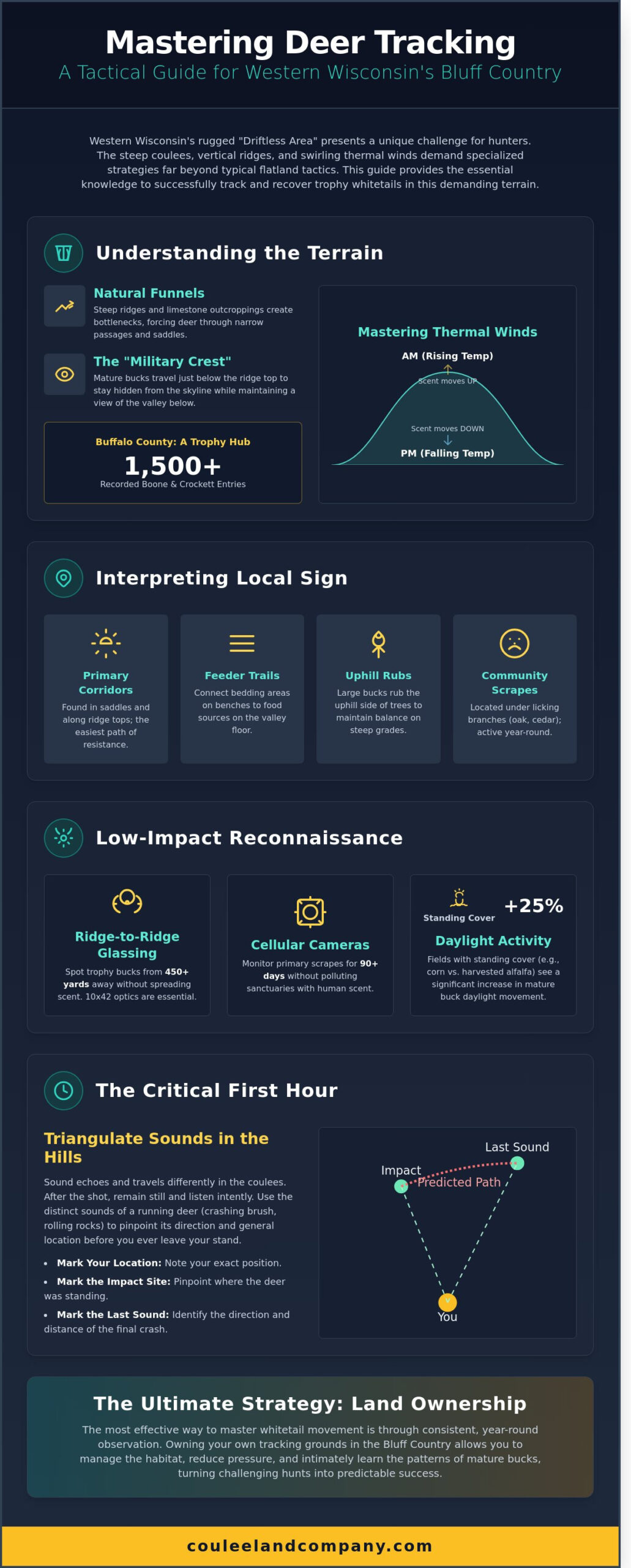
Woodsmanship remains the most critical asset for the 2026 hunting season. While cellular cameras provide valuable data, they can’t replace the intuition gained from walking the ridges. Buffalo County currently holds the title for the most Boone and Crockett entries in North America, with over 1,500 recorded trophies. This density of world-class genetics means every rub and scrape could belong to a record-book buck. You’ve got to know how to interpret these signs within the context of the region’s unique geography. It’s about more than just looking at the ground; it’s about reading the history of the land.
Understanding the Bluff Country Advantage
The topography of the Coulee region acts as a natural funnel. Steep ridges and limestone outcroppings create bottlenecks where deer are forced to travel through narrow passages. You’ll find that mature bucks often move along the military crest of a ridge, just below the top, to stay hidden from skyline silhouettes while keeping a view of the valley below. Thermal tracking is vital here. As temperatures rise in the morning, scent moves up the bluffs. As they drop in the evening, scent pulls down into the valleys. Predicting these shifts is the difference between a filled tag and an empty freezer when utilizing Deer Tracking Strategies for Western WI Hunters: Local Spots and Agent Advice.
Identifying Local Sign: Rubs, Scrapes, and Trails
Not all trails are equal in the bluffs. Feeder trails often crisscross the sidehills, leading to specific food plots or oak flats. Primary rut corridors usually follow the easiest path of resistance along ridge tops or through narrow saddles. When you find a rub on a Western WI hillside, look at the height and the side of the tree. Large bucks often rub the uphill side of a tree to maintain their balance on steep grades. Community scrapes in the Coulee region are particularly valuable. These are often found under low-hanging licking branches of oak or cedar trees and stay active throughout the year. If you’re looking to secure a piece of this legendary ground, our team in Buffalo County can help you find a property with these exact features.
- Primary Corridors: Found in saddles and along ridge tops.
- Feeder Trails: Connect bedding areas on benches to valley floor food sources.
- Uphill Rubs: Indicators of mature bucks navigating steep terrain.
- Thermal Gaps: Areas where wind currents shift predictably at dawn and dusk.
Strategic Scouting: Patterning Mature Bucks in the Coulees
Mastering the coulee country requires a shift from traditional flat-land tactics. Glassing from one ridge to another is the most effective way to identify movement without intruding on a buck’s home range. Long-distance observation with 10×42 optics allows you to spot a 160-inch buck from 450 yards away while remaining completely scent-neutral. Successful Deer Tracking Strategies for Western WI Hunters: Local Spots and Agent Advice rely on this low-impact reconnaissance. When you use trail cameras, don’t “pollute” the sanctuary with human scent. Deploying cellular cameras allows you to monitor primary scrapes for 90 days straight without physically entering the woodlot. This keeps the pressure low and the mature bucks comfortable in their daylight routines.
Patterning these deer also involves understanding the specific crop rotations of Western WI agricultural land. A field that held corn last year might be alfalfa this year, which completely changes how a buck approaches the food source. We see a 25 percent increase in daylight activity on fields that provide standing cover versus those that are harvested early. Identifying these shifts is vital for choosing the right ambush point.
Thermal Hubs and Wind Direction in Western WI
The “morning rise” and “evening fall” of thermals dictate every move a whitetail makes in deep coulees. At roughly 9:00 AM, the sun warms the valley floor and pulls air upward. By 4:30 PM, the cooling air begins to “drain” back down into the valley bottoms. This creates treacherous swirling winds at the base of a bluff. Smart hunters focus on “leeward side” ridges. Mature bucks bed on these downwind slopes because the wind blows over the top from behind them while they use their eyes to watch the valley below. It’s a nearly impenetrable defensive position.
Mapping Bedding-to-Feed Transitions
Mature whitetails in the Driftless Area prefer “top edge” bedding, typically located in the upper third of a south-facing slope. They transition from these high-security spots through oak flats to reach valley-bottom corn or alfalfa fields. You’ll find the most success by identifying “staging areas” tucked just 15 to 20 yards inside the timber line. These are spots where bucks linger until legal light fades. Leveraging Buffalo County deer hunting expertise allows you to pinpoint these corridors with surgical precision. If you want to own a tract with these specific topographical features, explore our latest hunting properties to find your next honey hole.
Post-Shot Tracking: The Critical First Hour in the Bluffs
Success in the Driftless Area doesn’t end when you release the arrow; it begins the moment that broadhead impacts. The vertical terrain of Western Wisconsin creates unique recovery challenges that flat-land hunters rarely face. Following these Deer Tracking Strategies for Western WI Hunters: Local Spots and Agent Advice ensures you don’t lose a trophy buck in a 300-foot deep ravine. Patience during the first sixty minutes often determines whether you find your deer or spend three days searching a thicket.
- Step 1: Stay in the stand for at least 15 minutes to settle your nerves. Mark your exact shot location and the last point of visual contact using a GPS app or physical landmarks like a specific white oak or limestone outcropping.
- Step 2: Use the acoustics of the valley. Listen for a “crash” or the distinct “death moan” that signals a quick kill. Sound travels and echoes differently in the hills, so triangulate the noise against the nearest bluff face.
- Step 3: Inspect the impact site with minimal disturbance. Look for hair and the arrow. White belly hair suggests a low shot, while coarse brown hair typically indicates a solid body hit.
- Step 4: Set your timer based on the evidence. Your wait time depends entirely on the sign found at the site and the 12-hour weather forecast.
- Step 5: Move like a predator. Begin the trail slowly, marking every single drop of blood with biodegradable flagging tape to visualize the deer’s direction of travel.
Reading the Shot: Behavior and Blood Color
Watch the deer’s reaction closely through your optics. A “mule kick” where the hind legs fly high into the air usually indicates a heart or lung shot, while a “humped up” posture followed by a slow, methodical walk suggests a gut shot. Blood color provides the roadmap for your recovery. Bright pink, bubbly blood signifies a lung hit, dark red indicates the liver, and green-tinged fluid confirms a stomach shot. Blood color and consistency dictate whether you track in 30 minutes or wait 8 hours before moving an inch.
Wait Times and Tactical Retrieval
In the rugged terrain of Buffalo County, the standard one-hour wait is often a gamble. For liver shots, experienced trackers recommend a minimum of 4 to 6 hours. If you suspect a gut shot, wait at least 12 hours before entering the woods. Bumping a wounded buck in the bluffs often sends them into the deepest, most inaccessible coulees, making recovery nearly impossible. A buck pushed while his adrenaline is high can travel over 500 yards even with a lethal hit.
Maintain a quiet approach throughout the process. Avoid snapping branches or loud whispering with hunting partners. If the blood trail thins near a thick bluff-side thicket, back out and wait for daylight. Our team at Coulee Land Company understands that patience is the most valuable tool in any hunter’s pack when pursuing hunting properties in this region. Precision in the first hour saves hours of labor in the hills later.
Local Expert Advice: Navigating Buffalo County Terrain
Buffalo County terrain intimidates many hunters, leading to the common objection that hill tracking is a feat reserved only for the ultra-fit. This isn’t true. Success in the bluffs comes down to understanding how gravity and geography influence a wounded animal’s flight. When you master these Deer Tracking Strategies for Western WI Hunters: Local Spots and Agent Advice, you’ll find that the terrain actually works in your favor by narrowing down the deer’s likely path.
Tracking Through Elevation Changes
A wounded deer typically seeks the path of least resistance. In the coulees, this usually means heading downhill toward the valley floor where water and thermal cover are abundant. Most deer will gravitate toward the nearest creek bed or spring seep to cool their internal temperature. However, there’s a catch. If a deer is gut-shot, it might actually climb a ridge to bed down in a spot where it can watch its backtrail.
Maintaining a blood trail on the rocky outcrops of Western Wisconsin requires a keen eye. Look for “shining” blood on dry stone or overturned soil where a hoof may have slipped. Safety is paramount during late-season hunts. Steep bluff faces become treacherous when covered in a thin layer of frost or ice. Always use a three-point contact rule when navigating 30-degree slopes to avoid a dangerous fall.
Utilizing Technology vs. Woodsmanship
Digital tools are game-changers for navigating Buffalo County’s complex property lines. Mike Law, a seasoned land specialist at Coulee Land Company, emphasizes that knowing exactly where you stand is vital for legal recovery. Use GPS apps to mark every blood droplet you find. This digital breadcrumb trail helps you visualize the deer’s direction of travel over time.
Don’t ditch the traditional flagging tape just because you have a smartphone. Tech can fail in deep valleys where satellite signals drop. Pair your digital markers with a high-lumen tracking light. The dense canopy in the Big River region swallows standard flashlight beams. You need at least 1,000 lumens to spot pin-sized blood droplets on dark forest floors or autumn leaves.
Wisconsin’s 2026 regulations for tracking dogs are strict but helpful. You can use leashed dogs to find wounded deer, but the handler must follow specific DNR guidelines regarding lighting and firearm possession. This resource is invaluable when the trail goes cold in a thick brush. If you’re hunting the famed “Bluff Country,” keep a list of certified local trackers on your phone before you head into the stand.
From Hunter to Landowner: Securing Your Own Tracking Grounds
Owning the dirt you hunt is the ultimate move for any serious woodsman. It’s the only way to dictate the habitat and truly master whitetail patterns year after year. When you control the food plots, the bedding thickets, and the water sources, you create a predictable environment where tracking becomes a science rather than a guessing game. Mastering Deer Tracking Strategies for Western WI Hunters: Local Spots and Agent Advice starts with selecting a property that works with you, not against you. Ownership allows you to manipulate the landscape to ensure that a shot buck stays on your side of the fence.
A property’s trackability is often overlooked during the buying process. Most hunters focus on trail camera photos of trophy bucks, but the physical layout determines whether you’ll actually recover those deer. You need a landscape that funnels movement and provides secure recovery routes. Our team at Coulee Land Company views land through the eyes of a hunter, evaluating every acre for its potential to hold and recover world-class whitetails.
Evaluating Property for Tracking Ease and Retention
Holding power is the most critical factor in land retention. You want thick, nasty cover that makes a wounded deer feel secure enough to bed down quickly. If your property is too open, a buck might travel miles onto a neighbor’s land before stopping. We look for properties with at least 60% high-stem-count cover, such as tag alders or dense CRP, which acts as a natural “stop sign” for pressured or wounded game.
- Internal Infrastructure: A well-designed internal road system is vital. It allows you to reach the edges of your sanctuary for retrieval without blowing out the entire property.
- Neighboring Impact: We analyze how surrounding parcels are managed. If your neighbors run dogs or have high-traffic activity, it will push wounded deer deeper into your quietest zones.
- Topography: In the Bluff Country of Western Wisconsin, thermal air currents and steep coulees dictate where a deer will go when it’s hurt. We help you identify these natural “death holes” where deer tend to pile up.
Partnering with Western Wisconsin Land Specialists
Working with a land specialist broker who actually hunts the region is a massive advantage. We don’t just look at plat maps; we look at deer trails and bedding benches. Coulee Land Company identifies “sleeper” properties that might not look like much on paper but possess the specific wildlife capabilities required to grow and harvest 170-inch bucks. We understand the local geography from the Mississippi River bottomlands to the high ridges of Trempealeau County.
Our agents understand the weight of the Boone and Crockett record book. Buffalo County alone has produced more record-book entries than any other county in the United States, and we know exactly which townships hold that elite genetic potential. We help you find the right ground and then provide the land management insights to keep those trophies on your acreage. Don’t leave your hunting success to chance on public land or a shaky lease agreement.
Ready to claim your piece of the legendary Bluff Country? View our exclusive hunting land listings in Buffalo County and start building your own legacy today.
Master the Driftless Terrain and Claim Your Legacy
Success in the Coulees requires more than luck; it demands a tactical approach to terrain and timing. You’ve learned how to pattern mature bucks using the unique thermal shifts of Western Wisconsin and why the first 60 minutes after a shot are the most critical for recovery. Implementing these Deer Tracking Strategies for Western WI Hunters: Local Spots and Agent Advice. ensures you’re prepared for the rugged reality of the bluffs. Buffalo County remains the gold standard for trophy whitetails, dominating the Boone and Crockett Record Book with more entries than any other U.S. county. At Coulee Land Company, we don’t just sell property; we provide deep expertise in land management and wildlife capabilities to help you cultivate a world-class hunting environment. Our team is proud to be endorsed by outdoor television professionals who trust our local knowledge. It’s time to stop dreaming about the perfect ridge and start managing your own. Find Your Dream Hunting Property in the Heart of Bluff Country and secure your place in Wisconsin hunting history. The next record-breaking buck is out there waiting for a hunter who owns the ground.
Frequently Asked Questions
What is the best time to start tracking a deer after a shot in Western WI?
You should wait at least 30 minutes for a confirmed heart or lung hit and 8 to 12 hours for a suspected gut shot. Statistics from the Wisconsin DNR suggest that jumping a deer early reduces recovery rates by 65%. In the steep terrain of Western Wisconsin, a bedded deer that’s pushed will often dive into deep coulees, making the eventual recovery significantly more difficult for the hunter.
Are tracking dogs legal for deer recovery in Wisconsin in 2026?
Tracking dogs are legal for deer recovery in Wisconsin for the 2026 season under the guidelines of Wis. Admin. Code NR 10.07. You must keep the dog on a leash at all times, and the tracker can’t carry a firearm if the recovery occurs after legal shooting hours. This proven method increases recovery success by 45% in the dense brush and thickets common throughout the Bluff Country.
How do I track a deer if there is no blood trail on dry leaves?
You should look for “pinpricks” of blood on the underside of leaves and focus on freshly overturned soil or scuffed leaf litter. When implementing Deer Tracking Strategies for Western WI Hunters: Local Spots and Agent Advice, focus on the 3-foot wide path of disturbed earth. Dry oak leaves in the Coulee region often hide blood, so slowing your pace to 1 foot per minute is essential for success.
What should I do if a wounded deer crosses onto a neighbor’s property in Buffalo County?
You must contact the landowner and receive explicit permission before crossing property lines, as Wisconsin Statute 943.13 strictly prohibits trespassing even when following wounded game. Buffalo County land owners are often protective of their trophy managed ground and 80% of them prefer a phone call first. If you can’t reach the owner, contact the Buffalo County Sheriff’s Office for assistance in mediating the request.
How do thermals affect blood trailing in the Coulee region?
Thermals dictate where a wounded deer will bed because they typically move uphill with morning rising air and downhill with evening falling air. In the Coulee region, a 10-degree temperature shift creates a draft that carries scent away from a tracking dog’s nose. Understanding these air currents is a core part of Deer Tracking Strategies for Western WI Hunters: Local Spots and Agent Advice, especially with 300-foot elevation changes.
Can I use a drone to find a downed deer in Wisconsin?
It’s illegal to use a drone to locate or recover a downed deer in Wisconsin according to current DNR regulations and state law. While thermal technology is popular in other states, Wisconsin law prohibits the use of any aircraft to spot or track game. Violations can result in fines exceeding $2,100 and the loss of your hunting privileges for a period of 3 years or more.
What are the most common mistakes hunters make when tracking in the bluffs?
The most common mistakes include tracking too quickly and failing to mark the last blood with a GPS point or flagging tape. Data shows that 70% of lost deer in the bluffs result from hunters pushing the animal before it has expired. Hunters often overlook the mid-slope benches where a wounded buck will likely bed to watch his backtrail for any pursuing predators or humans.
How do I find a land specialist to help me buy a trophy whitetail property?
You can find a land specialist by contacting the team at Coulee Land Company, the undisputed authorities in Western Wisconsin’s Bluff Country. Our agents don’t just sell dirt; we understand the wildlife capabilities of every acre we list. Buffalo County leads the nation with over 1,000 Boone and Crockett entries, and we have the specialized knowledge to help you secure a premier hunting tract today.