
With the average cost per acre for recreational tracts reaching $17,318 in June 2026, the barrier to entry for premier whitetail habitat has never been higher. You’ve likely felt the pressure of a tightening market where the fear of overpaying for “hunted out” land is a constant concern. It’s difficult to weigh the value of rugged timbered bluffs against rising property taxes and a 1.13% median tax rate. Understanding the current market prices for hunting land in Dunn County is the only way to ensure your investment matches the quality of the harvest.
I’ll provide a comprehensive breakdown of per-acre values, market drivers, and the specific investment trends defining the 2026 season. We’ll examine how topographic diversity creates “Sanctuary Capacity” that justifies a premium price. You’ll also learn how to navigate Managed Forest Law deadlines and tillable land returns to find hidden value in this high-demand market. This guide ensures you move from broad interest to a specific, data-driven acquisition strategy in one of Wisconsin’s most prized territories.
Key Takeaways
- Identify the 2026 benchmark for current market prices for hunting land in Dunn County to ensure you are paying for actual performance rather than speculation.
- Distinguish between tillable acreage, mixed timber, and bluff country to understand how different land types influence both the purchase price and future resale value.
- Learn how topographic features like hidden coulees and ridge tops contribute to a property’s Sanctuary Capacity and overall trophy potential.
- Discover how to leverage the Managed Forest Law and sustainable timber harvests to offset ownership costs and maximize your total return on investment.
- Understand the impact of neighborhood deer management and how local QDM practices can add a significant premium to your property’s market value.
The 2026 Benchmark: Average Prices per Acre in Dunn County
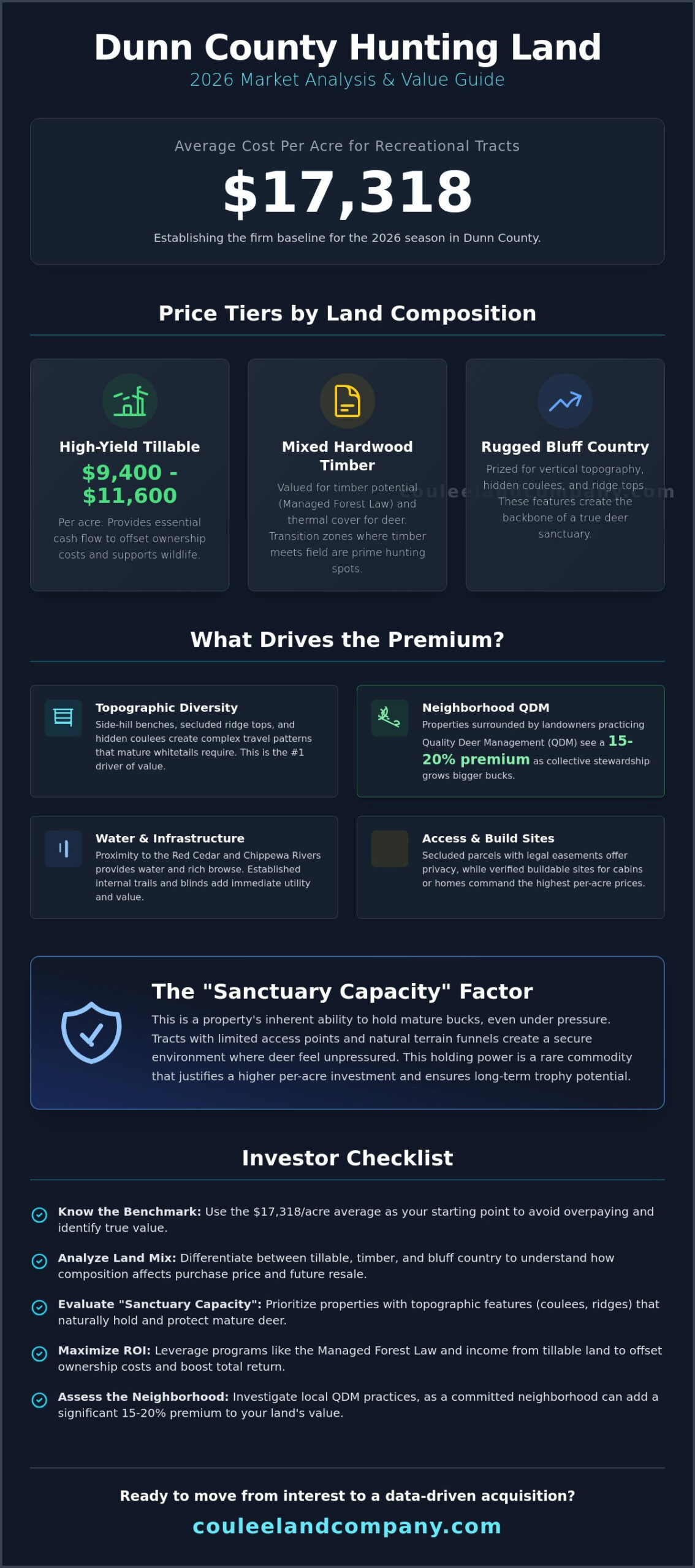
The current market prices for hunting land in Dunn County now sit at an average of $17,318 per acre, establishing a firm baseline for the 2026 season. This figure represents a sophisticated market where savvy investors differentiate between the “Big Three” land types: high-yield tillable acreage, mixed hardwood timber, and rugged bluff country. We define the “Dunn County Premium” as the specific price gap that exists between generic recreational land and trophy-managed acreage that boasts a proven history of mature buck production. Parcel size significantly impacts these numbers; a 40-acre “honey hole” typically commands a higher per-acre price than a sprawling 200-acre tract due to high demand for manageable, high-utility parcels.
To better understand how these land types intersect on a single property, watch this helpful video:
Price Tiers by Land Composition
High-value tillable land currently trades between $9,400 and $11,600 per acre, providing essential cash flow to offset ownership costs. In the bluff country, buyers value vertical topography and dense thermal cover, recognizing that these features are the backbone of a true sanctuary. Transition zones, the critical edges where field meets forest, remain the most expensive dirt in the region because they offer immediate, high-probability stand sites for the serious hunter.
Market Trends: Dunn County vs. Buffalo County
Investors often compare these values to Buffalo County, finding that Dunn County, Wisconsin provides world-class genetics with a more diverse range of entry points. The “Chippewa Valley Influence” is a major driver in 2026, as proximity to Menomonie and Eau Claire creates a robust market for residential-recreational hybrids. This geographic advantage ensures that current market prices for hunting land in Dunn County remain insulated from broader economic volatility while supporting steady appreciation.
What Drives the Premium? Factors Influencing Land Value
While the baseline average provides a starting point, current market prices for hunting land in Dunn County are truly dictated by a property’s unique physical and social attributes. Topographic diversity is the primary driver. Land featuring side-hill benches, secluded ridge tops, and hidden coulees offers the complex bedding and travel patterns that mature whitetails require. These features aren’t just aesthetic; they are functional assets that increase harvest success and long term value.
Neighborhood management is the most overlooked variable in land valuation. A property surrounded by landowners practicing disciplined Quality Deer Management (QDM) can command a 15-20% premium over isolated tracts. This collective stewardship ensures that young bucks reach maturity, directly impacting the trophy potential of your specific acreage. Proximity to the Red Cedar and Chippewa River tributaries also boosts value by providing reliable water sources and rich bottomland browse. Internal infrastructure, such as established trail systems and strategically placed box blinds, adds immediate utility. Some owners even leverage the Dunn County Voluntary Public Access program to enhance habitat while managing their land’s ROI.
The “Sanctuary” Factor
We evaluate every tract based on its “Sanctuary Capacity.” This is the property’s inherent ability to hold mature bucks even when hunting pressure intensifies in the surrounding area. Properties with limited access points and natural funnels protect your investment by creating a secure environment where deer feel unpressured. This holding power is a rare commodity that justifies a higher per-acre investment.
Access and Buildable Potential
Access remains a critical component of the price tag. While road frontage offers convenience and ease of management, secluded parcels with legal easements often provide the privacy that serious sportsmen crave. There is a significant price jump for properties that include verified buildable sites. Whether you envision a simple hunting cabin or a signature country home, these residential-ready acres represent the highest tier of current market prices for hunting land in Dunn County. If you are ready to secure a legacy property, our buyers’ agents can help you identify tracts with the best buildable potential.
Maximizing Value: ROI and Long-Term Ownership Costs
Owning a legacy property in Western Wisconsin requires a pragmatic approach to long-term carry costs. While the current market prices for hunting land in Dunn County reflect high demand, sophisticated owners mitigate these expenses through strategic tax programs. The Managed Forest Law (MFL) is your most powerful tool for financial efficiency. By enrolling your timbered acres, you can slash your property tax burden significantly. This is a vital strategy in a county where the median effective tax rate is 1.13%, which sits above the national average. You’ve got to be diligent with the calendar, as the application deadline is June 1st for enrollment to take effect the following January.
Beyond taxes, sustainable timber management acts as a periodic dividend for the land steward. A well-planned harvest doesn’t just put cash in your pocket; it creates the early successional habitat that mature bucks crave for bedding. This is where the Land Specialist advantage becomes clear. A generic realtor often misses the hidden value in a property’s timber stand or its specific “Sanctuary Capacity.” Closing a deal here requires rigorous due diligence. You must verify MFL status, check for existing agricultural leases, and confirm legal access before the ink dries on the contract.
Tax Strategies for the Wisconsin Landowner
You must choose between “Open” and “Closed” MFL status. Open designation offers the greatest tax reduction but requires you to allow public access for hunting and fishing. Most of our clients prefer “Closed” status. It costs slightly more in taxes than the open designation but maintains your absolute privacy while still providing a massive discount compared to standard rates. Agricultural use exemptions are another critical path. By keeping tillable portions of your tract in active production, you qualify for “use-value” assessment, which keeps your holding costs predictable. If you are considering selling hunting land in Wisconsin to capitalize on these 2026 highs, ensuring these exemptions are in place is vital for your marketing strategy.
The Future of Dunn County Real Estate
We’ve seen a 4.5% increase in tillable land values in the first quarter of 2026 alone. This trend suggests that current market prices for hunting land in Dunn County will continue their steady climb through the end of the decade as buyers from southern Wisconsin seek more affordable alternatives to their local markets. If you want a private market analysis of a specific tract, contact Mike Law or Bryan Lemke. Our team understands the soil, the timber, and the genetics that define this premier whitetail territory.
Secure Your Legacy in the Bluff Country
Success in the 2026 land market requires a balance of sporting passion and financial precision. You’ve seen how “Sanctuary Capacity” and disciplined neighborhood management create value that transcends simple acreage counts. By leveraging tax programs like the Managed Forest Law and prioritizing topographic diversity; you can transform a recreational purchase into a high-performing asset. Understanding the current market prices for hunting land in Dunn County is simply the first step in a much larger journey toward true land stewardship.
As a brokerage specializing in Western Wisconsin Bluff Country, we bring unparalleled expertise in trophy whitetail habitat and QDM practices to every transaction. Our team has a proven track record of record-breaking land sales. We don’t just list properties; we represent the unique character of the land. Whether you are searching for a rugged ridge top or a fertile transition zone, our regional authority ensures you never overpay for inferior dirt. We invite you to View Exclusive Dunn County Hunting Land Listings and start building your outdoor legacy today. The right tract is waiting for a steward who knows its worth.
Frequently Asked Questions
Is Dunn County hunting land a better investment than Buffalo County in 2026?
Dunn County often provides a superior return on investment because the entry costs are generally lower than those in Buffalo County while offering comparable trophy whitetail genetics. While Buffalo County remains a legendary destination, its prices have reached a high plateau. Dunn County’s diverse landscape and rising demand from southern Wisconsin buyers suggest stronger appreciation potential through the end of the decade.
How much does the Managed Forest Law (MFL) actually save on property taxes?
The MFL program typically reduces property taxes by 80% or more compared to standard municipal assessments. This program is essential for managing the long-term carry costs associated with the current market prices for hunting land in Dunn County. Even under the “Closed” status, which maintains your total privacy, the savings are substantial enough to offset a significant portion of your annual holding costs.
What is the average price for a 40-acre hunting tract in Dunn County?
A high-quality 40-acre tract currently averages approximately $692,720, though “honey hole” parcels with exceptional bedding and water access often command a higher per-acre premium. These smaller tracts are the most liquid assets in the region. They appeal to a broad base of buyers who want elite habitat without the massive capital outlay required for a 200-plus acre estate.
Can I build a cabin on land enrolled in the MFL program?
No, you cannot have any residential buildings on land enrolled in the MFL program if the enrollment occurred in 2017 or later. The Department of Natural Resources limits structures on enrolled land to those used exclusively for storage. If you plan to build a hunting cabin or a country home, you must work with a land specialist to exclude that specific acreage from the MFL map before closing.