
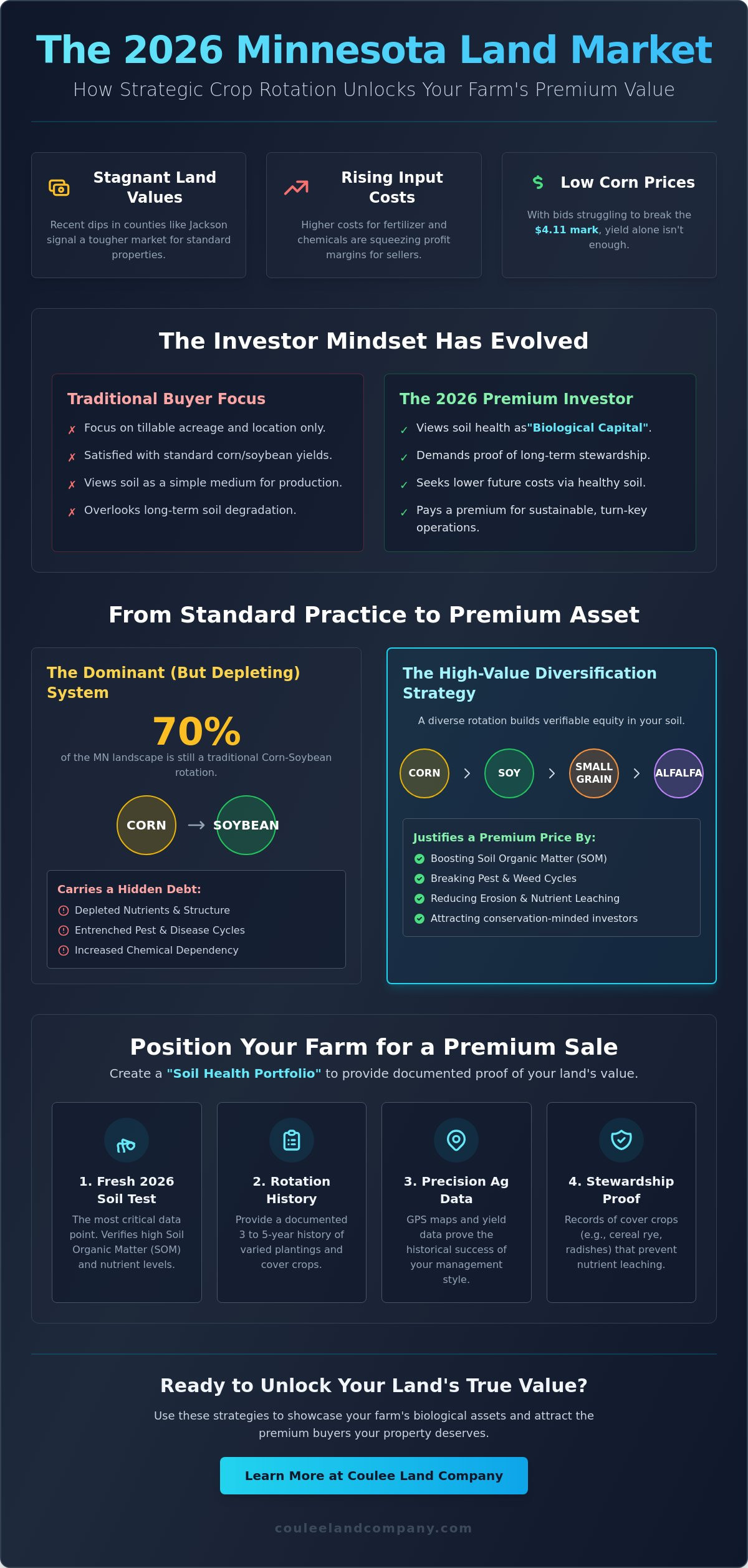
In the 2026 Minnesota land market, the most valuable asset you own isn’t just the acreage itself, but the documented vitality of the dirt beneath your boots. While traditional corn and soybean rotations still dominate 70% of our landscape, savvy investors are no longer satisfied with standard yields alone. They’re looking for proof of long-term stewardship. Implementing specific Crop Rotation Strategies for MN Farms: Boosting Sale Appeal. is now the fastest way to differentiate your property in a market where Jackson County values have seen recent dips and buyers are scrutinizing soil health records like never before.
You’ve probably felt the squeeze of stagnant land values and rising input costs, especially with corn bids struggling to break the $4.11 mark this May. It’s a frustrating reality when you know your land is worth more than the current commodity market suggests. We’ll show you exactly how strategic crop diversification and soil health documentation transform your Minnesota acreage from a standard farm into a premium real estate asset. You’ll learn how to leverage specialty crop opportunities and conservation practices to attract high-end buyers who are ready to pay a premium for a turn-key, sustainable operation.
Key Takeaways
- Understand why 2026 buyers view soil health as “biological capital” that justifies a higher appraisal than standard regional averages.
- Discover specific Crop Rotation Strategies for MN Farms: Boosting Sale Appeal. by diversifying beyond the traditional corn-soybean cycle into high-value alternatives.
- Learn how small grains like wheat and barley break pest cycles and build the long-term soil resilience that conservation-minded investors demand.
- Master the art of the “Soil Health Portfolio” to provide the documented proof necessary to attract premium-priced real estate offers.
- Recognize why a fresh 2026 soil test is the most critical piece of data for positioning your acreage as a top-tier agricultural asset.
The Financial Impact: How Crop Rotation Drives MN Land Value
In the current Minnesota land market, top-tier buyers treat soil health as “biological capital” rather than just a medium for production. A field that’s been hammered with back-to-back corn for a decade carries a hidden debt of depleted nutrients and degraded structure. Conversely, implementing a diverse crop rotation builds equity that savvy investors can verify through soil tests. By 2026, buyers are prioritizing land with a documented three to five year history of varied plantings. This history proves the land can sustain high yields with fewer expensive synthetic inputs, which is a massive selling point as Minnesota corn bids hover around $4.00 per bushel.
Strategic rotation also addresses Minnesota’s unique topography. In our rolling hills and river valleys, soil structure is your best defense against erosion. A rotation that includes deep-rooted perennials or small grains keeps your topsoil where it belongs. This physical stability is a major draw for investors who want to protect their long-term asset from the heavy spring rains we’ve seen lately. When you reduce chemical dependency through these natural cycles, you attract a wider pool of “green” investors looking for sustainable, low-input operations.
Soil Health as the New Real Estate Appraisal Metric
Modern appraisals in the Upper Midwest are evolving. While location and tillable acreage remain king, Soil Organic Matter (SOM) levels are becoming a primary differentiator for premium pricing. High SOM levels, often boosted by nitrogen-fixing legumes, justify a higher price per acre because they guarantee lower future costs for the next owner. It’s a simple calculation: better soil equals better margins. Using Crop Rotation Strategies for MN Farms: Boosting Sale Appeal. ensures your land stands out during the valuation process.
Attracting the 2026 Farm Investor
The investor profile is changing rapidly. We’re seeing a surge in buyers who specifically seek out properties with regenerative histories. They want to see that you’ve used Crop Rotation Strategies for MN Farms: Boosting Sale Appeal. to create a resilient ecosystem. If you can prove your land requires less fertilizer because of a smart rotation, you’ve just increased your farm’s marketability. For those ready to move their property, you can learn more about selling your land with Coulee Land Company to ensure these biological assets are properly highlighted to the right audience.
High-Value Rotation Models for the Minnesota Market
While a standard corn-soybean cycle is the regional baseline, it often overlooks the higher margins found in more complex systems. Transitioning to a corn-soy-oat-alfalfa rotation creates a more resilient profile for your land, signaling to investors that the property isn’t being mined for short-term gains. Small grains like wheat, barley, and rye serve as powerful biological tools for disrupting the pest and disease cycles that often take hold in monocultures. According to the latest research on Minnesota crop rotation strategies, these varieties improve soil tilth and offer a wider window for field operations during our unpredictable spring seasons.
The “Alfalfa Advantage” is particularly compelling for buyers looking to integrate livestock or secure high-quality forage. When you pair these perennials with cover crops like cereal rye or radishes, you build a “rotation bridge” that actively prevents nutrient leaching. This level of land stewardship is exactly what serious buyers demand in today’s market. It proves the acreage is managed with a long-term vision, making Crop Rotation Strategies for MN Farms: Boosting Sale Appeal. a central pillar of your property’s value proposition.
The 3-Year Diversification Strategy
Moving from a simple two-crop system to a more diverse model requires a tactical approach suited for Minnesota’s Zone 3 and 4 hardiness areas. Timing is the most critical factor in these northern climates. Planting winter rye immediately following a corn harvest or frost-seeding clover into small grains in early spring ensures your ground stays covered. This constant living root system builds the organic matter that justifies a higher appraisal and makes your property stand out in a crowded market.
Precision Agriculture and Data Tracking
Modern land sales require more than just anecdotal evidence; they demand verifiable records. Utilizing GPS-guided equipment allows you to document every phase of your rotation, proving the historical success of your management style. In 2026, a digital map of your rotation history is as valuable as the land itself. This transparency builds buyer confidence and solidifies your farm’s position as a premium asset, ensuring that your Crop Rotation Strategies for MN Farms: Boosting Sale Appeal. are fully visible and defensible during the due diligence process.
Positioning Your Farm for a Premium Sale
Packaging your property for the 2026 market involves more than just listing the tillable acreage. To command a top-tier price, you must present a comprehensive Soil Health Portfolio to prospective buyers and land brokers. This portfolio acts as the “service history” for your land, proving that you’ve implemented Crop Rotation Strategies for MN Farms: Boosting Sale Appeal. with precision. It should include detailed rotation logs, input reduction records, and yield maps that demonstrate consistent performance. In a market where buyers are increasingly skeptical of “tired” ground, this documentation provides the transparency needed to justify a higher appraisal.
A fresh 2026 soil test is no longer optional for high-end listings; it’s a mandatory requirement. This data confirms that your management has maintained or increased Soil Organic Matter (SOM) and nutrient availability. Beyond the agronomic benefits, a diversified rotation creates a superior mixed-use asset. The varied field edges and diverse food sources provided by small grains and cover crops significantly enhance wildlife habitat. This dual-purpose appeal attracts both agricultural investors and outdoor enthusiasts, widening your pool of potential buyers and driving up the final sale price.
Marketing to the Professional Land Broker
When you sit down with a broker, your rotation history should be a primary talking point. Highlighting these strategies in property listings helps attract out-of-state investors who are looking for turnkey, sustainable operations. They want to see that the land is already optimized for high yields and low inputs. If you’re also managing timber or recreational tracts, you might find useful parallels in Selling Hunting Land in Wisconsin: A Guide to Maximizing Your Profit, as both markets reward documented stewardship.
Closing the Deal with Transparency
Transparency is your strongest tool for overcoming buyer objections. When a prospect questions the long-term viability of the soil, your historical yield data and rotation records provide the definitive answer. This evidence-based approach moves the conversation from speculation to a solid investment analysis. To get an expert opinion on how your specific management history translates to market value, connect with a land specialist like Mike Law to evaluate your property. Our team understands how to translate your hard work in the field into a compelling narrative for the closing table.
Secure Your Legacy with Proven Soil Stewardship
The 2026 Minnesota land market demands more than just acreage; it requires a documented legacy of fertility and resilience. By moving beyond the standard corn-soybean cycle and embracing diverse rotations, you’re building biological capital that pays dividends at the closing table. You’ve learned how high Soil Organic Matter and precise data tracking justify premium pricing and attract a wider pool of conservation-minded investors. Implementing these Crop Rotation Strategies for MN Farms: Boosting Sale Appeal. ensures your property stands out as a high-value, turnkey asset in a competitive landscape.
At Coulee Land Company, we bring specialized expertise in MN and WI agricultural brokerage to every listing. Our team possesses authoritative knowledge of regional soil health trends and a proven track record of high-value land sales across the unique terrain of Bluff Country. We understand that your land is more than a commodity; it’s a life’s work that deserves a premium valuation. Get a Professional Property Valuation to See How Your Land Management Impacts Your Sale Price. Your commitment to the soil is your greatest asset, and we’re ready to help you capitalize on it.
Frequently Asked Questions
How long does it take for crop rotation to significantly improve land value?
It typically takes three to five years of consistent rotation to see measurable improvements in soil health that impact appraisal values. This timeframe allows for a full cycle of diverse crops to break pest cycles and build nutrient profiles. Buyers in the 2026 market look for this documented history to confirm the land’s long-term productivity and resilience before they commit to a premium offer.
Which crops are most effective for increasing soil organic matter in Minnesota?
Alfalfa and small grains like winter rye or oats are the most effective crops for building soil organic matter in our regional climate. These plants have extensive root systems that remain in the soil, adding carbon and improving structure over time. Integrating these into your Crop Rotation Strategies for MN Farms: Boosting Sale Appeal. is a proven way to transform “tired” ground into a high-value agricultural asset that stands out to savvy investors.
Do buyers actually pay more for farms with a history of cover cropping?
Modern agricultural investors and conservation-minded buyers prioritize land with a proven history of cover cropping and diverse rotations. They see these practices as a turnkey advantage that reduces their future input costs and protects the topsoil from erosion. Our experience in the Minnesota land market shows that properties with verified soil health records often command a premium price compared to standard corn-soybean tracts that lack documented stewardship.
Can I implement these strategies if I currently lease my land to a tenant farmer?
You can absolutely implement these strategies by including specific soil health requirements and Crop Rotation Strategies for MN Farms: Boosting Sale Appeal. within your formal lease agreements. Many landowners work with their tenants to share the costs of cover crop seeds or offer longer-term leases to incentivize sustainable management practices. This collaboration ensures the land’s value continues to grow even when you aren’t the one operating the equipment every day.