
Is your property a highway for whitetails but never the destination? You see the signs and get the occasional trail camera picture of a mature buck, but he’s always after dark, always just passing through. For landowners, this common frustration is often the biggest hurdle to realizing a property’s true wildlife potential. The key to transforming your land from a travel corridor into a permanent sanctuary lies in providing absolute security, and the most effective way to achieve this is by creating deer bedding areas that mature bucks will claim as their own core territory.
In this definitive 2026 guide, we move beyond theory to deliver the proven, field-tested strategies used by Wisconsin’s top land management specialists. You will learn how to identify prime locations-even on challenging ridges and hills-and execute the precise habitat improvements that hold deer on your property year-round. Prepare to increase your daylight buck sightings, enhance the huntability of your land, and significantly boost its long-term value for generations to come.
Key Takeaways
- Understand why a secure bedding sanctuary is the absolute foundation for holding mature bucks on your property year after year.
- Learn to identify high-potential bedding locations by leveraging topographical maps and a deer’s natural tendencies before you ever start a chainsaw.
- Discover proven, step-by-step techniques for creating deer bedding areas, starting with small, manageable sanctuaries that deliver immediate impact.
- A bedding area is only one piece of the puzzle; see how to connect it to food and water sources to create a complete habitat system.
- Transform your habitat improvements into a significant financial return by understanding how holding mature deer directly increases your land’s market value.
Understanding Whitetail Bedding: The Foundation of Your Habitat Plan
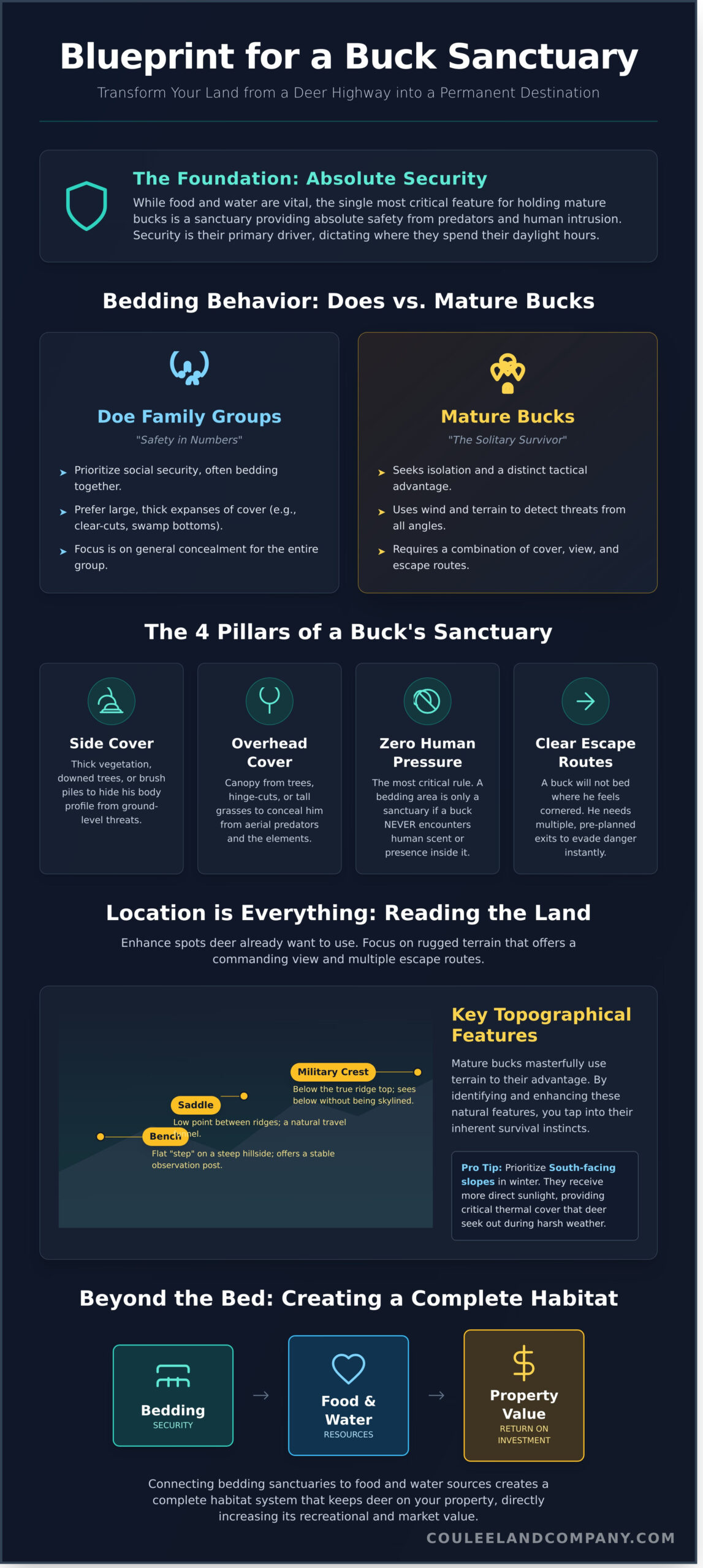
Before you can successfully hunt mature bucks on your property, you must first give them a reason to live there. While food plots and water sources are vital, the single most critical habitat feature for holding deer-especially reclusive, trophy-class bucks-is security. This is the core purpose of a deer bedding area: a dedicated sanctuary that provides absolute safety from predators and refuge from harsh weather. A deep understanding of whitetail deer ecology reveals that security is their primary driver, dictating where they spend the majority of their daylight hours. The entire discipline of creating deer bedding areas is built on this principle. Your goal is to engineer a sanctuary so secure that deer feel comfortable staying on your land long after the sun comes up, transforming your parcel from a nocturnal pass-through to a daylight destination.
Doe Bedding vs. Buck Bedding: Key Differences
Not all bedding cover is created equal. Doe family groups prioritize social security and often bed together in large, thick expanses of cover like regenerating clear-cuts or swamp bottoms. For them, safety is in numbers and dense concealment. A mature buck, however, is a solitary survivor. He seeks isolation and a distinct tactical advantage. Bucks will frequently bed with the wind at their back, using their nose to detect threats from behind while using their eyes to scan the terrain downwind.
The Psychology of Deer Security
A buck’s sense of safety is more complex than simply finding a thicket. True security cover involves specific structural elements. It requires side cover to hide his body, but also crucial overhead cover to conceal him from above. More important than the cover itself is the absolute lack of human intrusion. A bedding area is only a sanctuary if a buck never encounters you there. Finally, he must have clearly defined escape routes. A buck will not bed in a location where he feels cornered, making the strategic planning of entry and exit paths essential when creating deer bedding areas.
Location is Everything: How to Select the Perfect Bedding Site
Before you ever cut a single hinge or clear a patch of ground, the success of your project begins with a map. The art of creating deer bedding areas isn’t about forcing deer into unnatural locations; it’s about identifying and enhancing the spots they already want to use. The most effective sanctuaries are built upon a foundation of natural advantages-the overgrown, hard-to-reach places that other hunters ignore. A successful land manager thinks like a predator, always considering access routes. Your entry and exit paths are paramount; you must be able to hunt the perimeter of a bedding area without ever alerting the deer inside.
Reading the Land: Topography in Wisconsin’s Bluff Country
In the rugged terrain of Western Wisconsin, topography dictates deer movement and security. Mature bucks are masters of using the landscape to their advantage, and you should be, too. Focus your efforts on key features that offer a commanding view and multiple escape routes:
- Benches: Flat “steps” on the side of a steep hill.
- Saddles: Low points between two ridges.
- Military Crests: The point just below the true top of a ridge, allowing a buck to see what’s below without being skylined.
During our harsh winters, south-facing slopes provide critical thermal cover by soaking up sunlight. These topographical features are abundant in famed hunting regions like Buffalo County and are essential for holding the trophy-caliber whitetails the area is known for.
The ‘Edge’ Effect: Where Two Habitats Meet
Deer are creatures of the edge. They thrive in transition zones where two distinct habitat types converge, such as where thick, early-successional cover meets open hardwoods, or a stand of pines abuts a clear-cut. These edges provide the perfect combination of food and security, creating natural travel corridors. By identifying these zones, you can capitalize on predictable deer behavior. Enhancing these edges with bedding cover is a powerful strategy, as it leverages the core components of what science-based resources from institutions like Oklahoma State University define as optimal deer habitat composition.
Factoring in Wind and Access
A bedding area is useless if you can’t hunt it without educating the deer. Your selection process must account for the prevailing winds-typically from the northwest during Wisconsin’s fall and winter. The entire strategy behind creating deer bedding areas hinges on your ability to hunt them effectively. Plan your sites so you can access your stands on the downwind side of the travel corridors leading to and from the sanctuary. Finding parcels with this built-in strategic advantage is the hallmark of superior Wisconsin hunting properties and a non-negotiable for the serious hunter.
The Landowner’s Toolkit: Step-by-Step Bedding Creation Techniques
Transforming your property into a whitetail sanctuary requires more than just owning the land; it demands strategic, hands-on work. The process of creating deer bedding areas is an investment that pays dividends for seasons to come. Before you start your chainsaw, safety must be your top priority. Always operate with the proper personal protective equipment (PPE), including chaps, a helmet, and eye and ear protection. We recommend starting small by developing one or two “micro-sanctuaries” of 1-3 acres each. The objective is to create a tangled mess of cover so thick that a human would never want to walk through it, but a mature buck feels completely secure. These foundational principles are central to effective deer habitat management and ensure your efforts yield superior results. For minimal disturbance to the local herd, this work is best performed in the late winter or early spring.
Technique 1: Hinge-Cutting for Cover
Hinge-cutting is a cornerstone technique for habitat managers. It involves partially cutting through a tree’s trunk, allowing it to fall over while remaining connected and alive. This creates a living wall of horizontal cover and places nutritious buds and leaves (browse) at deer level. Focus your efforts on low-value trees like box elder, elm, or ironwood, typically between 3 and 8 inches in diameter. By making your cut at waist height, you maximize side cover and build an impenetrable fortress for whitetails.
Technique 2: Building Brush Piles for Structure
Don’t let downed trees and limbs go to waste. Use this material to construct dense, interlocking brush piles that provide immediate structure. These piles offer critical thermal cover during harsh Wisconsin winters and act as invaluable security cover, especially for does and newborn fawns. A savvy land manager will also place brush piles strategically to block unwanted entry points or to subtly guide deer movement toward preferred travel corridors and stand locations, giving you a distinct advantage.
Technique 3: Planting for Seclusion
While chainsaw work delivers immediate impact, planting is the long-term strategy that completes your bedding sanctuary. Establishing screens of fast-growing conifers like Norway Spruce or White Pine provides essential thermal protection and visual seclusion that holds deer on your property year-round. Furthermore, planting dense thickets of native shrubs can create the exact type of impenetrable doe bedding areas that are vital for fawn recruitment. This forward-thinking approach complements your hinge-cutting and ensures your habitat improvements last for generations.
Beyond the Bed: Integrating Sanctuaries into Your Property
A superior hunting property functions as a complete ecosystem, not just a collection of features. The process of creating deer bedding areas is only the first step. To truly hold mature whitetails, you must think like they do and map out their entire daily routine. A bedding area is useless without convenient access to food and water. By strategically connecting these essential elements, you transform your land from a simple pass-through into a destination where trophy bucks choose to live.
Connecting Bedding to Food and Water
The most effective bedding sanctuaries are located within a few hundred yards of reliable food sources. This proximity allows deer, especially cautious old bucks, to move comfortably between bed and feed during daylight hours. You can further influence this movement by using strategic hinge cuts or brush piles to create natural “fences,” subtly funneling deer past your stand locations. Never underestimate the power of water; a small, secluded water hole dug near a bedding area can be the single most powerful magnet for holding deer on your property during the rut.
Establishing No-Go Zones
This is the most critical and often the most difficult discipline in land management. Once your bedding areas are established, they must be treated as absolute sanctuaries. This means you do not enter them-period. No shed hunting, no scouting, no exceptions outside of initial creation and extremely rare maintenance. Human pressure is the number one reason mature bucks abandon a property. Committing to this hands-off approach is what separates good properties from the legendary parcels found in Wisconsin’s Bluff Country.
By integrating these elements, you are no longer just building a bed; you are orchestrating the entire flow of wildlife on your land. This holistic approach ensures deer feel secure enough to live out their daily patterns on your side of the fence. It’s this level of expert land management that maximizes a property’s potential and consistently produces opportunities for trophy whitetails. The team at Coulee Land Company specializes in identifying and developing properties with this amazing potential.
From Habitat to ROI: How Bedding Areas Boost Property Value
The time, effort, and resources invested into your property are more than just a hobby-they are a direct contribution to its market value. While food plots and trail systems are easily recognized, the strategic work of creating deer bedding areas is what truly elevates a recreational property from a simple plot of land to a premier hunting destination. For today’s discerning land buyer, nothing is more valuable than a property proven to hold and grow mature whitetails. This is the single greatest driver of value in the recreational real estate market.
Thoughtful habitat improvements demonstrate a deep understanding of wildlife management and a commitment to stewardship. They tell a story of a property that has been meticulously developed to maximize its potential, making it a highly sought-after asset.
Why Well-Managed Properties Sell Faster
Buyers are searching for turn-key hunting properties they can enjoy from day one. A parcel with established bedding sanctuaries, strategic food sources, and proven buck history saves a new owner years of demanding work and financial investment. It transforms a piece of land into a high-performance hunting asset, capable of consistently producing the trophy-class animals that define the dream of owning land in Wisconsin’s famed Bluff Country.
Partnering with a Land Specialist
A standard real estate agent sees timber and acreage; a true land specialist sees the immense value in your sweat equity. An expert land broker understands the language of habitat management and knows how to articulate the worth of your improvements to qualified buyers. They can translate the years you spent creating deer bedding areas and developing a sanctuary into a tangible dollar figure that the market will recognize.
If you’re thinking of selling your property, ensuring these unique features are professionally marketed is absolutely crucial to achieving its maximum value. At Coulee Land Company, we don’t just sell land-we specialize in premier hunting properties. Our team of hunter-realtors understands this value better than anyone and is uniquely positioned to help you find or sell the perfect property.
Transform Your Property into a Whitetail Haven
The journey from a simple parcel of land to a premier hunting destination is built on a foundation of superior habitat. As we’ve explored, understanding whitetail security and strategically selecting sites are the cornerstones of success. Ultimately, the art of creating deer bedding areas is about more than just holding deer; it’s about dictating movement, increasing herd health, and significantly boosting your property’s long-term value and hunting potential.
If your goal is to own a property with world-class potential, starting with the right piece of ground is paramount. As specialists in Wisconsin’s famed ‘Bluff Country,’ our team brings decades of combined experience in hunting and land management to every client relationship. We have a proven track record of connecting serious hunters with premier properties capable of producing trophy whitetails.
Ready to find a property with trophy potential? Browse our exclusive hunting land listings. Let us help you build your legacy.
Frequently Asked Questions About Creating Deer Bedding Areas
How big should a deer bedding area be?
The ideal size depends on your specific goals. For targeting mature bucks, a smaller, secluded sanctuary of a half-acre to one acre is often perfect, as it provides solitude. For does and family groups, a larger area of two or more acres can be more effective. The critical factor isn’t just the acreage but the density of the cover within it. The goal is to create a space so thick that a deer feels completely secure from predators and human pressure.
How long does it take for deer to start using a new bedding area?
Deer can adapt to new bedding cover remarkably fast, often within a few weeks or months, provided it offers superior security. If you execute habitat improvements like hinge-cutting during the late winter, you can realistically expect deer to be using the area by the following fall hunting season. The key is creating the thickest, nastiest cover in the neighborhood; whitetails are constantly seeking an edge in survival and will quickly find and occupy such a place.
What is the best time of year to create deer bedding areas?
The optimal window for this intensive habitat work is the dormant season, from late winter into early spring (typically February through April). Working when the trees are leafless makes chainsaw work safer and more efficient. This timing also ensures you are finished well before the critical fawning season begins. Completing the project before spring green-up allows the new growth and downed treetops to provide immediate cover that will only thicken throughout the growing season.
Can you have too much thick cover on your property?
While security cover is crucial, a property composed entirely of one thicket is not ideal. Whitetails are creatures of the edge, and the most productive properties feature a mosaic of habitat types. The best land management strategy is to create distinct bedding sanctuaries interspersed with food sources, water, and more open timber. This diversity creates predictable travel corridors and enhances the overall wildlife capabilities of your land, holding more deer throughout the year.
Do I need heavy equipment to create a bedding area?
No, heavy equipment is not a requirement. While machinery can speed up the process, some of the most effective bedding sanctuaries are crafted with nothing more than a chainsaw and strategic effort. Techniques like hinge-cutting, felling non-mast trees to open the canopy, and building brush piles create exceptional ground-level cover. For the dedicated land manager, simple tools are more than enough to transform a section of woods into a premier whitetail haven.
How do you make a mature buck feel safe on a small property?
On smaller parcels, creating an undisputed sanctuary is non-negotiable. Designate a core bedding area in the thickest cover available and commit to never entering it for any reason. This absolute lack of human pressure is the ultimate security guarantee for a wary buck. You then hunt the fringes, using meticulous, low-impact routes for entry and exit. By respecting that core zone, you teach him he is safe, which is the key to holding him on your property.
Will creating bedding areas attract more deer to my land?
Absolutely. In many hunting landscapes, especially the agricultural areas of Wisconsin, security cover is the single most limiting factor for a deer herd. By creating deer bedding areas with dense, regenerating cover, you are providing the safety that whitetails crave. This will not only hold existing deer on your property but will actively pull in deer from neighboring lands that lack high-quality sanctuary, dramatically improving your hunting opportunities.