
Imagine standing on a ridge in Buffalo County as a trophy whitetail steps into a food plot, knowing that this specific piece of Bluff Country will belong to your grandkids just as it belongs to you today. For many landowners, the fear isn’t just losing the hunt; it’s the reality that Wisconsin estates valued over $50,000 often trigger a grueling probate process that can tear families apart. You’ve poured your sweat into this land, and you deserve to know it won’t be sold off to settle a tax bill or a sibling dispute. We understand that your property is more than an asset. It’s a heritage that requires a tactical management plan to survive the transition between generations.
In this guide, we’ll show you why creating a family land trust in wisconsin is the most effective way to shield your acreage from the state and ensure your hunting legacy remains intact. You’ll learn the exact steps to navigate the $3.00 per $1,000 real estate transfer fee and the 2026 tax filing requirements for resident trusts. We’re providing a clear roadmap to help you minimize tax liability and establish a permanent management structure so your family can focus on the hunt, not the legal fees.
Key Takeaways
- Understand the critical differences between revocable and irrevocable trusts under Chapter 701 of the Wisconsin Trust Code to determine which structure best protects your land.
- Discover how creating a family land trust in wisconsin allows you to bypass the probate process entirely, keeping your property private and out of the state’s hands.
- Learn how to select a specialized estate attorney who understands the unique nuances of Wisconsin agricultural exemptions and recreational property rights.
- Establish a dedicated Land Management Fund within your trust to ensure future generations have the capital needed for food plots, trail maintenance, and property taxes.
- Secure a permanent management plan that maintains the elite habitat standards of your Bluff Country acreage for decades to come.
What is a Family Land Trust in Wisconsin?
A family land trust is a private legal arrangement where a trustee holds the legal title to your hunting ground for the benefit of your chosen heirs. Unlike a standard deed transfer, creating a family land trust in wisconsin allows you to maintain strategic control over your property while shielding it from the public eye. This legal structure is governed by the Wisconsin Trust Code under Chapter 701. Recent updates, such as those found in 2023 Wisconsin Act 127, have refined the requirements for transparency and documentation, making it essential to structure your trust correctly from the start. This title-holding nature is particularly valuable for owners of elite Buffalo County acreage, where privacy and legacy are paramount.
To better understand this concept, watch this helpful video:
Why Wisconsin Landowners Choose Trusts Over Wills
The primary driver for creating a family land trust in wisconsin is probate avoidance. In Wisconsin, estates valued over $50,000 generally require formal probate, a public process that can be both slow and expensive. A trust keeps your land out of the courts, ensuring that management of your Bluff Country timber and food plots continues without interruption. It also prevents partition suits, which occur when one heir tries to force a sale of the property against the family’s wishes. While a Conservation land trust focuses on environmental protection, a family trust is a tactical tool designed to keep your hunting heritage within the family line.
Key Roles: Grantor, Trustee, and Beneficiary
Every trust relies on three distinct roles to function effectively. The Grantor is the current landowner who establishes the rules and transfers the property into the trust. The Trustee is the individual or entity responsible for managing the land according to those rules; this could be a family member or a professional land manager. Finally, the Beneficiaries are the family members who enjoy the hunting rights and the long term equity of the property. By clearly defining these roles, you ensure your hunting properties are managed with the same passion and expertise you’ve applied for years.
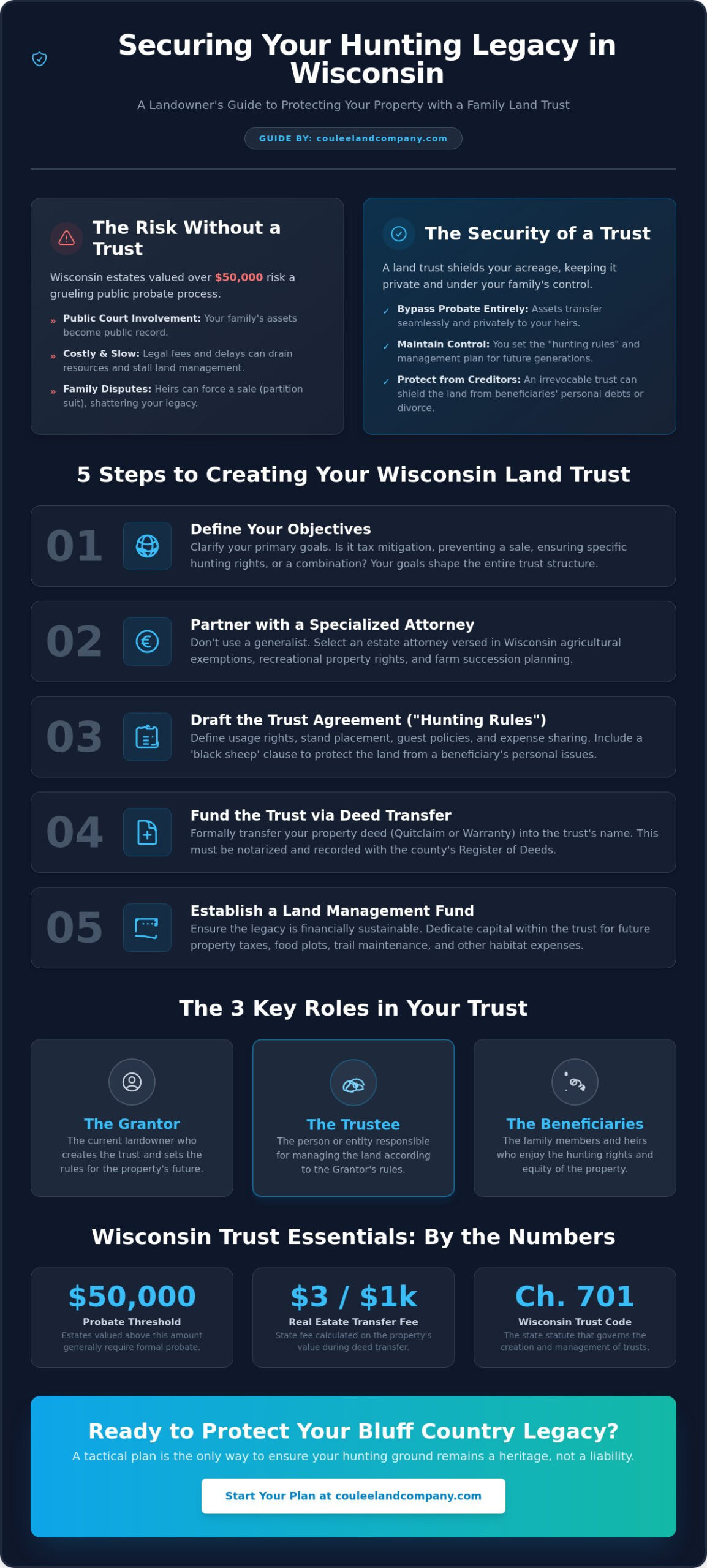
5 Steps to Creating Your Family Land Trust in Wisconsin
Establishing a legacy requires more than a handshake. It demands a tactical legal framework. When creating a family land trust in wisconsin, your first move is defining the primary objective. Are you prioritizing tax mitigation, or is the goal to prevent a future developer from touching your sanctuary? Once your objective is clear, you must partner with a specialized estate attorney. This isn’t the time for a generalist. You need someone versed in Wisconsin farm succession planning and agricultural use-value assessments to ensure your property’s specific wildlife capabilities are protected.
Drafting the ‘Hunting Rules’ and Usage Rights
Hunting land is emotional ground. To keep the peace, your trust agreement must specify usage rules that go beyond basic legalities. You need to define who can hang stands, which family members get opening weekend priority, and how food plot expenses are split. A well-drafted trust also includes a ‘black sheep’ clause. This protects the land if a beneficiary faces a divorce or personal debt. Our team sees the value of these structures every day while managing elite hunting properties across the state. Clear rules today prevent bitter disputes tomorrow.
Funding the Trust: The Deed Transfer Process
The trust is just a stack of paper until it’s funded. This means you must formally transfer the deed from your name into the trust’s name. In Wisconsin, this is typically done via a Quitclaim or Warranty Deed. You’ll need to record this document with the local Register of Deeds in counties like Buffalo or St. Croix. Expect a flat $30 recording fee per document as of May 2026, along with the state’s real estate transfer fee of $3.00 per $1,000 of value. Proper execution requires notarization to meet state statutes. If you’re looking to expand your holdings before locking them into a trust, our expert agents can help you find the right addition to your portfolio.
Protecting Your Hunting Legacy: Management and Succession
A trust serves as more than a legal boundary; it acts as a permanent steward for your property. By creating a family land trust in wisconsin, you can establish a dedicated Land Management Fund. This ensures that capital is always available for property taxes, trail maintenance, and seasonal food plots. Without this financial structure, even the best hunting ground can fall into disrepair if heirs lack the immediate funds to maintain it. This proactive approach preserves the elite habitat standards of the Bluff Country, keeping the land’s wildlife capabilities at their peak for decades.
Habitat fragmentation is the greatest threat to trophy whitetail populations in Western Wisconsin. When large parcels are split into small chunks, the mature buck potential vanishes. A trust prevents this by legally binding the acreage together as a single unit. This cohesion is a core tenet of Family Estate Planning in Wisconsin, which provides the framework for keeping recreational assets intact. By preventing the division of the land, you ensure that future generations inherit a functional ecosystem rather than a collection of small, unmanageable lots.
Integrating Wildlife Management into Your Trust
You can mandate specific conservation practices within the trust’s governing language. This includes Timber Stand Improvement (TSI) or prescribed burns to enhance bedding cover. Experts like Mike Law and Bryan Lemke understand that a trust held property is only as valuable as its management plan. For a deeper dive into these strategies, see our guide on Wisconsin Land Management for Wildlife. Clear mandates ensure the land remains a premier hunting destination long after the transition.
The Role of a Land Specialist in Trust Planning
A precise land appraisal is the foundation of any equitable trust. It ensures all beneficiaries understand the true market value of the hunting heritage they are inheriting. Coulee Land Company helps families determine the highest and best use for their acreage, balancing agricultural income with recreational value. Professional scouting and valuation are essential when creating a family land trust in wisconsin to avoid future disputes over equity. If you’re ready to evaluate your land’s legacy potential, contact our Wisconsin Land Specialists today.
Secure Your Piece of the Bluff Country
Your hunting land is more than just dirt and timber; it’s the culmination of years of hard work and respect for the outdoors. By creating a family land trust in wisconsin, you remove the uncertainty of probate and ensure that your trophy whitetail habitat remains undivided for generations. You’ve seen how a trust protects against legal disputes and provides a funded management plan for food plots and Timber Stand Improvement. These tactical steps turn a simple property into a permanent family sanctuary.
As specialists in the famed Bluff Country, Coulee Land Company brings insider knowledge that goes beyond standard real estate. Our team is endorsed by leading outdoor television personalities and possesses deep expertise in managing land for Boone and Crockett whitetails. We understand that a successful trust begins with an accurate assessment of the land’s wildlife capabilities and market value. Secure your family’s hunting legacy with a professional land valuation from Coulee Land Company. Your legacy is built on the decisions you make today, and we’re here to ensure those decisions stand the test of time.
Frequently Asked Questions
Is a family land trust the same as a conservation easement in Wisconsin?
No, a family land trust is a private ownership structure while a conservation easement is a legal restriction on land use. A trust dictates who owns and manages the property for your family’s benefit. An easement typically involves a third party and limits development rights forever. You can use both tools together, but they serve different legal purposes in your estate plan.
Can I still hunt on my land once it is in a trust?
You absolutely retain the right to hunt your land after creating a family land trust in wisconsin. The trust agreement is a custom document where you define exactly who has access to the property. You can set specific rules for family members, guests, and even opening weekend priorities. This structure ensures your specific hunting traditions and habitat management goals are followed by future generations.
How much does it cost to set up a family land trust in Wisconsin?
Total costs include legal fees and state mandated recording charges. As of May 2026, Wisconsin requires a flat $30 fee to record a deed with the county Register of Deeds. You must also pay a real estate transfer fee of $3.00 per $1,000 of the property’s value. Attorney fees for drafting the trust agreement will vary depending on how complex your land management and succession rules are.
Does a land trust protect my property from creditors or nursing home costs?
Protection levels depend on whether you choose a revocable or irrevocable trust under Chapter 701 of the Wisconsin Statutes. A revocable trust offers flexibility but generally doesn’t shield assets from creditors since you still control the land. An irrevocable trust can provide significant asset protection and help with long term care planning. However, this requires you to give up certain rights to change the trust later.
Can a revocable land trust be changed if my family situation changes?
A revocable trust is fully flexible and can be amended at any time to reflect your current family needs. If you acquire more acreage or need to update your beneficiaries, you can make those changes with a simple amendment. This adaptability is a primary reason for creating a family land trust in wisconsin. It allows you to avoid the $50,000 probate threshold while maintaining control over your legacy.
Who should I choose as the trustee for my Wisconsin hunting land?
Your trustee should be someone who understands the legal duties of the role and the physical needs of the land. This is often a family member with a passion for hunting or a professional land manager. They are responsible for paying taxes, filing the Form 2 state fiduciary return if gross income hits $600, and enforcing hunting rules. Select someone who shares your vision for the property’s wildlife capabilities.