
Why are the most impressive bucks on your Western Wisconsin acreage only showing up on trail cameras at 2:00 AM? It’s a frustrating reality for many land managers who watch their hard work benefit the neighbor across the fence the moment the first shot of the season rings out. If you’re tired of providing the snacks only to have others harvest the trophies, it’s time to shift your strategy. By creating a deer sanctuary on your property, you aren’t just leaving a corner of the woods alone; you’re engineering a high-security zone that outcompetes every other acre in the township.
We understand that owning land in Bluff Country is about more than just a deed. It’s about the legacy of the hunt and the pride of stewardship. You deserve a property that holds mature whitetails through the heaviest hunting pressure. This guide reveals how to transform your land into a bulletproof haven that keeps deer on your side of the line and increases your property’s resale value. We will explore how to leverage terrain, maximize bedding cover, and establish the strict sanctuary rules required to turn a standard woodlot into a premier whitetail haven.
Key Takeaways
- Understand why a true sanctuary requires 365 days of zero human pressure and why simply neglecting your timber results in a lack of security and food.
- Master the strategic process of creating a deer sanctuary on your property by mapping stealthy access routes to ensure you never “blow out” your best holding cover.
- Learn how to engineer elite bedding habitat using Timber Stand Improvement and hinge-cutting techniques that provide the high-stem density mature bucks crave.
- Discover how professional habitat management translates into a higher market value and attracts serious buyers looking for top-tier hunting land.
Defining the Bluff Country Sanctuary: More Than Just a “No-Go” Zone
A sanctuary isn’t merely a line on a map where you stop walking. Real success when creating a deer sanctuary on your property depends on understanding that “leaving it alone” often leads to failure. A mature forest with a closed canopy creates a dark, open floor that offers zero horizontal security and even less food. This type of neglect is the enemy of deer retention. In the steep terrain of Western Wisconsin, a true sanctuary must be a 365-day security zone where deer feel zero human pressure. We define a sanctuary as a strategically managed area of high-quality habitat that provides year-round security through the total exclusion of human activity and the deliberate enhancement of thick, woody cover.
To better understand this concept, watch this helpful video:
The “Bluff Factor” adds another layer of complexity to your plan. Ridge-top sanctuaries require dense, wind-breaking cover to protect deer from the elements and prying eyes from across the valley. Conversely, valley-bottom havens must account for shifting thermals that can carry your scent directly into a bedding area before you even step off your tractor. Successful habitat conservation on hunting land means working with these geographic realities rather than against them. You aren’t just saving trees; you’re building a fortress.
Why Buffalo County Standards Matter
In Buffalo County and the surrounding driftless region, the hunting pressure is relentless. When the “Whitetail Capital” sees an influx of hunters in November, your sanctuary acts as a buck bank. It’s the only place a four-year-old buck feels safe enough to move during daylight hours. If your neighbors are shooting every legal deer they see, your sanctuary becomes the literal life-raft for the local age structure and your future harvest success.
Determining the Right Size for Your Acreage
Most land managers follow the 20-50% rule. On a 40-acre parcel, dedicating 15 to 20 acres to a “no-go” zone is a powerful move. Small-parcel owners shouldn’t feel sidelined. You can create effective micro-sanctuaries on as little as five acres if the stem density is high enough. The goal is to maximize the ratio of security to total acreage while ensuring you have enough room to hunt the edges without compromising the core.
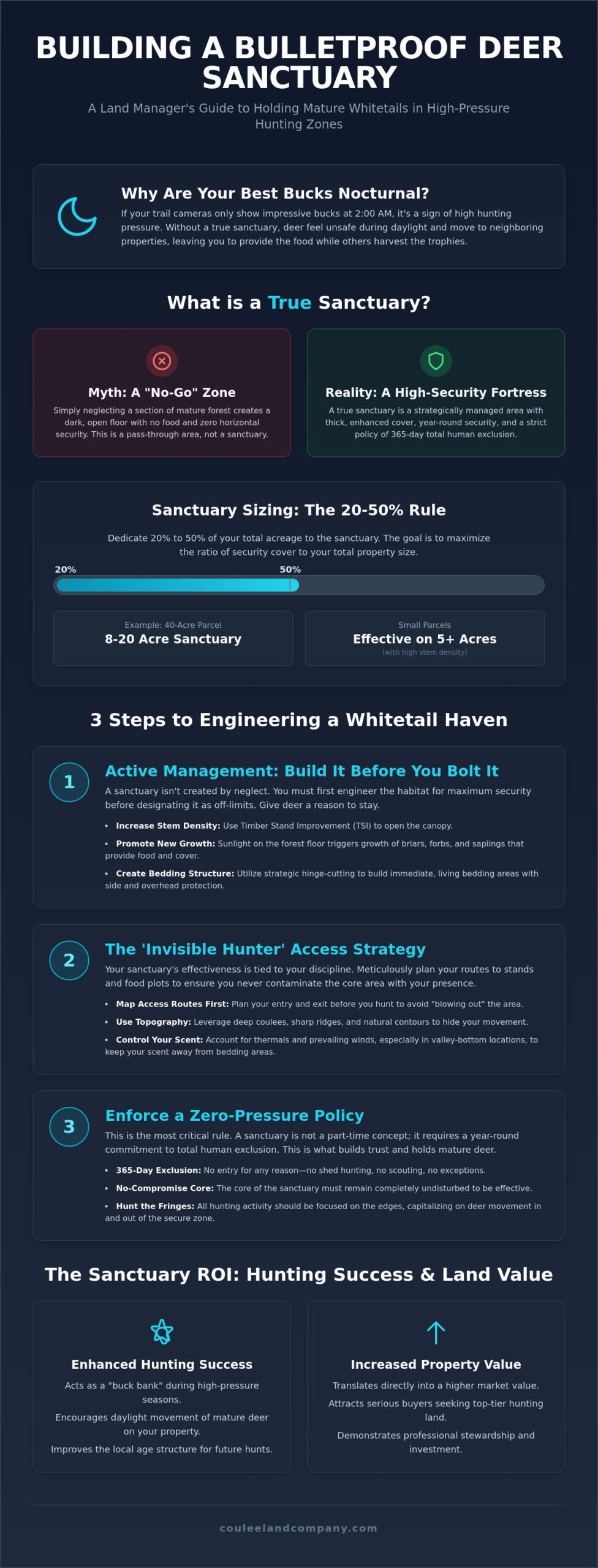
3 Steps to Creating a Deer Sanctuary on Your Property
Successful land managers know that a sanctuary isn’t established the moment you stop walking into a woodlot. You must prepare the ground before you designate it as off-limits. Creating a deer sanctuary on your property requires a “build then bolt” approach where the habitat is engineered for maximum security before the first gate is locked. If you simply stop hunting an open, mature forest, the deer won’t stay; they’ll just pass through on their way to better cover on the neighbor’s land. You need to give them a reason to bed down and stay put.
Active Management: Creating Bedding and Browse
The first physical step is increasing stem density. In Western Wisconsin, this usually means aggressive Timber Stand Improvement (TSI) to drop the canopy and allow sunlight to reach the forest floor. When sunlight hits the dirt, it triggers the growth of briars, forbs, and saplings that provide both food and horizontal cover. You should also utilize strategic hinge-cutting to create immediate, living bedding structures that offer side-cover and overhead protection. For a detailed breakdown of which trees to target, refer to our wisconsin-land-management-for-wildlife-a-landowners-guide. Integrating these techniques into a formal wildlife habitat management plan ensures your efforts result in a sustainable, long-term haven rather than a temporary brush pile.
The “Invisible Hunter” Access Strategy
Your sanctuary is only as good as your ability to stay away from it. You must map your access routes first to ensure you never “blow out” the area when traveling to your stands. Use the natural topography of our region, such as deep coulees and sharp ridges, to hide your movement and your scent. If your food plots sit adjacent to the sanctuary, establish “soft edges” with native grasses or Egyptian wheat to create a visual screen. This prevents deer from seeing you enter the field and keeps the interior of the sanctuary feeling 100% secure. If you’re looking for a parcel with the right terrain features to pull this off, our team can help you evaluate current hunting properties that offer superior layout potential.
Finally, once the cover is thick and your access is stealthy, you must commit to the rules. A sanctuary is a zero-entry zone. This means no shed hunting, no summer hiking, and no “just checking” trail cameras inside the border. By the time the October lull hits, the local buck population will have patterned your absence, making your property the only place they feel safe moving during daylight hours.
The ROI of Sanctuary Management: Hunting Success and Land Value
Creating a deer sanctuary on your property delivers a return on investment that transcends the thrill of the hunt. While the immediate benefit is a noticeable shift in harvest age structure, the long-term financial gains are equally compelling. By providing a secure environment, you effectively anchor mature bucks that would otherwise wander onto neighboring parcels. This consistency reduces “property turnover” by ensuring high-quality hunting opportunities year after year, preventing the frustration that often leads owners to sell prematurely.
Documentation is the bridge between habitat work and market value. Serious hunting land buyers aren’t just looking for acreage; they’re looking for proof of performance. Use perimeter trail cameras to catalog the mature bucks that utilize your sanctuary without ever stepping foot inside the core. This data serves as a powerful record of your land’s potential. For more technical details on the physical construction of these areas, you can study professional guides on how to build a mature buck sanctuary to ensure your efforts meet elite standards.
Positioning Your Property for Resale
A well-defined sanctuary is a premier signature feature in any land listing. It signals to prospective owners that the property has been managed with a professional vision. We recommend walking the perimeter with a land specialist during a showing. This allows you to highlight the specific TSI work and access strategies that make your acreage unique, turning a simple walk into a demonstration of elite land stewardship.
The Long-Term Legacy of Land Stewardship
Your commitment to creating a deer sanctuary on your property builds a neighborhood reputation. When you consistently pass young bucks and provide the best cover in the township, neighbors often take notice and adjust their own habits. This management elevates the trophy-class potential of the entire region. It links your individual efforts to the broader conservation legacy of Buffalo County, ensuring this prized landscape remains a whitetail mecca for the next generation of outdoorsmen.
Secure Your Legacy in Bluff Country
Success in Western Wisconsin’s driftless region isn’t a matter of luck. It’s the result of deliberate strategy and superior land management. We’ve seen that a true sanctuary requires more than just a “no-go” designation; it demands active habitat work like Timber Stand Improvement and the discipline to maintain invisible access routes. Creating a deer sanctuary on your property is the single most powerful move you can make to hold mature bucks and protect the age structure of your local herd. This commitment to stewardship doesn’t just improve your hunting season; it builds significant market value for the future.
As specialists in Western Wisconsin Bluff Country, we’ve built our reputation on a proven track record of record-breaking Buffalo County sales and are proud to be endorsed by industry-leading whitetail experts. We understand the unique terrain of this region and what it takes to find land that truly performs. Whether you’re ready to sell a managed property or looking for your next sanctuary project, we’re here to guide you. View our current Buffalo County hunting properties and see land management in action. Your dream of owning a premier whitetail haven is within reach, and the right piece of dirt is waiting for you.
Frequently Asked Questions
Can I ever enter my deer sanctuary for shed hunting or maintenance?
No, you shouldn’t enter the core sanctuary area for shed hunting or non-essential maintenance. Shed hunting is a major disruptor that often pushes mature bucks off your land during their most vulnerable winter months. Group your essential maintenance into a short window during late spring. This ensures that the security you’ve built remains intact during the times when deer need it most.
How close can I hunt to the edge of a sanctuary without ruining it?
You can hunt the immediate perimeter of a sanctuary as long as your scent and access remain completely outside the core. The effectiveness of an edge stand depends on wind direction and thermal drift. If you’ve established thick screening cover, you can sit within 15 to 20 yards of the border. Always prioritize a “just off” approach where you intercept deer moving from the sanctuary to food sources without alerting the interior.
What is the best time of year to perform habitat work in a sanctuary?
Late winter and early spring are the best times for habitat work like Timber Stand Improvement. Performing chainsaw work and hinge-cutting during this window provides immediate winter browse and allows the area plenty of time to recover before the fall. When creating a deer sanctuary on your property, aim to have all major disturbances finished by July. This gives the local herd several months of total peace before the hunting season begins.
Does a sanctuary need a water source inside its borders?
A water source inside the sanctuary is a significant asset that can double your buck-holding power. While not strictly required, a pond or tank allows deer to remain in the thickest cover for days at a time without needing to travel to open creek bottoms. This is a critical component when creating a deer sanctuary on your property that survives heavy hunting pressure. It keeps mature bucks on your side of the fence during the heat of the rut.