
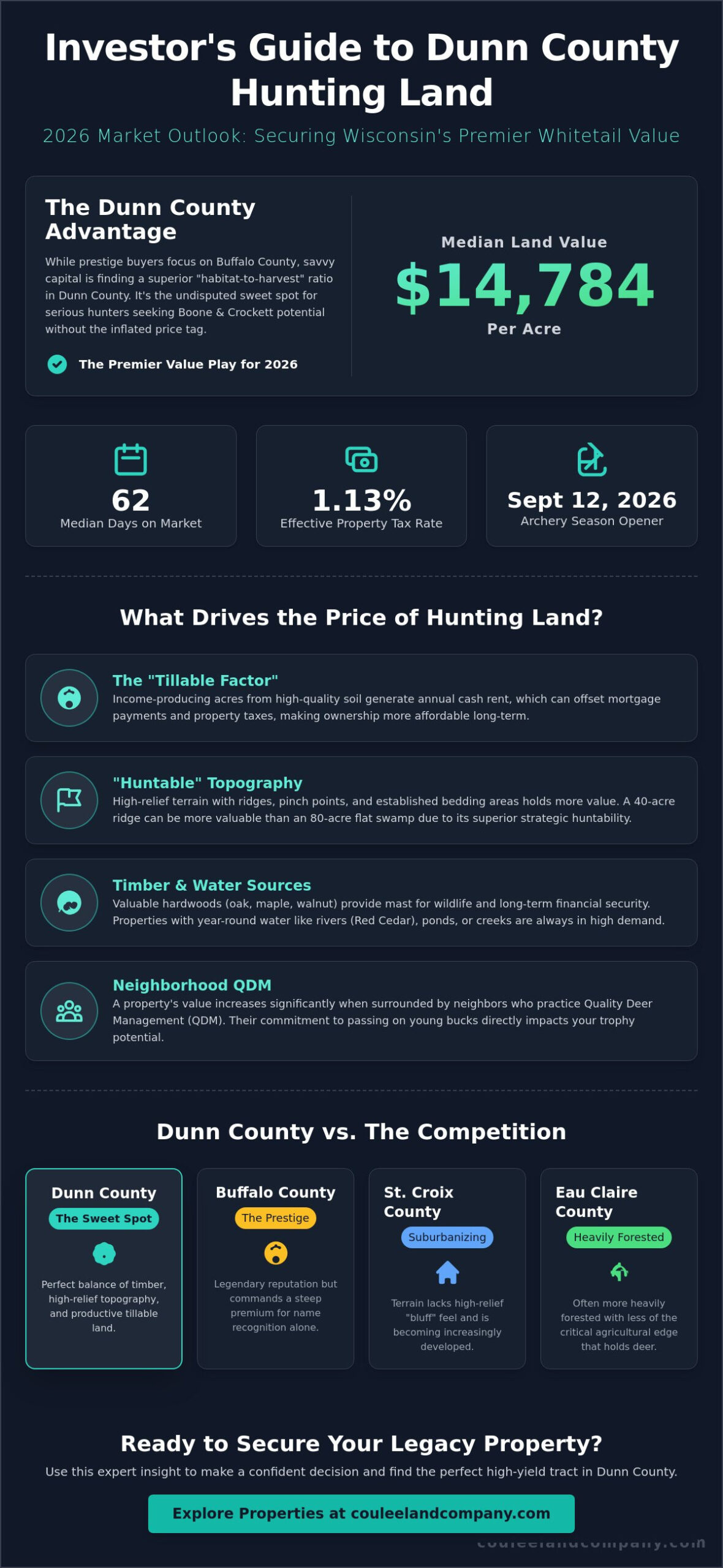
The most expensive dirt in Wisconsin isn’t always the dirt that grows the biggest bucks. While many hunters fixate on the prestige of Buffalo County, savvy capital is migrating north to find a superior “habitat-to-harvest” ratio. The cost of buying hunting land in Dunn County currently sits at a median of $14,784 per acre, positioning it as the premier value play for whitetail enthusiasts in 2026. You probably feel the pressure of rising valuations and fear overpaying for a parcel that lacks the right bedding cover or neighborhood history. It’s frustrating to see similar-sized tracts priced so differently without knowing the true potential of the land.
This guide will show you how to identify high-quality acreage and secure a legacy property at the best relative value. We’ll explore why townships like Hay River and Colfax remain hotspots for trophy potential and how tillable acreage can offset your ownership costs. From property tax benchmarks to the 62-day median time on market, we provide the expert insight needed to make a confident decision before the archery season opens on September 12, 2026.
Key Takeaways
- Evaluate the 2026 market climate where the demand for recreational retreats meets agricultural expansion, impacting overall land liquidity and long-term value.
- Navigate the cost of buying hunting land in Dunn County by understanding why high-relief topography often holds more “huntable” value than larger, flat parcels.
- Calculate the “Tillable Factor” to see how income-producing acres can effectively subsidize your mortgage and property tax obligations.
- Learn the strategic importance of boots-on-the-ground inspections with an expert to decode local deer sign and thermal wind patterns.
- Pinpoint the specific geographic features that distinguish a standard tract from a high-yield legacy property with elite trophy potential.
Analyzing the Dunn County Hunting Land Market
The 2026 market climate in Dunn County, Wisconsin is defined by a persistent tug-of-war between agricultural expansion and the surging demand for elite recreational retreats. Farmers seeking to increase tillable acreage often compete with hunters for the same high-quality tracts, which keeps land liquidity high and inventory moving. With a median of 62 days on market, the pace is brisk but manageable for those who have their finances in order. Location drives much of this activity. Dunn County sits in a strategic corridor, offering an easy commute for buyers from the Twin Cities and Eau Claire who want a world-class hunting property within a short drive. This proximity ensures that the cost of buying hunting land in Dunn County remains resilient, as there is a constant influx of capital seeking the solace of the timber.
To better understand what to prioritize when evaluating these parcels, watch this helpful video:
Smart buyers recognize the “Value Gap” that exists when comparing this region to the legendary “Bluff Country” of neighboring Buffalo County. While Buffalo County often commands a steep premium based on name recognition alone, Dunn County offers a nearly identical trophy profile for a lower entry point. It’s the undisputed “sweet spot” for serious whitetail hunters who want Boone & Crockett potential without the inflated price tag found further south. Dunn County stands as a premier whitetail destination because of its diverse habitat mix, featuring the fertile Red Cedar River bottomlands and the mast-producing rolling hardwoods that provide elite bedding and nutrition.
Market Trends and Buyer Demand
The shift toward “recreational residences” continues to support land values as more people look for properties that serve as both a hunting camp and a remote office. Local wildlife management groups also influence parcel desirability. A property surrounded by neighbors who practice Quality Deer Management (QDM) and pass young bucks is naturally worth more than a tract in an unmanaged area.
Dunn County vs. Surrounding Counties
When you look at St. Croix or Eau Claire counties, the terrain often lacks the high-relief “bluff” feel found in southern Dunn. St. Croix is becoming increasingly suburbanized, while Eau Claire can be more heavily forested with less agricultural edge. Dunn County hits a perfect balance of heavy timber, river corridors, and productive tillable land, making it a superior choice for those focused on land stewardship and big-buck ROI.
Key Valuation Factors: What Drives the Price of Hunting Land?
Valuation in the 2026 market goes far beyond a simple price per acre calculation. One of the most significant drivers is the “Tillable Factor.” Properties with high-quality soil and income-producing acres allow you to offset the cost of buying hunting land in Dunn County by generating annual cash rent. This agricultural return can often cover the 1.13% effective property tax rate and a portion of mortgage interest, making the land more affordable over a long-term hold. Beyond the balance sheet, topography dictates “huntability.” A 40-acre ridge-top with established bedding and pinch points might command a higher premium than an 80-acre flat swamp because every square inch is usable for the hunt. Standing timber also serves as a growing bank account. High-value hardwoods like white oak, maple, and walnut provide both critical mast for wildlife and long-term financial security through sustainable harvesting. Quality Deer Management (QDM) practices in the immediate neighborhood can add significant intangible value to a tract, as your neighbors’ commitment to passing young bucks directly impacts your own trophy potential.
Habitat Diversity and Water Sources
Water is the lifeblood of any premier hunting tract. Properties featuring the Red Cedar River, spring-fed ponds, or year-round creeks see higher liquidity and higher valuations. You can explore waterfront properties in Western Wisconsin to see how these natural features influence market positioning and wildlife density. Thermal cover and secluded bedding areas are equally vital for sustaining a year-round deer herd and keeping mature bucks on your side of the fence. Landowners often utilize Wisconsin DNR private land programs to enhance these habitats while exploring various financial incentives for conservation.
Access and Infrastructure
Access can make or break a land investment. Road frontage offers convenience and ease of development, while secluded parcels with deeded easements provide the ultimate privacy required for a sanctuary. Existing infrastructure like established trail systems, cleared food plots, and cabin sites with power allow sellers to command a higher price. These improvements represent thousands of dollars in “sweat equity” already completed. If you are ready to evaluate these variables on a specific parcel, our team of specialists can help you identify a property with high trophy potential that matches your specific goals.
The Strategic Path to Purchasing Dunn County Land
Securing a legacy property in 2026 requires more than just a checkbook. It demands a disciplined strategy that balances your financial limits with your desire for elite trophy potential. The cost of buying hunting land in Dunn County is an investment in a specific lifestyle, but navigating the financing for recreational tracts is different from a standard residential mortgage. Lenders typically view vacant land as a higher risk, often requiring 20% to 35% down. You need to have your capital ready and your pre-approval in hand before the right parcel hits the market. Success in this territory comes down to preparation and the ability to act when the right “habitat-to-harvest” ratio appears.
Why a Land Specialist is Essential
A generalist realtor might show you the property lines, but they won’t recognize a primary scrape or a hidden bedding thicket. Working with an expert like Mike Law or Bryan Lemke ensures you evaluate the dirt through the lens of a seasoned hunter. They understand how thermal wind patterns and neighborhood QDM history dictate the true value of a tract. You can learn more about our specialized buyer services to see how we vet every property for its hunting merit. For those looking beyond this region, our guide on hunting land for sale in Wisconsin: the ultimate buyer’s guide provides a wider perspective on the state market.
Due Diligence Checklist for Hunting Properties
Due diligence is where you protect your investment. You must verify property boundaries, easements, and local zoning regulations to avoid future surprises. It’s essential to consult the Agricultural Assessment Guide to understand how use-value assessments can significantly lower your holding costs. Reviewing the Managed Forest Law (MFL) status is also critical; it offers a path to lower taxes through sustainable timber management. Finally, assess the local deer density and health statistics for the specific township to ensure your property remains a productive sanctuary for generations. Closing with confidence means knowing every detail of the land before you sign the deed.
Secure Your Legacy in the Red Cedar River Valley
Owning a piece of Wisconsin’s bluff country is a dream that requires both passion and pragmatism. You’ve seen how the cost of buying hunting land in Dunn County offers a strategic advantage for those who prioritize habitat quality over county name recognition. By focusing on income-producing tillable acres and the high-relief topography of the south, you’re building a foundation for both a world-class hunt and a sound financial asset. It’s about finding that perfect balance between a sanctuary for mature bucks and a property that works for you year-round.
Our team consists of authentic outdoorsmen who live and breathe the land we sell. We specialize in Western Wisconsin’s unique terrain and possess the deep expertise in trophy whitetail habitat necessary to separate a standard parcel from a once-in-a-lifetime sanctuary. Don’t leave your family’s legacy to chance by working with a generalist who doesn’t understand deer behavior. View our exclusive Dunn County hunting land listings today and take the first step toward the property you’ve always envisioned. Your next great season starts with the right dirt.
Frequently Asked Questions
Is Dunn County good for trophy whitetail hunting?
Dunn County is an elite destination for trophy whitetail, particularly within the Hay River, Colfax, and New Haven townships. The region’s unique combination of high-relief bluff country and fertile agricultural river bottoms provides the ideal habitat for growing mature, high-scoring bucks. This area has a consistent history of Boone & Crockett entries, making it a top-tier choice for serious hunters who prioritize trophy potential.
How does Managed Forest Law (MFL) affect property taxes in Dunn County?
Enrolling in the Managed Forest Law program can drastically reduce your annual property tax burden. While the median effective property tax rate in the county is 1.13%, MFL allows landowners to pay a significantly lower per-acre fee in exchange for following a sustainable forest management plan. This program is an essential tool for managing the long-term cost of buying hunting land in Dunn County while improving timber quality and wildlife habitat.
Can I get a loan for hunting land in Wisconsin?
You can secure financing for recreational land, but the process differs from obtaining a traditional residential mortgage. Most specialized land lenders require a down payment ranging from 20% to 35% because vacant land is viewed as a different risk profile. It’s helpful to work with a broker who has deep connections with local lenders who understand the intrinsic value of Western Wisconsin acreage and timber assets.
What is the average parcel size for a viable hunting property in Dunn County?
A viable hunting tract typically starts at 40 acres, though the quality of the topography is more important than the total size. Many successful hunters look for 40 to 80-acre parcels that feature a balance of thick bedding cover and established food sources. Since the average cost of buying hunting land in Dunn County is $17,118 per acre, focusing on properties with high-relief ridge-tops ensures you maximize your usable hunting ground for every dollar invested.