
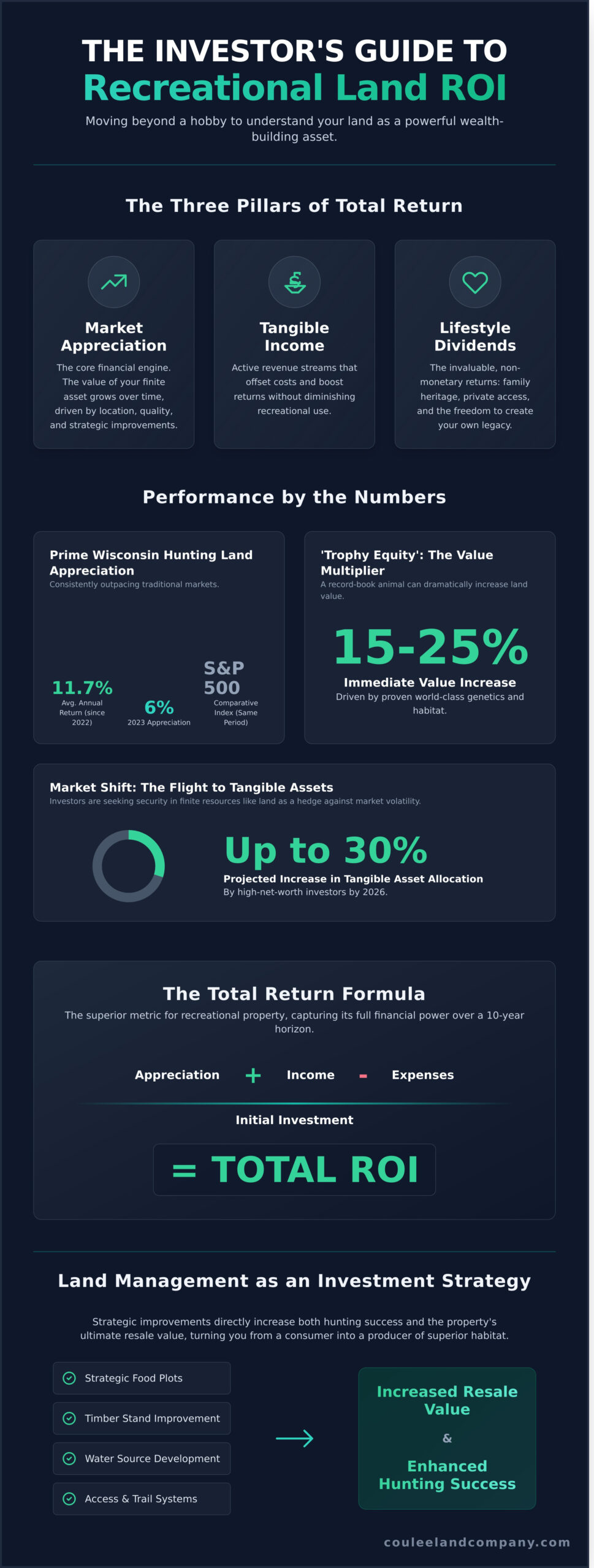
Your hunting property is more than a passion project; it’s one of the most powerful wealth-building tools you can own, with prime Wisconsin hunting land appreciating over 6% in 2023 alone. We know the thrill of watching a trophy buck step into a food plot is priceless. But in a market with fluctuating interest rates, you’re right to question if your land is just a costly hobby or a sound financial asset. Many hunters struggle to justify the investment when the only clear return is a full freezer and cherished memories.
This guide provides the expert framework for calculating ROI on recreational property. You will learn how to quantify the complete financial and lifestyle returns, moving beyond simple rental math to master land appreciation, timber value, and the “trophy equity” that makes Buffalo County parcels a world-class investment. We’ll break down the key metrics, reveal how strategic land management directly increases resale value, and give you the confidence to evaluate your next purchase as both a hunter and a savvy investor for 2026.
Key Takeaways
- Understand the three pillars of land return-financial appreciation, tangible income streams, and invaluable lifestyle dividends-to see the complete investment picture.
- Master the core formula for calculating ROI on recreational property by analyzing historical land appreciation and current per-acre lease income in your target area.
- Discover how a location’s “trophy genetics,” like those in Wisconsin’s Bluff Country, can act as a powerful ROI multiplier that stabilizes and enhances your land’s long-term value.
- Learn how strategic land management, from habitat improvements to food plot placement, directly increases both your hunting success and the property’s ultimate resale value.
Defining ROI for Recreational Land: More Than Just Rental Income
When you’re calculating ROI on recreational property, you must first discard the conventional wisdom applied to residential or commercial real estate. The metrics used for a duplex in Madison or an office building in Milwaukee simply don’t apply to a sprawling 80-acre tract in Buffalo County. The return on hunting land isn’t measured in monthly rent checks; it’s measured in generations, in heartbeats, and in the tangible growth of a legacy asset. Your investment is built upon three distinct pillars: market appreciation, tangible income streams, and what we call Lifestyle Dividends.
For a clear breakdown of the basic financial formula, this video offers an excellent primer on the core concept of investment return.
While financial growth is crucial, the unique value of recreational land is often found in its non-monetary returns. Appreciation is a powerful force, especially in a region famed for its wildlife capabilities. This is the concept of ‘Trophy Equity’. A property in Western Wisconsin’s Bluff Country that produces a record-book whitetail isn’t just a successful hunt; it’s a significant market event that can increase the land’s value by 15-25% almost overnight. Demand for land that can produce world-class deer is intense and unwavering. Furthermore, tangible income can be generated through timber harvests, CRP (Conservation Reserve Program) payments, or agricultural leases, creating revenue without sacrificing the property’s recreational use.
Looking ahead, the investment landscape is changing. Projections show that by 2026, high-net-worth investors will increase their allocation to tangible assets by up to 30% as a hedge against market volatility. Since 2022, prime Wisconsin hunting land has delivered an average annual appreciation of 11.7%, a figure that has consistently outpaced the S&P 500’s performance during the same period. This isn’t a trend; it’s a fundamental shift toward the security of owning real, finite land.
The Concept of ‘Lifestyle ROI’
How do you quantify the value of watching your kids catch their first fish on a pond you own? Or the certainty of knowing your hunting spot is exclusively yours? This is ‘Lifestyle ROI’. It’s the private access, the family heritage, and the freedom to manage your land your way. This ‘recreational utility’ provides a powerful hedge against market downturns, as its value is immune to stock market fluctuations. It marks the critical transition from being a consumer of hunting to a producer of superior habitat and wildlife.
Total Return vs. Cash-on-Cash Return
Traditional real estate often focuses on cash-on-cash return, an annual measure of income against cash invested. For raw land, this metric is shortsighted. The superior approach for calculating ROI on recreational property is Total Return. The formula is simple: (Appreciation + Income – Expenses) / Initial Investment. By incorporating appreciation, it captures the true financial power of land ownership. This is why we advise clients to adopt a 10-year horizon; it allows for market cycles and for the long-term value of a well-managed property to fully mature, aligning with the foundational principles of Return on Investment (ROI).
Recreational ROI is the combined value of fiscal growth and personal usage rights.
The Hard Numbers: Calculating Tangible Financial Returns
Owning a slice of Wisconsin’s Bluff Country is a dream fulfilled, but it’s also a significant financial asset. A savvy investor looks beyond the thrill of the hunt to the bottom line. The process of calculating the ROI on a property investment requires a clear-eyed look at appreciation, income, and expenses. For those serious about calculating ROI on recreational property, understanding these tangible returns is the first step toward building a legacy that is both personally rewarding and financially sound.
The foundation of your return is the land itself. Historically, quality recreational land in Western Wisconsin has demonstrated a consistent appreciation rate between 5-7% annually. This underlying growth acts as a powerful, passive wealth-building tool. Beyond appreciation, a well-managed property can generate multiple active income streams that offset costs and boost your overall return. These revenue sources turn your passion into a performing asset.
- Hunting Leases: Demand for exclusive hunting rights in premier areas like Buffalo County is intense. Current lease rates for prime whitetail ground in the Bluff Country range from $40 to over $80 per acre, per year, providing a predictable annual income.
- Timber Value: Your woods are not just habitat; they are a long-term investment. Strategic Timber Stand Improvement (TSI) practices don’t just improve wildlife habitat, they cultivate a future high-value timber harvest, turning patience into profit.
- Government Programs: Enrollment in state and federal conservation programs can provide direct payments and significant tax advantages. Programs like the Conservation Reserve Program (CRP) offer annual rental payments for certain conservation practices, while Wisconsin’s Managed Forest Law (MFL) can slash your property tax liability.
Calculating the ‘Holding Cost’ of Land
To get a true picture of your net return, you must first calculate your annual holding costs. These are the necessary expenses of ownership, including property taxes, liability insurance, and basic maintenance like trail clearing or food plot upkeep. However, programs like Wisconsin’s MFL can dramatically reduce this burden, often cutting property taxes by up to 80% for enrolled parcels. Factoring in your financing rate is also critical, as interest payments directly impact your net annual cash flow and overall ROI.
Timber as a Growing Bank Account
A professional timber cruise conducted during your due diligence is non-negotiable. It provides a precise inventory and valuation of the marketable timber on a property, giving you a clear financial picture from day one. A well-planned selective harvest offers a dual benefit: it generates immediate cash flow and, by opening the canopy, stimulates the thick undergrowth that creates superior bedding cover for mature bucks. Looking ahead, the ROI on natural hardwood regeneration remains a steady, long-term play, while faster-growing pine plantations established in 2026 could offer a quicker harvest cycle, though often with a different end-market value. Understanding these timber dynamics is a core component of calculating ROI on recreational property, and it’s where our detailed property assessments provide clients with a critical advantage.
The Buffalo County Advantage: Why Location is the Ultimate ROI Multiplier
In any real estate investment, location is king. But when calculating ROI on recreational property, location becomes an undeniable force multiplier, and no location in the whitetail world carries the weight of Buffalo County, Wisconsin. This isn’t a matter of opinion; it’s a statistical fact proven by decades of entries in the Boone and Crockett record book. This legendary status creates a market dynamic unlike any other, providing a stable foundation for long-term value appreciation.
The value is rooted in two core principles: world-class genetics and geographic scarcity. The “Boone and Crockett Effect” means that the genetic potential for producing trophy-class whitetails is a known commodity, not a hopeful gamble. This proven production acts as a floor for land values, insulating them from the volatility seen in generic rural acreage. Compounding this is the simple fact that they aren’t making any more “Bluff Country.” The dramatic, rugged topography of deep coulees and steep ridges is a finite resource, creating intense and consistent demand for a limited supply of land.
While other Midwest states like Iowa or Illinois have pockets of exceptional hunting, Buffalo County offers a proven concentration of trophy potential. A property here exists within a powerful “neighborhood” of like-minded landowners. Having neighbors who actively practice Quality Deer Management (QDM) is a massive value-add, creating a cooperative environment where the entire region’s deer herd is managed as a shared, appreciating asset.
The Economics of Trophy Whitetails
The proof of this genetic premium is in the price. It’s a phenomenon our brokers witness season after season: a credible trail camera photo of a legitimate 170-class buck can add up to $500 per acre to a property’s final sale price. Why? Because it removes all speculation for the buyer. It’s tangible proof of the land’s capabilities. The region’s topography plays a crucial role, creating natural, “un-huntable” sanctuaries on steep hillsides that allow bucks to reach full maturity. To understand the specific market forces at play, explore the data on our Buffalo County community page.
Market Liquidity in Elite Hunting Zones
Not all acreage sells equally. Our internal market analysis, compiled since our founding in 2008, shows that A-grade hunting properties in premier zones like Buffalo County sell up to three times faster than generic rural parcels. These properties attract a specific “Legacy Buyer” profile: a sophisticated investor looking for a multi-generational asset, not just a weekend getaway. They have the capital and demand proven quality, ensuring high liquidity for sellers. At Coulee Land Company, we specialize in this elite market, actively tracking exclusive off-market sales to provide our clients with unmatched insight and access.
Maximizing Your Return: Land Management as an Investment Strategy
Purchasing a prime piece of Wisconsin hunting land is the first step. True value creation, however, begins the day you close. Thinking like a land manager, not just an owner, transforms your property from a simple asset into a high-performance investment. Every improvement should be viewed through the lens of what it adds to the hunting experience and, consequently, the final sale price. The most successful investors don’t just buy land; they cultivate its potential.
A strategic approach to land development directly impacts your bottom line. These five core strategies are proven to build equity and create the kind of property that commands a premium in the Bluff Country market.
- Step 1: The Comprehensive Habitat Plan. This is your property’s ‘curb appeal.’ Implementing a plan that includes hinge-cut bedding areas, planting native grasses for cover, and removing invasive species creates an environment where wildlife thrives. A property teeming with game is a property that sells fast.
- Step 2: Strategic Food Plot Placement. Anyone can clear a field and throw down seed. A specialist knows to place smaller “kill plots” in secluded corners accessible by stealth and larger “destination plots” that act as a central hub for deer activity, increasing both hunting success and perceived value.
- Step 3: Creating ‘Silent Entry’ Access. The single biggest mistake hunters make is educating their deer. We see savvy buyers pay a significant premium for properties with established, screened access routes that allow entry and exit without spooking game from food sources or bedding areas. This feature is pure gold.
- Step 4: Water Source Development. Often overlooked, this is a high-impact, low-cost improvement. A small, secluded pond dug with a dozer for under $2,000 can become the primary water source for wildlife on your property, ensuring deer stay on your land during dry periods in late October.
- Step 5: Documenting the ‘Trail Cam History.’ A picture is worth a thousand words, but a five-year trail camera history of a 160-inch buck is worth tens of thousands of dollars. This visual record is a tangible asset that proves the property’s genetic and age-structure potential.
The ROI of Habitat Improvements
Does a $5,000 food plot investment add $10,000 in property value? Absolutely. The math works because you’re selling time and certainty. A buyer in the 2024 market sees an established, productive food plot and knows it saves them two years of soil amendment, planting, and growth. In a market where interest rates hover over 6%, these Turnkey properties that are hunt-ready from day one command a 10-15% premium over raw land, as buyers have less liquid capital for immediate, large-scale projects.
Documenting Your Success
Your work in the field must be recorded to be monetized. We advise clients to build a comprehensive ‘Property Portfolio’ containing soil test results from a lab like Dairyland Laboratories, laminated maps, and dated harvest and trail camera photos. Using a professional mapping service or even a detailed onX Hunt map layer to clearly delineate sanctuaries, food plots, and access routes transforms your sweat equity into a professional presentation. This data-driven approach is fundamental to accurately calculating ROI on recreational property and proves your land’s ‘Production Capacity’ for holding and growing mature bucks.
A well-managed property with a documented history isn’t just a parcel of land; it’s a proven hunting destination. Let our land specialists help you design a management plan that builds real equity in your property.
Securing Your Legacy: Why a Land Specialist is Essential for ROI
You wouldn’t hire a boat captain to fly a plane. So why would you trust a residential realtor with what is likely one of the most significant investments of your life: a piece of prime recreational land? The skill sets are fundamentally different. A residential agent sees square footage, countertops, and school districts. They don’t see the subtle nuances that determine the true, long-term value of a hunting property. They can’t tell you the difference between a south-facing slope that acts as a thermal deer sanctuary and a north-facing slope that holds snow, and value, differently.
This knowledge gap is where potential ROI is lost. A standard agent might miss a poorly documented access easement that could lock you out of your best stand location, effectively slashing your property’s utility and resale value. They won’t have the network of foresters to accurately cruise and value a stand of mature white oak or black walnut, a tangible asset that can provide immediate income. True land specialists understand that value is hidden in the details:
- Mineral and Timber Rights: We verify the complete ownership of all subsurface and timber rights, which can represent a significant, often overlooked, portion of a property’s total asset value.
- Government Program Potential: Our team is versed in navigating CRP, MFL, and other conservation programs that can generate annual income and reduce your tax burden.
- Trophy Potential Analysis: We walk the dirt. We understand how topography, water sources, and food plot locations create the specific travel corridors that produce the Boone and Crockett-class whitetails this region is famous for.
Closing the gap between a recreational dream and a high-performing asset is our specialty. The process of calculating ROI on recreational property becomes far more accurate and favorable when every variable is identified and leveraged by an expert. It’s about transforming your passion for the outdoors into a legacy-building investment that pays dividends for generations.
The Coulee Land Company Difference
Our “hunter’s realtor” approach is what sets us apart. We don’t just sell land; we live and breathe it. Our network of dedicated land specialists, including seasoned experts like Mike Law and Bryan Lemke, are hunters first. They possess an intimate, on-the-ground knowledge of Western Wisconsin that allows them to uncover ROI potential others miss. We invite you to see the caliber of properties this expertise secures in our exclusive hunting property listings.
Ready to Sell? Maximize Your Exit ROI
Selling your property requires the same level of specialized expertise. Timing the market in Western Wisconsin is a seasonal science, and we know precisely when to list to attract the most qualified and motivated buyers. We don’t just put a sign up; we market your ‘Bluff Country’ property to a national audience of trophy hunters and investors who are actively seeking the unique legacy our region offers. Maximize your return by working with the best. Visit our Sellers page for a professional land valuation.
Secure Your Legacy: The Ultimate Return on Your Hunting Investment
Your investment in hunting land for 2026 isn’t just a line item on a spreadsheet; it’s a legacy built on sunrises in the stand and the pursuit of world-class whitetails. The truest return emerges when you combine tangible financial metrics with the unparalleled advantage of a location like Buffalo County, a region that dominates the Boone and Crockett record books. Mastering the art of calculating ROI on recreational property means looking beyond the purchase price to the long-term potential for both your portfolio and your passion.
You don’t have to navigate this complex landscape alone. The specialists at Coulee Land Company bring decades of combined land management and real estate expertise to every transaction. We are the trusted guides in Buffalo County’s world-record whitetail corridor, endorsed by leading outdoor television personalities who understand what it takes to find and develop superior hunting properties. It’s time to transform your dream into a tangible asset. Start your search for high-ROI hunting land today with Coulee Land Company and secure a heritage that will last for generations.
Frequently Asked Questions About Recreational Property ROI
Is hunting land a good investment compared to the stock market?
Hunting land can be a superior long-term investment because it’s a tangible asset you can use and enjoy while it appreciates. Unlike the stock market’s volatility, land values have historically shown consistent growth. You can also actively increase the property’s value through strategic land management, habitat improvements, and enhancing its wildlife capabilities, creating a legacy asset that offers returns far beyond the financial.
How much does land typically appreciate in Wisconsin each year?
According to the USDA’s 2023 Land Values Summary, Wisconsin’s agricultural land values saw an average increase of 11.5% year-over-year. However, premier recreational tracts in coveted regions like the Bluff Country often outperform this average. Properties in counties like Buffalo or Trempealeau, known for world-class whitetails, can see even higher appreciation rates due to intense demand from serious hunters and investors.
Can I deduct land management expenses on my taxes?
Yes, you can deduct many land management expenses, provided your property is set up to generate income through activities like hunting leases, farming, or timber sales. Deductible costs can include property taxes, food plot supplies, trail maintenance, and consulting forester fees. It’s crucial to consult with a qualified tax professional to ensure you’re correctly structuring your ownership and maximizing your deductions.
What is the ‘trophy premium’ in Buffalo County real estate?
The ‘trophy premium’ is the additional 15-25% value that buyers are willing to pay for a property located in Buffalo County, which dominates the Boone and Crockett record book for whitetail deer. This premium isn’t just about acreage; it’s about owning a piece of a legendary hunting destination. This added value is a direct result of the area’s proven genetics and superior wildlife management, making it a key factor in your ROI.
How do I calculate the timber value of a property before buying?
The only accurate way to calculate timber value is to hire a professional consulting forester to conduct a “timber cruise.” This detailed inventory assesses the species, size, quality, and volume of marketable trees on the property. The forester’s report will provide a precise valuation based on current market prices for sawlogs and pulpwood, giving you a critical piece of your property’s total asset value.
What is the Managed Forest Law (MFL) and how does it affect ROI?
Wisconsin’s Managed Forest Law (MFL) is a DNR incentive program that dramatically reduces property taxes for landowners who agree to a sustainable forest management plan. Enrolling a property in MFL significantly lowers your annual holding costs, which has a powerful, direct impact on your net return. Properly calculating ROI on recreational property requires factoring in tax savings from programs like this, as they directly boost your bottom line.
Is it better to lease my land for hunting or keep it private to preserve value?
Leasing your land provides immediate, predictable income that improves your annual ROI and can cover expenses like property taxes. Alternatively, keeping a property private gives you total control over hunting pressure and habitat, allowing you to manage for mature trophy bucks. This can significantly increase the land’s long-term resale value and enhance its ‘trophy premium’, appealing to high-end buyers and delivering a larger return upon sale.
What are the biggest risks to recreational land ROI in 2026?
Looking toward 2026, the primary risks to ROI include potential changes in CWD management zones that could impact local hunter demand and sustained high interest rates, which can shrink the pool of qualified buyers. Additionally, commodity price fluctuations for timber and crops can affect income projections. A diligent investor will monitor these factors closely to protect their asset and adapt their management strategy accordingly.