
Imagine closing on a 20-acre parcel in the heart of Bluff Country only to discover that Shoreland Zoning ordinances or the 2015 Wisconsin Act 55 prevent you from clearing a single tree for your dream cabin site. It’s a devastating realization that many buyers face when they prioritize a view over technical due diligence. Buying Waterfront Properties in Western WI: Avoid Pitfalls with Proven Guidance is about ensuring your investment doesn’t turn into a regulatory nightmare. You’ve worked hard to secure a piece of land that offers more than just beauty; you want functional recreational ground that supports trophy whitetail and provides a secure building site for generations.
We understand that the dream of owning Wisconsin waterfront is often clouded by legitimate fears of DNR restrictions and shifting floodplains along the Mississippi or Chippewa rivers. You’re right to be cautious, as managing riparian rights and erosion control requires the specialized knowledge of Wisconsin’s Land & Property Sales Specialists. This guide provides the expert local guidance needed to secure a property that meets both your hunting goals and strict zoning requirements. We’ll break down the essential steps for environmental assessments and local permit processes to ensure your future in Western Wisconsin is built on solid ground.
Key Takeaways
- Learn to distinguish between a scenic view and legal “usability” by understanding the intersection of physical access and strict Wisconsin DNR regulatory compliance.
- Discover why the rugged topography of Western Wisconsin’s Bluff Country requires a more rigorous due diligence approach than traditional flatland lake districts.
- Protect your investment when Buying Waterfront Properties in Western WI: Avoid Pitfalls with Proven Guidance by conducting formal site-suitability and FEMA flood zone analyses.
- Understand how waterfront acreage serves as a vital travel corridor for trophy whitetails, making a specialized land specialist non-negotiable for serious hunters.
- Identify the hidden financial risks regarding building rights and long-term ownership costs that residential realtors often overlook in complex river and stream transactions.
The Reality of Western Wisconsin Waterfront: Beyond the View
Buying Waterfront Properties in Western WI: Avoid Pitfalls with Proven Guidance starts with the realization that a stunning sunset view doesn’t guarantee a functional property. In our rugged Bluff Country, “usability” is the critical intersection where physical access meets strict Wisconsin DNR regulatory compliance. Unlike the flat, sandy beaches found in northern lake districts, Western Wisconsin features steep elevations and complex floodplains. A parcel might offer 500 feet of shoreline on paper, but if it’s separated from the building site by a 60-foot limestone cliff or a protected wetland, your actual interaction with the water is limited. understanding riparian rights is the first step in determining what you can legally do with that shoreline.
To better understand the complexities of the local market, watch this helpful video:
Navigating DNR Shoreland Zoning and Local Permits
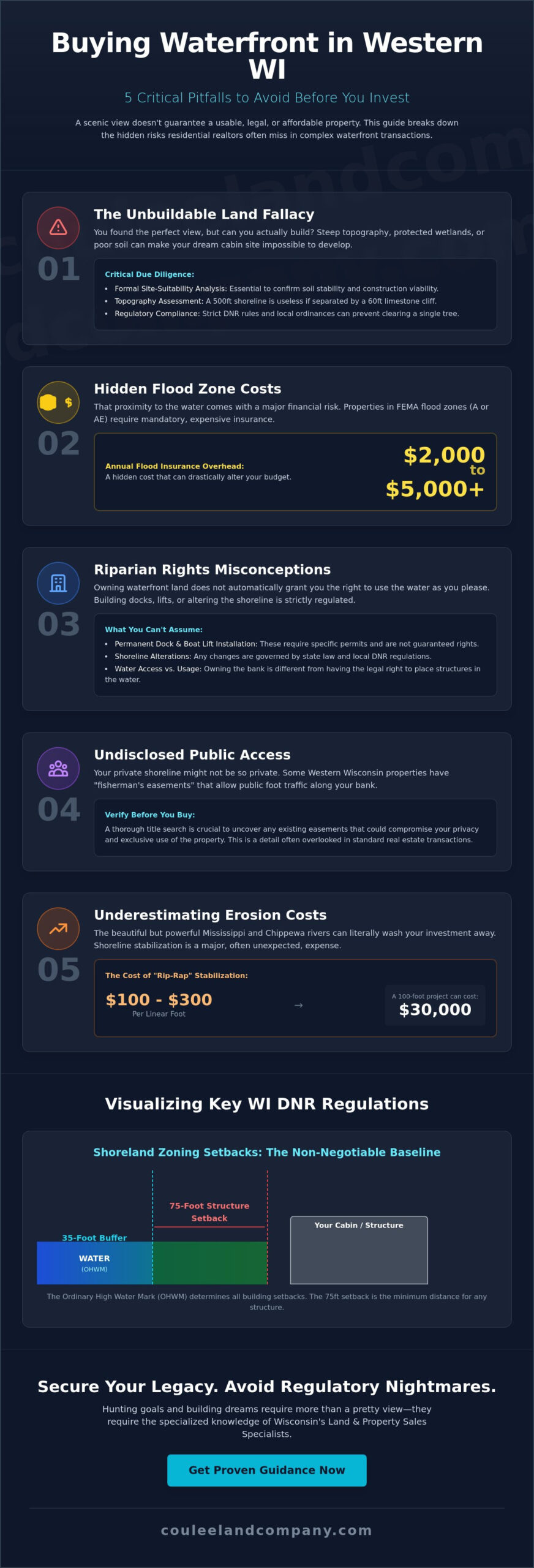
The Wisconsin DNR maintains rigorous standards for shoreland management, and upcoming 2026 regulations will further tighten requirements for shoreland buffer zones and vegetation removal. These rules dictate that at least 35 feet of the primary buffer must remain in natural vegetation to prevent erosion. While state law provides a floor, counties like Buffalo and St. Croix often implement stricter local ordinances to protect the unique topography of the Coulee Region. The 75-foot setback rule serves as the non-negotiable baseline for all Western WI waterfront structures, ensuring buildings remain a safe distance from the water’s edge. Identifying the Ordinary High Water Mark (OHWM) is essential, as this point of regular presence of water determines every building setback on your lot.
Western WI Water Types: Rivers vs. Inland Lakes
Choosing between a river and an inland lake involves more than just personal preference; it’s about long-term land management. Mississippi River frontage offers massive recreational scale but brings challenges like seasonal siltation and shifting currents that can alter your bank over time. In contrast, spring-fed inland lakes offer more stability but require vigilant monitoring of nutrient loading. If you’re looking at trout streams in the Coulee Region, realize that these tributaries are sensitive ecosystems where even minor bank disturbances can trigger DNR enforcement. For those focused on waterfront properties, distinguishing between “frontage” and “accessible water” is vital, especially in the Mississippi valley where backwaters and marshes can make launching a boat physically impossible despite owning the land.
Avoiding the 5 Most Common Pitfalls in Waterfront Transactions
Buying Waterfront Properties in Western WI: Avoid Pitfalls with Proven Guidance requires more than a scenic view. Many buyers assume they can build a cabin right on the shoreline. They’re often wrong. A formal site-suitability analysis frequently reveals soil limitations or setbacks that prevent construction entirely. FEMA flood zone designations also catch owners off guard; properties in Zone A or AE require mandatory flood insurance, which can add $2,000 to $5,000 annually to your overhead costs.
Understanding “Riparian Rights” is another critical hurdle. Owning the land doesn’t grant an automatic right to install a permanent dock or a boat lift. These rights are strictly governed by state law and local DNR regulations. Additionally, you must check for public access easements. Some shorelines in Western Wisconsin contain “fisherman’s easements” that allow public foot traffic along the bank. Finally, don’t ignore shoreline erosion. Installing “rip-rap” (large rocks used for stabilization) can cost between $100 and $300 per linear foot, turning a 100-foot shoreline project into a $30,000 expense.
Hidden Costs: Maintenance, Erosion, and Insurance
The humid river valley climate along the St. Croix or Mississippi Rivers demands marine-grade exterior maintenance. Wood decks and siding require treatment every 2 to 3 years to prevent rot. If your property sits near the riverbank, you’ll likely need an Elevation Certificate to determine your actual flood risk and lower your premiums. Waterfront features significantly impact property value, and you can see how these assets compare to other land types in our Selling Hunting Land in Wisconsin guide.
Due Diligence: The Essential Waterfront Checklist
Never rely on “plat maps” for boundaries. Instead, follow this 3-step verification process:
- Hire a licensed surveyor to mark physical corners and verify acreage.
- Review the deed for recorded easements or utility rights-of-way.
- Verify the ordinary high-water mark with local zoning offices.
In the Bluff Country, you must also check for “Steep Slope” ordinances. Many counties prohibit building on slopes exceeding 12% to 20% to prevent runoff and landslides. If you’re ready to find your piece of the river, explore our current waterfront properties today.
Securing Your Legacy: Why a Land Specialist is Non-Negotiable
Buying a creek bottom or riverfront parcel isn’t just a typical real estate transaction. It’s a legacy move. Most residential realtors focus on kitchen finishes and school districts, but those metrics don’t apply here. At Coulee Land Company, we focus on how a tract functions as a travel corridor for trophy whitetails. Waterfront in the Coulee Region acts as a natural funnel. Big bucks use these low-lying areas to move between bedding and feeding sites under the cover of timber. If you’re Buying Waterfront Properties in Western WI: Avoid Pitfalls with Proven Guidance by partnering with specialists who understand these wildlife patterns.
We vet every property for multi-generational longevity. This means ensuring shoreline stability and legal access are secured before you sign any papers. Our brokers handle the heavy lifting of DNR approvals and complex contingencies that would leave a standard agent overwhelmed. We look at the land’s utility, not just its view. Our goal is to protect your investment from the regulatory traps that often plague rural sales.
Integrating Waterfront with Hunting and Land Management
Water access provides a strategic advantage for serious hunters. A river or large creek allows for a “stealth entry” via canoe or small boat. This lets you reach remote stands without leaving a scent trail on the ground. When you browse Coulee Land Company Waterfront Properties, you’re viewing land evaluated for its hunting potential. For context on regional land value, consider how Buffalo County Wisconsin Deer Hunting dominates the record books. We help you manage these riparian zones to maximize both trophy potential and property value.
The Coulee Land Company Advantage in Bluff Country
Our team provides a level of boots-on-the-ground expertise that’s rare in this industry. Agents like Mike Law spend their time walking the bluffs and bottoms of Western Wisconsin. We don’t just look at a map; we evaluate the following before a property ever hits the market:
- Shoreline Stability: We assess erosion risks and soil types to ensure building sites are secure.
- Regulatory History: We verify existing DNR permits and floodplain designations.
- Wildlife Capabilities: We map out how water features influence deer movement across the specific terrain.
This rigorous vetting process ensures that Buying Waterfront Properties in Western WI: Avoid Pitfalls with Proven Guidance is more than just a slogan. It’s our standard operating procedure. We’re hunters and land managers first, which allows us to see the “hidden” value or potential risks in every acre of Bluff Country.
Secure Your Legacy on the Western Wisconsin Shoreline
Owning a retreat in the heart of Bluff Country is a dream that demands a strategic approach. You now understand that a beautiful view doesn’t guarantee a buildable site. Navigating WI DNR shoreland regulations and avoiding the five most common transaction pitfalls are the difference between a sound investment and a costly mistake. Since our inception, Coulee Land Company has specialized in these exact complexities. We’ve earned the trust of leading outdoor television personalities because we don’t just sell land; we understand the wildlife capabilities and management potential of every acre we represent.
Success in Buying Waterfront Properties in Western WI: Avoid Pitfalls with Proven Guidance. starts with an expert who knows the local soil and zoning laws as well as they know the trophy whitetail patterns of Buffalo County. This specific region dominates the whitetail entries in the Boone and Crockett Record Book, and our team provides the authoritative insight you need to protect your future heritage in this prized territory. Don’t leave your legacy to chance when you can work with Wisconsin’s dedicated land and property sales specialists.
Take the first step toward your shoreline escape today. Browse Vetted Waterfront Properties in Western Wisconsin to find a property that meets our rigorous standards. Your piece of the legendary Wisconsin landscape is waiting for you.
Frequently Asked Questions
Do I need a permit to clear trees or brush for a better water view in Wisconsin?
Yes, you generally need a permit and must adhere to strict shoreland zoning regulations. Wisconsin Administrative Code NR 115 establishes a 35-foot vegetative buffer zone starting at the ordinary high-water mark where clear-cutting is strictly prohibited. You’re permitted to prune lower branches or remove invasive species, but removing healthy trees usually requires a permit from your specific county. Buffalo County and Trempealeau County officials enforce these rules to maintain the soil stability that protects your investment.
What is the difference between “lakefront” and “riverfront” in terms of property rights?
The main distinction involves your property boundary and ownership of the land beneath the water. On many Wisconsin rivers, your deed might extend to the center of the stream bed. Conversely, lakefront owners typically own land only to the ordinary high-water mark. When Buying Waterfront Properties in Western WI: Avoid Pitfalls with Proven Guidance, you’ll see the state’s Public Trust Doctrine allows public use of the water, regardless of who owns the riverbed or lake bottom.
How does being in a flood zone affect my ability to get a mortgage in Western WI?
You can get a mortgage in a flood zone, but federal law requires you to carry flood insurance if the home sits in a Special Flood Hazard Area. Lenders won’t fund a loan for a property in a FEMA-designated Zone A or AE without an active policy. This adds a fixed monthly cost to your expenses. We recommend obtaining an Elevation Certificate from a surveyor to get an accurate insurance quote before you commit to a closing date.
Can I build a dock on any waterfront property I own in Wisconsin?
You have a legal right to place a dock as a riparian owner if the structure meets Wisconsin DNR size standards. Most seasonal piers are exempt from permits if they’re 6 feet wide or less and don’t obstruct navigation. Larger permanent structures require a permit under Chapter 30 of the Wisconsin Statutes. Buying Waterfront Properties in Western WI: Avoid Pitfalls with Proven Guidance requires verifying local town ordinances that often limit pier length or specify certain construction materials.