
Owning a piece of the Driftless Region is more than a real estate transaction; it’s a legacy-building investment in the world’s premier whitetail habitat. Buying rural land in western wisconsin requires more than a simple search. It demands a deep understanding of the unique Bluff Country terrain and the specific 2026 market dynamics that define this territory. You’ve likely felt the frustration of looking at properties that look great on a map but lack the thermal cover or bedding areas needed to hold mature deer.
We understand the uncertainty that comes with specialized financing and the complexity of Managed Forest Law (MFL) taxes. This guide provides a clear roadmap to master the purchase process, from navigating the 7.250% interest rates for bare land loans to meeting the June 1, 2026, MFL application deadline. You’ll gain expert insights on the $3.00 per $1,000 transfer tax and the specific habitat requirements that turn a standard parcel into a trophy property. We’ll preview the essential steps for securing your piece of the Wisconsin wild with absolute confidence and professional precision.
Key Takeaways
- Secure a strategic advantage by understanding why local rural lenders often outperform national banks for specialized acreage financing.
- Gain the upper hand when buying rural land in western wisconsin by mastering the ridge-and-coulee scouting techniques essential for the Driftless Region.
- Identify the specific terrain features and habitat attributes that define the market value in Buffalo County, the nation’s premier trophy whitetail destination.
- Ensure a seamless closing by navigating the unique requirements of rural-specific inspections, from soil perc tests to the complexities of Managed Forest Law (MFL) transitions.
Wisconsin Land Buying: Laying the Financial and Strategic Foundation
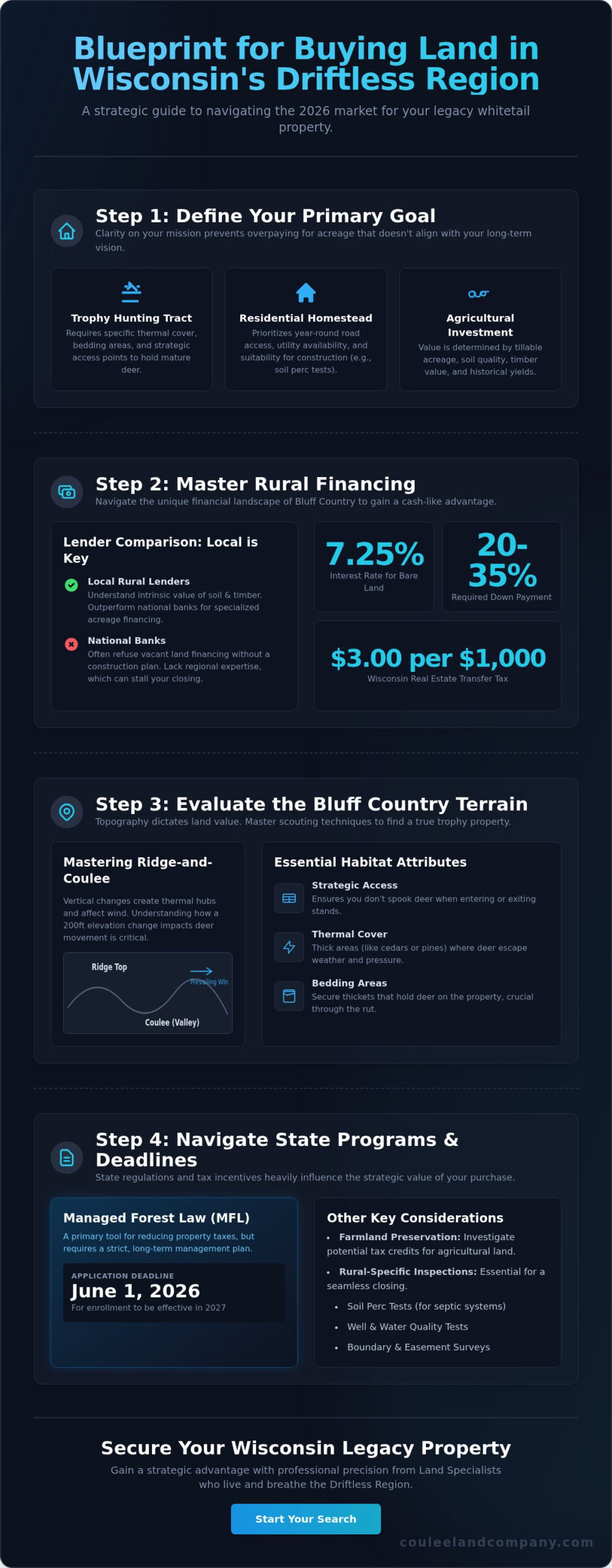
Successful land ownership begins long before you step foot on a timbered ridge. When buying rural land in western wisconsin, your first move isn’t finding a parcel; it’s defining your mission. A trophy hunting tract requires different thermal cover and access points than a residential homestead or a working agricultural investment. You must decide if you’re chasing world-class whitetails or seeking a quiet place for a country home. This clarity prevents you from overpaying for acreage that doesn’t align with your long-term goals.
To better understand the nuances of this process, watch this helpful video:
Identifying Your Primary Property Goal
Evaluating land requires a specialized lens. There’s a significant difference between recreational utility and trophy potential. A property might be great for hiking but lack the security cover needed to hold mature bucks through the rut. If you’re looking for a year-round residence, you’ll need to prioritize road maintenance and utility access, whereas a seasonal cabin can be more remote. You can browse our exclusive hunting properties to see how different tracts offer varied habitat profiles across the region.
Navigating Rural Financing Hurdles
National lenders often struggle with the unique complexities of the Driftless Area geography. They frequently refuse to finance vacant land without a construction plan already in place. Local rural banks and agricultural credit associations understand the intrinsic value of the soil and timber. In Wisconsin, land-only loans typically require a higher down payment, often 20% to 35%, compared to standard residential mortgages. This reality makes pre-approval vital for buying rural land in western wisconsin with any degree of speed.
Securing a pre-approval from a lender who understands the Bluff Country market gives you a cash-like advantage. Programs like WHEDA or specific agricultural credits can sometimes provide a bridge, but you must prepare for the appraisal gap. Rural appraisers look at 40-plus acres differently than city lots; they weigh timber value, tillable acreage, and historical yields to determine true market worth. Don’t let a standard bank’s lack of regional expertise stall your closing.
Bluff Country Specifics: Evaluating Terrain, Wildlife, and Local Regulations
The Driftless Region isn’t just a scenic backdrop; it’s a complex ecosystem where topography dictates every aspect of land value. When buying rural land in western wisconsin, you’re navigating a landscape of steep ridges and deep coulees that require specialized scouting. Unlike the flat tracts found elsewhere, these vertical changes create distinct thermal hubs and wind currents. Understanding how a 200 foot elevation change affects deer movement is the difference between a productive hunting site and an empty woods. Access points must be strategically placed to ensure you don’t blow out the entire valley when the wind shifts.
The Land Specialist Advantage
A general Realtor might understand square footage, but they rarely understand soil quality or bedding thickets. A Land Specialist provides “boots on the ground” evaluation that looks at the property’s biological carrying capacity. Experts like Mike Law and Bryan Lemke bring an insider’s perspective to the Buffalo County market, which remains the nation’s premier destination for record book whitetails. For a deeper look at why this specific county leads the charts, see our Buffalo County Wisconsin Deer Hunting: An Expert’s Guide.
Understanding Wisconsin Land Programs
State regulations and tax incentives heavily influence the strategic value of your purchase. The Managed Forest Law (MFL) program is a primary tool for reducing property taxes, but it comes with strict management plans. If you’re looking to enroll for the 2027 effective year, the application deadline is June 1, 2026. You should also investigate the Wisconsin Farmland Preservation Program to see if your potential tract qualifies for additional tax credits based on local zoning. These programs can significantly lower your annual carrying costs while improving the habitat.
Before you commit to a deed, check the Buffalo County community page to understand local zoning easements and water rights. If you’re eyeing a waterfront tract, remember that DNR regulations on wetlands and waterways are strictly enforced. Finding a property that balances these legal requirements with your personal goals is easier when you have a peer who knows the dirt as well as the paperwork. Reach out to our team to see how we can help you find your ideal Western Wisconsin property today.
Executing the Rural Purchase: Inspections, Appraisals, and Closing
Closing on a property in the Coulee Region involves technical hurdles that urban buyers rarely encounter. Buying rural land in western wisconsin requires a specialized Wisconsin Offer to Purchase that accounts for timber value, survey rights, and habitat contingencies. Unlike a standard city lot, the value of a 40-acre tract is driven by tillable soil quality and harvestable timber. To understand how these factors influence market value, savvy buyers consult UW-Extension Agricultural Land Pricing Data. This research ensures your offer reflects the actual productive capacity of the land rather than just emotional appeal.
The Inspection Checklist for Country Homes
When buying land with existing structures, a standard home inspection is just the baseline. You must test for nitrates and bacteria in private wells, which is a critical safety step for Wisconsin rural living. Septic system certifications are equally vital; a failed system can cost tens of thousands of dollars to replace in rocky Bluff Country soil. Soil “perc” tests are non-negotiable if you plan to build, as they determine if the land can even support a private onsite wastewater treatment system. For more home-specific advice, read our Country Homes for Sale in Western Wisconsin: Your 2026 Buyer’s Guide.
Finalizing Your Legacy Property
Legal access is the most critical hurdle in the Driftless Area. You must verify that the property isn’t “landlocked,” as relying on old handshake agreements for easements is a recipe for future litigation. A current boundary survey is essential, especially when steep terrain makes old plat maps unreliable. A plat of survey for rural residential small tracts typically costs between $1,000 and $2,000, but it’s a necessary investment to protect your boundaries. Start your professional search by visiting the Coulee Land Company Buyers page to connect with agents who understand these technical nuances.
The final step occurs at a rural title company. These professionals specialize in agricultural easements and complex land titles that urban firms might overlook. They ensure the $3.00 per $1,000 transfer tax is handled correctly and that all Managed Forest Law transitions are recorded properly. By following this roadmap, you move from a hopeful hunter to a confident landowner, securing a legacy in the finest whitetail territory in the nation.
Secure Your Legacy in the Driftless Region
Owning a world-class hunting tract or a secluded country home is the ultimate achievement for the dedicated outdoorsman. Mastering the nuances of specialized financing and the unique topography of the Driftless Area ensures your investment is sound. You’ve learned how to navigate Managed Forest Law deadlines and the critical importance of rural-specific inspections. Buying rural land in western wisconsin is a strategic process that rewards those who prioritize habitat quality and legal clarity over simple convenience. Don’t leave your rural investment to chance when the stakes involve your family’s heritage.
Our team brings decades of experience in Western Wisconsin land brokerage to every transaction. We are the undisputed specialists in Buffalo County “Bluff Country” properties, and our work is endorsed by high-profile industry figures across the hunting community. We understand the soil, the timber, and the record-breaking wildlife that make this region legendary. Ready to find your piece of Wisconsin? View our exclusive land and country home listings today. Your legacy in the coulees starts with a partner who knows the dirt as well as the paperwork.
Frequently Asked Questions
What is the Managed Forest Law (MFL) and how does it affect my property taxes?
The Managed Forest Law is a state incentive program that provides significant property tax relief in exchange for a commitment to sustainable forest management. To qualify, you must own at least 20 contiguous acres that are at least 80% productive forest. Enrollment for the 2027 tax year requires a submitted application by the June 1, 2026, deadline. It’s an excellent way to reduce annual carrying costs while improving timber quality and wildlife habitat.
How do I finance a land purchase if there is no house on the property?
Financing bare land requires specialized loan products from local agricultural lenders or credit unions rather than national mortgage companies. As of May 2026, representative interest rates for bare land loans are approximately 7.250% (7.410% APR) for a 3/1 ARM. Raw land often requires a 40% down payment and shorter amortization terms. Local lenders understand the value of the Driftless Area and are more comfortable with these rural assets.
Why is Buffalo County, WI considered the best place for hunting land?
Buffalo County is the nation’s premier trophy whitetail destination because its steep ridges and coulees provide perfect security cover for mature bucks. The county consistently leads the record books for Boone and Crockett entries due to its unique geography and local management culture. This high demand is reflected in the market, where prime listings in high-value areas can reach an average price of $51,807 per acre.
What is a “perc test” and why do I need one before buying land in Wisconsin?
A percolation test measures how quickly water drains through the soil to determine if the site can support a private septic system. This is a critical step when buying rural land in western wisconsin if you plan to build a cabin or country home. If the soil doesn’t “perc,” you may be forced to use an expensive holding tank or be unable to build altogether, which significantly impacts the property’s value.
Can I use a standard residential realtor to buy 100 acres of hunting land?
While any licensed agent can facilitate a sale, a residential realtor often lacks the “boots on the ground” expertise required for large tracts. A Land Specialist understands timber value, USDA soil maps, and how topography influences deer movement. You need an expert who knows the difference between a southern-facing thermal hub and a simple woodlot to ensure your investment meets your specific goals.
What are the common closing costs for land transactions in Wisconsin?
The primary closing cost is the Wisconsin Real Estate Transfer Tax, which is $3.00 per $1,000 of the property’s value and is typically paid by the seller. Buyers should expect to pay for a current plat of survey, which usually ranges from $1,000 to $2,000 for small rural tracts. Additional costs include title insurance, recording fees, and any specialized inspections for wells or septic systems requested during the contingency period.