
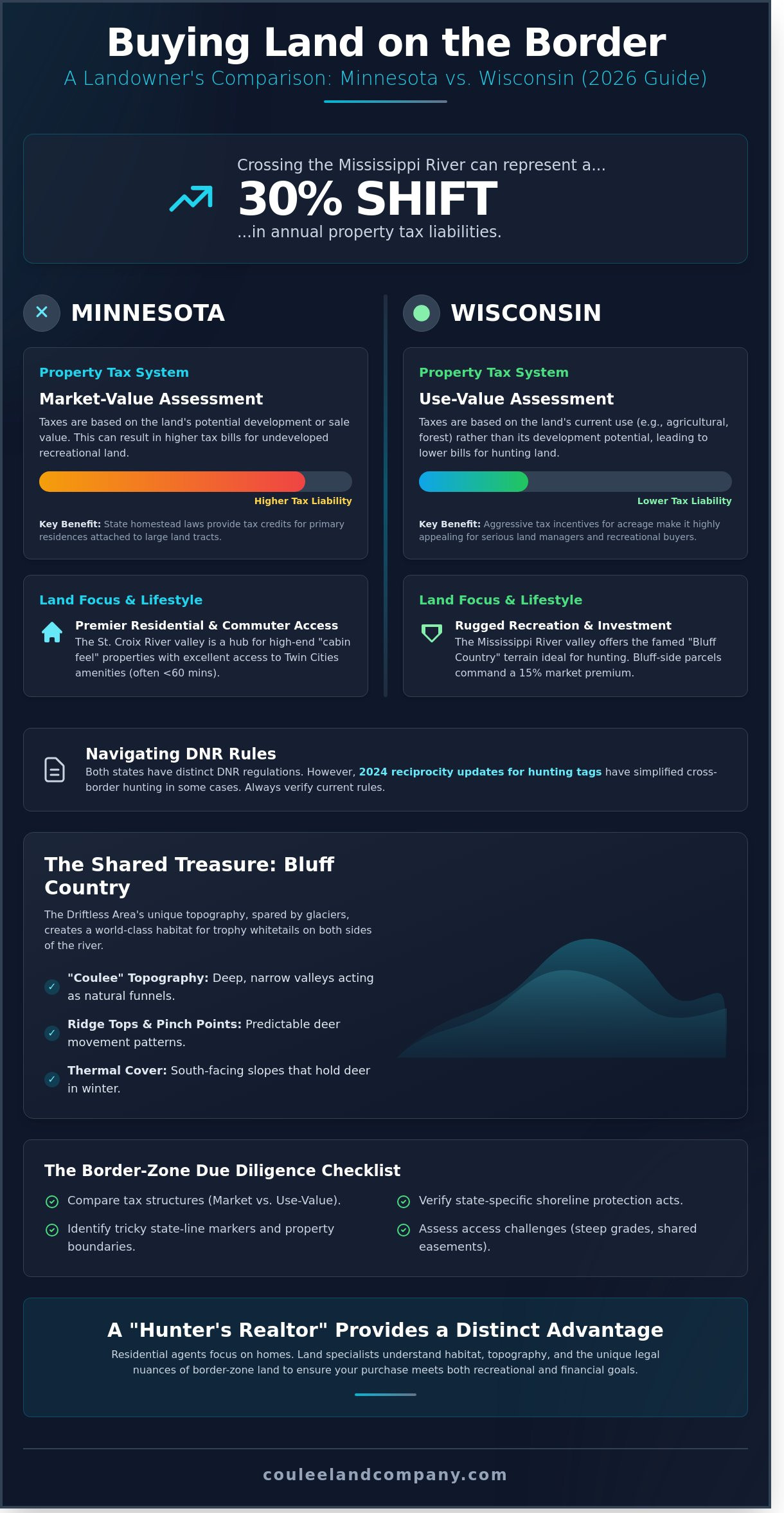
Crossing the Mississippi River takes less than five minutes, but for a property owner, that short bridge crossing can represent a 30% shift in annual tax liabilities or the difference between a successful harvest and a season on the sidelines. You already know that the driftless region holds a legendary reputation for producing world-class whitetails, yet the complexity of state-line regulations often turns a dream purchase into a logistical headache. Buying land on the minnesota wisconsin border requires a specialized strategy that accounts for two distinct sets of DNR rules and property codes.
It’s frustrating when the perfect ridge-top property is shrouded in confusion over zoning or tag availability. This 2026 guide simplifies your search by breaking down the critical differences between Gopher State and Badger State ownership. We’ll explore the 2024 reciprocity updates for hunting tags and the specific land-use standards enforced within the Mississippi River Corridor Critical Area. You’ll gain the expert insights needed to compare tax structures and regulations side by side, ensuring you secure a piece of Bluff Country that meets your recreational and financial goals.
Key Takeaways
- Compare the financial impact of Minnesota’s market-value assessments against Wisconsin’s use-value tax structures to ensure your investment aligns with your long-term budget.
- Learn how to read specialized Bluff Country maps to identify the ridge tops and thermal cover essential for holding trophy whitetail bucks on your property.
- Master the legal nuances of buying land on the minnesota wisconsin border, including state-specific shoreline protection acts and the pitfalls of tricky state-line markers.
- Identify the specific access challenges of river valley terrain, from managing steep grades to navigating complex shared easements in rugged terrain.
- Discover why a “hunter’s realtor” provides a distinct advantage over residential agents when evaluating the wildlife capabilities and habitat potential of border-zone land.
The Allure of the Minnesota-Wisconsin Border: Life in the River Valleys
For those considering buying land on the minnesota wisconsin border, the 2026 market presents a unique opportunity. This region isn’t just a political boundary; it’s a massive ecological corridor defined by the St. Croix and Mississippi River valleys. This “Bluff Country” terrain offers a rugged beauty that draws recreational buyers away from the flat, agricultural interiors of both states. The landscape here was shaped by glacial bypass, leaving behind the steep ridges and deep valleys that define the Driftless Area. This geological history creates a sanctuary for wildlife and a playground for outdoor enthusiasts who demand more than a standard woodlot.
Owning acreage here means you’re never more than 60 minutes from St. Paul or Minneapolis amenities. Border land typically retains value better than interior properties because of this dual-state accessibility and the finite supply of river-facing topography. Real estate data from the previous two years shows that bluff-side parcels in Western Wisconsin often command a 15% premium over similar acreage further inland. Buyers in 2026 are prioritizing “lifestyle properties” that offer both seclusion and high-speed internet connectivity, a combination readily available in these thriving river towns.
To better understand the strategies for securing these prime parcels, watch this expert breakdown:
The St. Croix vs. The Mississippi: Choosing Your River
The St. Croix River valley serves as the premier destination for residential luxury and high-end water recreation. It’s the go-to for buyers wanting a sophisticated “cabin feel” with a manageable commute to the Twin Cities. Conversely, the Mississippi River valley offers the rugged, vertical terrain known as the Driftless Area. This is where you find the famed “Bluff Country.” For 2026, the “sweet spot” counties for investment include Pierce and Pepin. These areas offer the same dramatic views as Buffalo County but often at a more accessible entry point for new investors looking to build equity.
The “Hunter’s Realtor” Perspective on Border Terrain
Whitetail deer don’t recognize state lines, but they definitely follow the land. As specialized land agents, we look for the “Coulee” topography, a French term for the deep, narrow valleys common in this region. These steep ridges create natural funnels that force trophy bucks into predictable movement patterns. This makes buying land on the minnesota wisconsin border a strategic move for serious hunters who understand the value of “pinch points.” If you want to dominate the record books, you need to own the dirt where the giants live. The combination of thermal cover on south-facing slopes and hidden bedding areas makes this terrain superior to flat timber. You can explore our current hunting properties to see how these topographic features create world-class opportunities.
Minnesota vs. Wisconsin: The Landowner’s Comparison
Deciding which side of the river to call home involves more than just a preference for a specific football team. When buying land on the minnesota wisconsin border, you’re choosing between two entirely different financial and regulatory ecosystems. Wisconsin often appeals to the serious land manager because of its aggressive tax incentives for acreage. Use-Value Assessment is the primary driver for low taxes on WI hunting land. This system ensures that property is taxed based on its agricultural or forest productivity rather than its potential development value, which can result in annual tax bills that are significantly lower than comparable parcels across the state line.
Minnesota approaches land valuation through a market value lens, though it offers relief for those living on-site. The state’s homestead laws provide credits for homes attached to large tracts of land, which is a major benefit for buyers planning a permanent move. For those focused on timber, Minnesota’s Sustainable Forest Incentive Act (SFIA) provides annual incentive payments to landowners who practice long-term forest management. This contrasts with Wisconsin’s Managed Forest Law (MFL), which focuses on reducing property taxes in exchange for a commitment to sustainable logging practices. Landowners should consult a Landowner’s Guide to the Lower St. Croix Riverway to understand how these conservation programs intersect with specific riverway regulations.
Property Taxes and Financial Incentives
Wisconsin is a powerhouse for agricultural and managed forest land tax breaks. Under the MFL program, landowners can see their property taxes drop to as low as $2.12 per acre for closed-enrollment lands in 2024. Minnesota doesn’t always match these rock-bottom rates for recreational land, but its SFIA payments, which reached $19.43 per acre in some categories for 2024, offer a different kind of financial return. Your primary residency status dictates your eligibility for these perks. Becoming a legal resident in the state where you own land often unlocks the best tax tiers and lowest permit costs.
Hunting Regulations and Landowner Tags
If your goal is a world-class buck, the choice often leans toward the Badger State. Wisconsin dominates the whitetail entries in the Boone and Crockett Record Book, with Buffalo County consistently ranking as the top producer of trophy whitetails in the nation. This reputation is built on superior genetics and a culture of land management that we live and breathe at Coulee Land Company.
You won’t find tag reciprocity here. Owning land on both sides of the border doesn’t give you a “free pass” to hunt both; you’ll need separate licenses and must follow the specific season dates for each state. Wisconsin offers specific landowner preference for turkey and antlerless deer tags in certain units, while Minnesota’s landowner tags are generally tied to specific management areas with high deer populations. If you’re looking for the best hunting properties
Evaluating Border-Zone Property: Topography, Access, and Habitat
Success in buying land on the minnesota wisconsin border starts with understanding the vertical nature of the Driftless Area. Bluff Country maps reveal more than just elevation; they show the movement patterns of world-class bucks. When you analyze a 2026 topographic map, focus on the ridge tops. These are the primary travel corridors for mature deer. Look for “saddles,” or low points on a ridge, where deer naturally cross between bedding and feeding areas. Thermal cover, typically found on south-facing slopes or in dense cedar thickets, provides the protection wildlife needs during harsh Upper Midwest winters. Water sources are equally critical. While the Mississippi River is the main artery, small spring-fed creeks in the valley floors are what keep deer on your property during the heat of late summer.
Access is the most common hurdle for new buyers. Steep grades often require professional excavation for driveway construction, and shared easements can complicate long-term privacy. You’ll also want to evaluate the soil. The river valley is famous for its silt-loam soils, which are ideal for high-protein food plots that can sustain a herd through December. Beyond the dirt, look at the canopy. Oak and walnut stands represent significant timber value. A mature walnut grove can act as a “savings account” for the property owner, appreciating in value while providing essential mast for wildlife.
Identifying Trophy Whitetail Potential
Bluff Country is the gold standard for mature buck habitat because the terrain provides natural sanctuary that’s difficult for hunters to penetrate. You aren’t just buying dirt; you’re buying a neighborhood. The management practices of your neighbors dictate whether a 140-inch buck reaches his full potential at five or six years old. Mike Law specializes in evaluating whitetail habitat, looking for the specific bedding-to-food transitions that define high-end hunting tracts. When buying land on the minnesota wisconsin border, finding a parcel with 40% or more thermal cover is a proven strategy for holding deer year-round.
Building Sites and Utilities in Rural Areas
Developing country homes near the river requires careful planning. Drilling a well through limestone bluff layers is a specialized task, and septic systems must meet strict county codes, especially near the watershed. Zoning restrictions often limit building to specific “buildable” acres to preserve the viewshed and prevent erosion on steep slopes. For a deeper look at residential opportunities, check out our guide on Country Homes for Sale in Western Wisconsin: Your 2026 Buyer’s Guide. Understanding these logistics early prevents costly surprises during the construction phase.
The Border-Zone Due Diligence Checklist
Buying land on the minnesota wisconsin border requires a dual-state mindset. You aren’t just buying dirt; you’re navigating two different sets of DNR rules, tax codes, and conservation priorities. Your first step involves verifying state-specific zoning and shoreline protection acts. Minnesota’s Shoreland Management Program often imposes stricter vegetation removal limits than Wisconsin’s NR 115. If you want a bluff-top cabin, these rules dictate exactly where you can clear a view for that sunset over the Mississippi. You don’t want to find out after the closing that your “million-dollar view” is blocked by protected timber you can’t touch.
Conducting a boundary survey is your second priority. Don’t trust a rusted fence post from 1950. State lines often follow the river’s center, but decades of flood events can shift the actual navigable channel. This creates “accretion” or “avulsion” issues that cloud a title. A professional survey ensures you own the acreage you’re paying for, especially in the rugged terrain of the Driftless Area where property lines can be notoriously difficult to track.
Analyze the tax status of the property immediately. Wisconsin’s Managed Forest Law (MFL) can slash property taxes by 80 percent, but it comes with a 25 or 50-year commitment. Minnesota’s Sustainable Forest Incentive Act (SFIA) offers annual incentive payments instead of direct tax credits. Both programs have strict 2026 enrollment deadlines and stiff penalties for early withdrawal. Finally, secure financing with a lender who understands rural land. Traditional big-box banks often struggle to value raw acreage or timber value. They see “vacant land” as a risk, while specialized lenders see it as an asset.
River-Specific Regulations to Watch
The Lower St. Croix Wild and Scenic River Act creates a federal layer of oversight that limits building height and color palettes to preserve the “scenic” nature of the valley. The Mississippi River Parkway Commission (MRPC) also manages scenic easements that might prevent you from building any permanent structures within a certain distance of the Great River Road. As of January 2026, Pierce and St. Croix counties have implemented revised shoreline setbacks. These updates require a 75-foot minimum from the ordinary high-water mark, but local “slope stability” zones can push this back 150 feet from the bluff edge to prevent erosion.
Financing and Closing the Deal
Traditional banks fail at land deals because they can’t easily appraise the “wildlife capability” of a 40-acre tract. We recommend working with specialized agricultural lenders who understand the value of trophy whitetail habitat and timber stands. When you reach the closing table, expect different costs on either side of the river. Wisconsin sellers typically pay a transfer fee of $3 per $1,000 of value. Minnesota uses a “Deed Tax” of $1.65 per $500. Understanding these nuances early prevents surprises during the final handshake. If you’re ready to find your piece of the bluff country, visit our buyers page to see our latest listings.
Why a Land Specialist is Essential for Border Purchases
A residential agent sells houses; a hunter’s realtor sells potential. When you’re buying land on the minnesota wisconsin border, you aren’t just looking for square footage or a modern kitchen. You’re analyzing topography, thermal cover, and historical buck movement. Coulee Land Company bridges the gap between these two distinct markets. We understand that a 40-acre parcel in Winona County, MN, carries different tax implications and hunting regulations than a similar plot in Buffalo County, WI. Our team spends over 250 days a year in the field. This boots-on-the-ground perspective ensures we see the details a satellite map misses.
Local knowledge matters in the Coulee region because the terrain is unforgiving and complex. You need an advocate who knows which side of the ridge holds the morning sun and which valleys act as natural funnels for trophy whitetails. We don’t just show properties; we evaluate the long-term land management potential of every acre. Our reputation is built on being authentic peers to our clients. We share your passion for the outdoors and your drive to own a piece of the legendary Bluff Country.
Expert Negotiation in a Niche Market
Pricing in the driftless area defies standard appraisal logic. Acreage isn’t the only metric that determines value. A 20-acre ridge top with established food plots and south-facing bedding often commands a higher premium than 60 acres of flat, open pasture. We help you understand these nuances so you don’t overpay for “dead” air. Identifying off-market opportunities is another way we provide value. Many of the best tracts never reach a public listing because we maintain deep ties with local landowners.
Bryan Lemke exemplifies the vision and diligence required to close these complex transactions. He looks past the current state of a property to see what it can become with the right management plan. In 2025, approximately 35% of our successful transactions involved properties that were secured through our private network before they hit the open market. This insider access is vital when buying land on the minnesota wisconsin border where competition for prime dirt is fierce.
Your Next Steps to Owning the Border
Don’t wait for the perfect property to appear on a generic real estate app. Start your search by defining your goals. Are you looking for a pure hunting play, or a legacy estate with a buildable site? Set up specific property alerts through our system to stay ahead of the crowd. If you’re focusing your search on the eastern side of the Mississippi, read our Hunting Land for Sale in Wisconsin: The Ultimate Buyer’s Guide for a deeper dive into state-specific strategies.
- Identify your primary use case (recreation, investment, or residential).
- Secure a pre-approval from a lender who understands unconventional land loans.
- Review recent sales data from 2024 and 2025 to understand current market velocity.
The market moves fast in the Coulee region. Buyers who have their “must-have” list finalized are the ones who secure the best tracts. Contact Coulee Land Company to find your border-zone property today and let our expertise guide you home.
Secure Your Legacy in the Mississippi River Valley
Navigating the 2026 market requires a sharp focus on the specific tax codes and land management regulations that define the border region. You must prioritize a property’s topography and habitat quality to ensure long-term value. Buying land on the minnesota wisconsin border represents a unique opportunity to own a piece of the driftless area, but it demands an expert eye for due diligence. Coulee Land Company stands as Wisconsin’s Land & Property Sales Specialists, offering the deep local insight needed to identify superior acreage.
Our team specializes in the famed bluff country, particularly in Buffalo County, which holds more Boone and Crockett whitetail entries than any other county in the United States. This proven track record is why we’re endorsed by leading outdoor television celebrities who demand the best in hunting ground. We understand the wildlife capabilities of these river valleys because we live and hunt here ourselves. You’re not just finding a plot of dirt; you’re securing a premier outdoor destination.
Find Your Border-Zone Property with the Land Specialists and take the first step toward owning the land you’ve always dreamed of. The ridges are calling, and it’s time to answer.
Frequently Asked Questions
Is land cheaper in Minnesota or Wisconsin on the border?
Wisconsin generally offers better value for recreational acreage, especially within the rugged terrain of the Driftless Area. According to the 2023 USDA Land Values report, Wisconsin’s average agricultural land value was $6,100 per acre, which is 11% lower than Minnesota’s $6,820 average. This price gap allows buyers to secure larger tracts of prime habitat for the same investment when buying land on the minnesota wisconsin border.
Can I hunt on my own land in Wisconsin if I live in Minnesota?
You can absolutely hunt your own land in Wisconsin as a Minnesota resident, though you’ll need to purchase non-resident licenses. The Wisconsin DNR requires non-residents to pay $160 for a 2024 gun deer license or $165 for an archer license. Owning the land doesn’t exempt you from these fees, but it does guarantee you a private place to manage your own trophy whitetail herd without public pressure.
What are the property tax differences for recreational land on the border?
Property tax rates are typically higher in Wisconsin, but specialized programs often make it the more affordable option for large tracts. While Wisconsin’s effective tax rate averages 1.61%, programs like the Managed Forest Law can reduce your liability significantly. In 2024, some landowners in the MFL program pay less than $1.00 per acre, a rate Minnesota’s standard 1.02% property tax rarely matches for recreational woods.
Do I need a special permit to build a home near the St. Croix River?
You’ll definitely need specialized permits if your property falls within the Lower St. Croix National Scenic Riverway. This area is protected by the Wild and Scenic Rivers Act of 1968, which limits development to preserve the river’s natural state. You must coordinate with the National Park Service and local county zoning offices to ensure your building site meets strict setback and visibility requirements before you break ground.
What is Managed Forest Law (MFL) and how does it affect my land purchase?
The Managed Forest Law is a landowner incentive program enacted in 1985 that encourages sustainable forestry on private lands. When buying land on the minnesota wisconsin border, you’ll find many parcels already enrolled in these 25 or 50-year contracts. It slashes your property taxes in exchange for following a professional forest management plan, which actually improves the wildlife capabilities of your hunting ground over the long term.
How much does a boundary survey cost for 40 acres on the border?
A professional boundary survey for a standard 40-acre parcel usually costs between $2,500 and $4,500. Prices vary based on the density of the brush and the steepness of the bluffs. The Wisconsin Society of Land Surveyors indicates that properties with missing corner monuments or difficult terrain require more field hours, which pushes the final cost toward the higher end of that price range.
Are there specific whitetail hunting advantages to the Wisconsin side?
Wisconsin’s side of the border is legendary for its trophy whitetail production and superior age structure. Buffalo County alone has recorded over 1,500 Boone and Crockett entries, which is more than any other county in North America. The combination of nutrient-rich soils and the steep topography of the Coulee Region creates natural sanctuaries that allow bucks to reach the 5.5 to 6.5-year age class required for world-class racks.
What should I look for in a land specialist when buying on the state line?
You need a specialist who is a “hunter’s realtor” with a deep understanding of land management and local topography. Don’t just hire a general agent; find someone who can identify oak wilt, interpret MFL maps, and evaluate a property’s wildlife potential. A true expert should have a portfolio of successful sales in the Driftless Area and understand the nuances of cross-border transactions for non-resident buyers.