
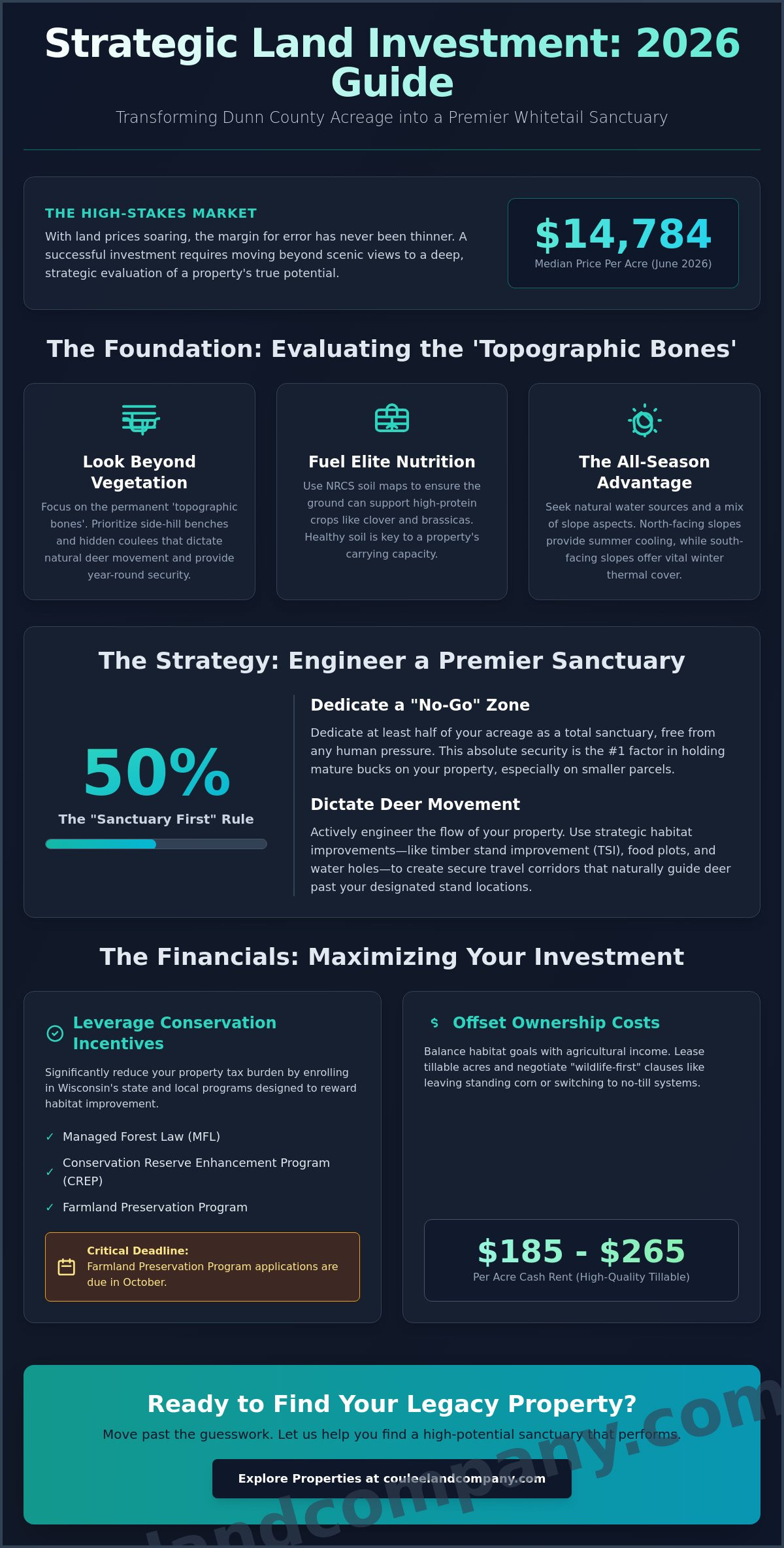
The most picturesque ridge in Western Wisconsin is often the least productive spot for a food plot. With the median price for hunting land hitting $14,784 per acre in June 2026, the margin for error has never been thinner. Buying land for wildlife habitat improvement Dunn County is no longer just about finding a scenic escape; it’s about identifying raw acreage with the specific topography and soil quality required to hold mature bucks year-round. You likely feel the pressure of these rising costs and the frustration of trying to decode complex state programs like MFL and CREP.
We’re here to help you move past the guesswork and secure a legacy property that performs. You’ll learn how to distinguish between a “pretty” woods and a high-potential sanctuary while utilizing expert land management tactics to reduce your property tax burden through local conservation incentives. This guide provides a strategic roadmap for 2026. We’ll cover everything from identifying ‘hidden bones’ in a parcel to meeting critical October application deadlines for the Farmland Preservation Program to ensure your investment thrives.
Key Takeaways
- Learn to look beyond existing vegetation to evaluate the “topographic bones” of a property, focusing on side-hill benches and hidden coulees that dictate natural deer movement.
- Master the 2026 strategy for buying land for wildlife habitat improvement Dunn County by identifying parcels with the specific soil quality and terrain needed for elite nutrition and security.
- Implement the “Sanctuary First” rule to transform your acreage into a premier whitetail destination where at least 50% of the land remains entirely free from human pressure.
- Discover how to engineer a strategic property flow that naturally guides mature bucks through high-security corridors and directly past your designated stand locations.
- Navigate complex Wisconsin tax incentives like the Managed Forest Law and CREP to significantly reduce your property tax burden while funding your long-term habitat goals.
Identifying High-Potential Habitat in Dunn County’s Terrain
Successful hunters often say you can’t kill what isn’t there. When you’re buying land for wildlife habitat improvement Dunn County, you aren’t just purchasing acreage; you’re investing in the “topographic bones” of the landscape. While vegetation can be changed with a chainsaw or a tractor in a single season, the underlying dirt and elevation are permanent. You must look for side-hill benches and hidden coulees that provide natural bedding security. These features are the foundation of habitat conservation principles, ensuring that mature bucks have the “un-huntable” sanctuaries they need to reach four or five years of age.
Evaluating a property also requires looking over the fence. You can build the best sanctuary in the Chippewa Valley, but if your neighbors aren’t practicing Quality Deer Management (QDM), your ceiling for success will be capped. Look for areas where neighboring landowners share a vision for trophy potential. This creates a massive, contiguous block of protected habitat that benefits every parcel within it. It’s much easier to hold deer when the surrounding culture supports the same goals you do.
To better understand how to visualize these improvements on a raw piece of ground, watch this helpful video:
The Role of Soil Health in Habitat Potential
Dunn County’s landscape is heavily influenced by the Chippewa Valley, resulting in a patchwork of soil productivity that can vary wildly from one ridge to the next. Before closing on a parcel, consult NRCS soil maps to verify if the ground can actually support high-protein crops like brassicas or clover. Carrying capacity in Western Wisconsin is the maximum number of healthy deer a specific parcel can support year-round without degrading the natural forage. If the soil is too acidic or sandy, your ability to increase that capacity will require significant, costly amendments.
Evaluating Water Access and Thermal Cover
Water is the great equalizer. A property with natural springs or a year-round creek holds a distinct advantage over one where you must rely on man-made water holes. Beyond hydration, you must evaluate the aspect of the slopes. North-facing slopes offer essential cooling during humid Wisconsin summers, while south-facing hillsides provide the thermal cover deer need to survive late-season bitter cold. A premier sanctuary offers both, allowing wildlife to transition seasonally without ever leaving your borders. You can find high-potential tracts by browsing our current hunting properties that feature these diverse terrain attributes.
Strategic Improvements for Trophy Whitetails and Beyond
Transformation begins the moment the deed is signed. When buying land for wildlife habitat improvement Dunn County, your success depends on how effectively you dictate movement across the terrain. You aren’t just letting nature take its course; you’re engineering a flow that forces deer to pass specific stand locations. This strategy requires a “Sanctuary First” approach. We recommend that at least 50% of your acreage remains a total “no-go” zone where a human footprint is never seen. This level of security is what keeps mature bucks on small parcels even when neighbors begin pressured hunting in November.
Many landowners balance their habitat goals with agricultural lease income to offset ownership costs. In 2026, high-quality tillable acres in the Chippewa Valley are commanding cash rents between $185 and $265 per acre. While this income is attractive, you should negotiate wildlife-first clauses, such as leaving several rows of standing corn or switching to a no-till system that preserves soil health. You can find more details on coordinating these efforts through the Dunn County Conservation Programs office. If you’re looking for land with the right mix of tillable and timber, our hunting properties listings often feature these high-potential tracts.
Timber Stand Improvement (TSI) for Bedding and Browse
Dunn County’s hardwoods often suffer from a lack of sunlight reaching the forest floor. Through hinge-cutting and selective harvests, you can create immediate security cover and stimulate the growth of native forbs. This early successional habitat provides critical fawning cover and high-quality browse. A “clean woods” with a park-like floor might look beautiful to a hiker, but it’s a biological desert for a trophy whitetail that requires thick, horizontal structure to feel safe.
Food Plot Architecture in the Bluff Country
In the steep bluffs of Western Wisconsin, large destination fields are often too exposed for daylight activity. We focus on transition zone food plots. These 1/4 acre “kill plots” bridge the gap between heavy bedding and major food sources, catching bucks in those final minutes of legal light. To ensure you can access these stands undetected, utilize a “Green Screen” strategy. Planting Egyptian wheat or switchgrass creates a visual barrier that hides your movement from the very deer you’re trying to hunt. For a deeper dive into these tactics, check out our guide on Wisconsin Land Management for Wildlife.
Navigating Dunn County Conservation Programs and Tax Incentives
Navigating the financial side of land ownership is just as critical as choosing the right pinch point. When you’re buying land for wildlife habitat improvement Dunn County, you need to leverage every state and federal incentive available to keep your carrying costs low. The Farmland Preservation Program is a powerhouse for tax relief in the Chippewa Valley. To stay ahead of the curve, ensure your applications are submitted to the DATCP by October 1, 2026. This secures your priority for 2026 tax credits and keeps your investment sustainable while you focus on the “Sanctuary First” rules discussed earlier. Our Buyers Guide for Hunting Land provides additional insights into navigating these complex acquisitions.
The MFL Advantage for Habitat Improvement
The Managed Forest Law (MFL) is perhaps the most effective tool for the serious habitat manager. By enrolling, you can slash your property taxes in exchange for following a sustainable forestry plan. We strongly advise choosing the “Closed” status. While it carries a slightly higher tax rate than the “Open” option, it preserves your absolute privacy and exclusive hunting rights. Work closely with a certified forester to ensure mandatory timber harvests aren’t just about board feet. You can time these selective cuts to create immediate horizontal cover and regenerative bedding areas that hold deer on your side of the fence during the rut.
CREP and Wildlife Damage Abatement
For parcels with water features or tillable edges, the Conservation Reserve Enhancement Program (CREP) offers a strategic advantage. It provides financial incentives to plant native grasses and stream-side buffers. These aren’t just environmental safeguards; they serve as elite nesting cover and vital visual screens that hide your movement from bedded deer. While the May 1, 2026, batching period for the current fiscal year has passed, planning your enrollment now ensures you’re ready for the next cycle. If your habitat improvements lead to a significant population surge, the Wildlife Damage Abatement and Claims Program in Dunn County provides a safety net. It helps mitigate the financial impact of crop loss, ensuring your passion for hunting doesn’t compromise the parcel’s agricultural viability.
Secure Your Legacy in the Chippewa Valley
Building a world-class sanctuary in Western Wisconsin requires a blend of grit, vision, and expert guidance. You now understand that the most valuable parcels are those with the right topographic bones, side-hill benches, and hidden coulees that naturally hold mature bucks. By applying the “Sanctuary First” rule and leveraging programs like MFL and CREP, you transform raw acreage into a premier destination while keeping your tax burden manageable. Success in the 2026 market isn’t just about the highest bid; it’s about the foresight to see what a property can become.
Buying land for wildlife habitat improvement Dunn County is a high-stakes investment that demands regional expertise. Our team at Coulee Land Company brings deep roots in Bluff Country QDM and a specialized brokerage focus on the Chippewa Valley. Expert agents like Mike Law and Bryan Lemke are ready to help you identify properties with the hidden potential others miss. We understand the land because we hunt the land.
Don’t settle for a scenic view when you can own a high-performance habitat. View our exclusive Dunn County hunting land listings today and start building your outdoors legacy. Your vision for the land starts right here.
Frequently Asked Questions
Is Dunn County better for wildlife habitat than Buffalo County?
Dunn County isn’t necessarily better than Buffalo County, but it offers a distinct strategic advantage for the savvy investor. While Buffalo County holds the crown for record-book entries, Dunn County provides nearly identical bluff-country topography and elite genetics at a more accessible entry point. The mix of the Chippewa Valley’s fertile river bottoms and rugged ridges creates a diverse habitat that can produce world-class whitetails without the extreme price premiums found further south.
Can I get government funding to plant food plots in Dunn County?
Direct government funding for traditional food plots is uncommon, but cost-sharing programs like EQIP and RCPP provide significant capital for the foundational work. These programs fund timber stand improvement, invasive species removal, and native prairie restoration. When buying land for wildlife habitat improvement Dunn County, these incentives allow you to allocate your personal budget toward high-end forage while the state helps fund the essential security cover and bedding areas.
How many acres do I need in Dunn County to effectively manage for trophy bucks?
You can effectively manage for trophy class whitetails on a parcel as small as 40 acres, provided the property features superior bones and minimal human intrusion. In the tight coulees of Dunn County, a small tract that utilizes 20 acres of high-security sanctuary can hold more mature deer than a larger, poorly designed property. Success on small acreage depends entirely on your ability to dictate movement and provide the one thing pressured bucks crave: total seclusion.
What is the average cost of hunting land in Dunn County in 2026?
The median price for hunting land in Dunn County reached $14,784 per acre as of June 2026. This valuation is a testament to the region’s status as a premier destination for outdoor enthusiasts. While high-quality tillable ground currently sells between $9,400 and $11,600 per acre, the market for recreational timber remains incredibly competitive. Buyers should expect to move quickly on parcels with established trail systems, water features, and proven trophy history.
Does the Managed Forest Law (MFL) allow me to restrict public access?
The Managed Forest Law program explicitly allows you to restrict public access by enrolling your land under “Closed” status. Choosing this option ensures that you retain exclusive hunting rights while still benefiting from a substantial reduction in property taxes. For those buying land for wildlife habitat improvement Dunn County, the Closed MFL status is the preferred choice because it allows for the strict scent and noise control necessary to cultivate a true trophy sanctuary.