
Owning the wrong side of the state line can cost you $2,500 more in annual property taxes on a 40-acre parcel without adding a single inch to a buck’s rack. You already know that the Bluff Country region spanning the Mississippi River is the premier destination for world-class whitetails, but choosing the right zip code is where many hunters stumble. When you look to buy land in Minnesota border Wisconsin, you are stepping into a market where one mile can change your hunting season and your bank account balance. It’s frustrating to find a perfect ridge top only to realize the access is blocked by an ancient easement or the tax bill eats your habitat budget.
We’ve spent years analyzing the 150-mile stretch of border country to ensure our clients don’t just buy dirt; they invest in legacies. This guide breaks down the critical 2024 tax assessments and cross-border hunting regulations that dictate where your dollar works hardest. You’ll learn how to identify properties with genuine Boone and Crockett potential and how to avoid the common pitfalls of poor access. From the steep bluffs of Winona County to the rolling hardwoods across the river, we are providing the roadmap to a seamless purchase and a superior piece of land.
Key Takeaways
- Discover why the St. Croix and Mississippi River Valleys represent the most sought-after acreage in the Midwest for serious land investors and outdoor enthusiasts.
- Compare property tax structures and hunting regulations to make an informed financial decision before you buy land in Minnesota border Wisconsin.
- Learn to identify “trophy” terrain by evaluating the thermal cover and south-facing slopes that hold world-class whitetails in the Driftless region.
- Avoid costly pitfalls by mastering essential due diligence, from securing legal access to evaluating utility potential for your future country home.
- Understand why partnering with a specialized “Hunter’s Realtor” is the key to accurately assessing the true wildlife capabilities and long-term value of a property.
The Minnesota-Wisconsin Border Region: A Land Buyer’s Paradise
The border between Minnesota and Wisconsin represents a unique convergence of topography and opportunity. Defined by the winding St. Croix and Mississippi River Valleys, this region offers a diverse landscape that transitions from rolling prairies to rugged limestone bluffs. For those looking to buy land in Minnesota border Wisconsin, the primary draw is the ability to secure a legacy property that remains within a 45-minute drive of the Twin Cities metro area. This geographic “sweet spot” ensures that land values remain resilient even during market fluctuations, as demand for rural retreats near urban centers continues to climb.
Much of this region lies within the Driftless Area, a 24,000-square-mile zone that escaped the flattening effects of the last glacial period. This lack of “drift” resulted in a landscape of deep valleys and high ridges that are unlike anything else in the Midwest. These features create natural funnels and bedding areas for wildlife, making it the most coveted territory for serious land managers. Owning a piece of the “Border Country” means owning a slice of geological history that provides both seclusion and world-class recreational potential.
The Appeal of the St. Croix River Valley
Beyond the legendary hunting, the St. Croix River Valley provides a lifestyle defined by water. Residents enjoy premier boating, smallmouth bass fishing, and miles of hiking trails within state parks like Interstate Park. Towns such as New Richmond have seen a 12% increase in residential land interest over the last 18 months. Investors prioritize “commutable acreage” here because it allows for a primary residence on 20 or 40 acres while maintaining a professional career in the city. It’s a high-growth investment category that combines daily utility with weekend recreation.
Western Wisconsin’s Bluff Country Explained
The topography of Western Wisconsin creates distinct micro-habitats where south-facing slopes provide thermal cover and valley floors offer rich agricultural soils. Buffalo County stands as the epicenter of this region; it consistently produces more record-book whitetails than any other county in the United States. This biological productivity drives the market for every country home and recreational tract in the area. Buyers aren’t just purchasing dirt; they’re investing in a proven ecosystem that supports trophy-class wildlife and breathtaking views that command premium prices. The natural beauty of these bluffs acts as a permanent hedge against depreciation, ensuring these properties remain the crown jewels of the Midwest.
Minnesota vs. Wisconsin: Comparing the Border States
Deciding to buy land in Minnesota border Wisconsin involves more than just picking a scenic spot on a map. The state line represents a significant shift in how your investment is taxed, managed, and hunted. While both states share the rugged beauty of the Driftless Area, the financial and regulatory frameworks differ enough to impact your long term satisfaction and bottom line.
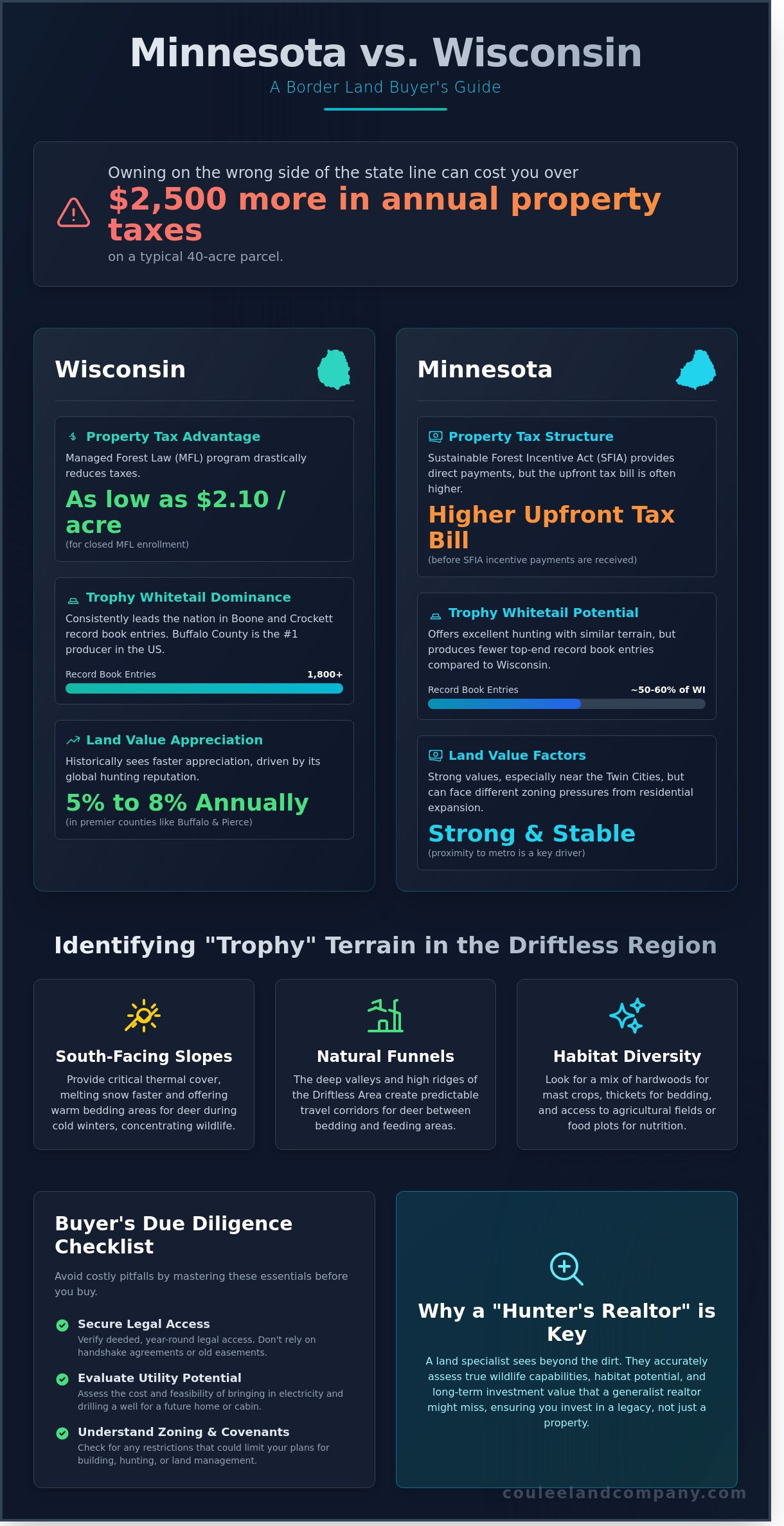
Resale values in this region remain high, but Wisconsin’s side of the river often sees faster appreciation. Land values in Buffalo and Pierce counties have historically climbed at a rate of 5 to 8 percent annually, driven largely by the global reputation of their hunting grounds. Minnesota’s border counties, such as Winona and Houston, offer similar terrain but often face different zoning pressures from expanding residential hubs. Understanding these nuances ensures you don’t face unexpected hurdles after closing.
Tax Implications for Landowners
Property tax structures vary wildly across the river. Wisconsin’s Managed Forest Law (MFL) is a powerhouse for recreational landowners. By enrolling in a 25 or 50 year forest management plan, owners can reduce their property taxes to as little as $2.10 per acre for closed land. This represents a massive saving compared to standard recreational rates. Minnesota offers the Sustainable Forest Incentive Act (SFIA), which provides direct incentive payments to landowners rather than a tax reduction. While SFIA is beneficial, the upfront tax bill in Minnesota often stays higher than an MFL-enrolled parcel in Wisconsin. Agricultural exemptions in both states can lower carrying costs by 60 percent or more, provided the land meets specific production or rental income requirements.
The Trophy Whitetail Factor
Wisconsin consistently dominates the Boone and Crockett record books. The state has recorded over 1,800 entries, nearly double the total of its neighbors in some categories. This isn’t an accident of nature; it’s the result of specific management policies and a culture dedicated to letting bucks reach maturity. Wisconsin’s earn-a-buck history and current antlerless tag availability keep the herd healthy and the age structure balanced. If you are looking for world class genetics, you can browse our hunting properties to see how specific tracts are managed for top tier wildlife capabilities. Minnesota’s season structure and tag allocations are also productive, but the sheer volume of record-breaking deer in the Wisconsin Bluff Country remains the primary draw for serious hunters. When you buy land in Minnesota border Wisconsin, you are choosing between two distinct management philosophies that will define your autumns for years to come.
Evaluating Terrain: What Makes a “Trophy” Property?
You aren’t just buying acreage; you’re investing in habitat architecture. A trophy property isn’t defined by its total size but by its ability to hold and grow mature whitetails. We differentiate high-value acreage from “un-huntable” land by analyzing how deer utilize specific terrain features. High-value land features dense thermal cover, particularly on south-facing slopes in the Driftless region where cedar thickets and brushy sidehills provide essential winter bedding. These micro-climates can be 10 degrees warmer than valley floors during a January freeze.
Water is the lifeblood of any premier tract. We evaluate every creek and spring to ensure consistent hydration for local herds. If you’re looking for waterfront properties, remember that a secluded spring hole or a hidden oxbow is often more valuable for hunting than a wide, navigable river. Soil quality is equally vital. We look for Class II or III silt loams that support high-protein food plots. When you look to buy land in Minnesota border Wisconsin, prioritizing soil health ensures your land offers more than just aesthetic beauty; it provides the nutrients needed for antler growth.
Bluff Country Topography 101
The vertical nature of the border country creates unique advantages for the savvy hunter. Points, hollows, and benches act as natural funnels that dictate deer movement. A well-structured 40-acre bluff property often hunts like an 80-acre flat parcel because the elevation changes create more usable surface area and naturally separate bedding from feeding zones. Access strategy is the make-or-break factor for these tracts. Top-access properties allow you to slip into stands without blowing your scent into the valley, while bottom-access tracts require careful management of evening thermals to avoid spooking game.
Timber and Agriculture Synergy
The most sought-after “Signature” properties offer a precise balance of tillable land and hardwood timber. This synergy creates the edge habitat where trophy bucks thrive. Properties with established wildlife corridors and a 30/70 split of agriculture to timber often see the highest ROI. While you’re looking to buy land in Minnesota border Wisconsin, keep Buffalo County in mind as the gold standard for terrain diversity. Its mix of mast-producing oak ridges and fertile valley floors sets the benchmark for what a high-performance hunting property should achieve.
Essential Due Diligence for Border Land Buyers
Buying land in the border country requires a sharp eye for detail. You aren’t just buying dirt; you’re acquiring a legal entity with specific rights and restrictions. The process to buy land in Minnesota border Wisconsin requires localized expertise because the excitement of the hunt can sometimes overshadow technical realities. Skipping due diligence can turn a dream property into a legal or financial burden.
- Legal Access: Never assume a visible driveway equals legal access. Landlocked parcels are common in rural areas, and gaining a new easement can cost upwards of $10,000 in legal fees and compensation.
- Utility Costs: Bringing power to a remote site is expensive. Current estimates for trenching or pole installation often range from $12 to $30 per linear foot depending on the rocky terrain of the bluff country.
- Easements: Programs like CREP or NRCS easements provide conservation benefits but can strictly limit your ability to build structures or clear timber for food plots.
- Soil and Perc Tests: These are non-negotiable. If the soil doesn’t drain, you can’t install a septic system for a country home, effectively stalling your building plans.
- Boundary Surveys: Old fence lines are notorious for being 5 to 15 feet off the actual property line. A modern survey using GPS technology is the only way to secure your boundaries and avoid neighbor disputes.
Legal and Access Considerations
Handshake agreements for crossing a neighbor’s field don’t hold up in court when that neighbor sells their land. You need a recorded easement documented at the county level to ensure permanent access. Rural townships also have varying road maintenance standards. Some “minimum maintenance” roads might not see a snowplow for 48 hours after a heavy snow. It’s vital to have a buyer’s specialist who knows how to dig into courthouse records and verify these details before you make an offer.
Future-Proofing Your Investment
Think about the property’s long-term flexibility. Check local zoning laws to see if the land can be subdivided in the future. A 40-acre parcel might be restricted to a single building site by local ordinance. You should also identify “red flag” neighbors, such as industrial operations or large-scale feedlots, that could affect your quiet enjoyment or resale value. When you buy land in Minnesota border Wisconsin, understanding these factors now prevents surprises ten years down the road.
Why a Land Specialist is Your Best Asset
A standard residential realtor understands square footage and school districts, but they rarely know how to read the “bones” of a property. When you decide to buy land in Minnesota border Wisconsin, you need a hunter’s realtor who recognizes the difference between a scenic view and a strategic bedding area. Coulee Land Company operates as Wisconsin’s land and property sales specialists because we live the lifestyle we sell. Our team evaluates a parcel based on its wildlife capabilities, looking for the specific habitat features that draw in trophy whitetail bucks from the surrounding Bluff Country.
The border region is exceptionally competitive, with prime tracts often moving before they hit the open market. We maintain deep roots in these local communities, giving our clients access to off-market knowledge that a typical agent simply won’t have. Whether it is a 40-acre honey hole or a 500-acre legacy estate, we provide the pragmatic, results-oriented guidance required to secure high-quality ground in a tight market.
Expert Eyes on the Ground
Our vetting process goes far beyond a simple walk-through. We utilize high-resolution topography maps to identify natural pinch points and thermal cover. When a property shows potential, we often deploy trail camera data to verify the quality of the local herd. Specialists like Mike Law and Bryan Lemke bring decades of boots-on-the-ground experience to every consultation. They don’t just show you where the property lines are; they provide a comprehensive land management vision that includes food plot placement and timber stand improvement strategies to maximize your investment’s hunting potential.
Closing the Deal in a Competitive Market
Prime acreage in the Mississippi River valley doesn’t stay available for long. In the current market, 75% of top-tier listings receive multiple offers within the first week. We implement aggressive bidding strategies to ensure our clients stand out without overpaying for the dirt. Navigating a purchase where state lines are involved requires specific expertise in local tax laws and conservation easements. We handle the technical complexities so you can focus on the hunt. If you are ready to buy land in Minnesota border Wisconsin, work with a team that understands the dirt as well as you do. View our exclusive border-country listings and start your journey today.
Secure Your Legacy in the Bluff Country
Owning a piece of the legendary border country is more than a real estate transaction; it’s a commitment to a lifestyle defined by the hunt. You’ve seen how state-specific regulations and tax structures impact your investment. You know that identifying trophy terrain requires an eye for land management that goes beyond simple acreage. When you decide to buy land in Minnesota border Wisconsin, you’re entering a market where precision is everything.
Coulee Land Company brings a specialized edge to your search. We’ve facilitated over $100M in regional land sales and earned the trust of top outdoor TV personalities who demand the best. Our team specializes in the same Buffalo County ground that consistently dominates the Boone and Crockett record books. We don’t just list properties; we understand the wildlife capabilities of every ridge and valley. Don’t leave your legacy to chance. Partner with the experts who live and breathe this land every day.
Browse Our Exclusive Border Country Hunting & Land Listings
Your dream property is waiting in the bluffs, and we’re ready to help you claim it.
Frequently Asked Questions
Is it cheaper to buy land in Minnesota or Wisconsin?
Wisconsin land often provides better long-term value due to lower agricultural property tax assessments. While Minnesota’s average property tax rate sits at 1.02 percent, Wisconsin’s Use Value Assessment can lower taxes on tillable land to less than 10 dollars per acre. Buyers find that the initial purchase price per acre in Western Wisconsin stays competitive with Eastern Minnesota while offering superior bluff topography.
Can I hunt on my own land in Wisconsin if I live in Minnesota?
You can hunt your own land in Wisconsin as a Minnesota resident, but you must purchase a non-resident license. For the 2024 season, a non-resident archer or gun deer license costs 160 dollars. Wisconsin law doesn’t grant resident-rate licenses to landowners who primary residence is out of state. You must follow all Wisconsin Department of Natural Resources regulations for the specific unit where your land sits.
What is the “Driftless Area” and why is it popular for land buyers?
The Driftless Area is a 24,000 square mile region that escaped the flattening effects of the last ice age. This creates a rugged landscape of 400 foot bluffs and deep coulees that provide elite wildlife habitat. Hunters prize this region because the steep terrain creates natural pinch points. These geographic funnels make it easier to predict trophy buck movement compared to the flat farm country found elsewhere.
Do I need a special loan to buy vacant land on the border?
You generally need a specific land or recreational loan because standard residential mortgages don’t cover unimproved property. Lenders like Compeer Financial typically require a 20 percent to 35 percent down payment for vacant acreage. If you want to buy land in Minnesota border Wisconsin territory, local agricultural banks offer the best terms. These institutions understand the intrinsic value of timber and tillable soil in the Coulee Region.
How much land do I need for a viable hunting property?
A 40 acre parcel is the standard minimum for a viable, self-contained hunting property in the bluff country. This size allows you to dedicate 5 acres to high-protein food plots while keeping 35 acres as a sanctuary. Properties smaller than 20 acres are difficult to manage because deer movement is heavily influenced by neighbors. On 40 acres, you can control the wind and entry points to avoid spooking mature bucks.
What are the property tax benefits of agricultural land in Wisconsin?
Wisconsin’s Use Value Assessment law, established in 1995, taxes farmland based on its agricultural productivity rather than its fair market value. This shift often results in a 90 percent reduction in property taxes for qualified acres. To benefit from this, your land must be devoted primarily to farming, which includes crop production or livestock grazing. This program makes owning large tracts of land much more affordable for the average sportsman.
How do I check if a property has trophy whitetail potential?
You should review the Boone and Crockett Club records for the specific county and analyze the neighborhood’s timber density. Buffalo County, Wisconsin, currently leads the nation with over 1,000 record book entries. Look for properties with diverse thermal cover and north-facing slopes. A property’s potential is confirmed by the presence of mature white oaks and a lack of public road visibility into the primary bedding areas.
Are there specific building restrictions for homes near the Mississippi River?
The Mississippi River Corridor Critical Area (MRCCA) program enforces strict rules for any structure built within 1,000 feet of the river. These regulations often require a 100 foot setback from the bluffline to prevent erosion and preserve the scenic view. Before you buy land in Minnesota border Wisconsin along the riverway, check the local county’s 2023 zoning map. Height limits for new homes are often capped at 35 feet to maintain the river’s natural aesthetic.