
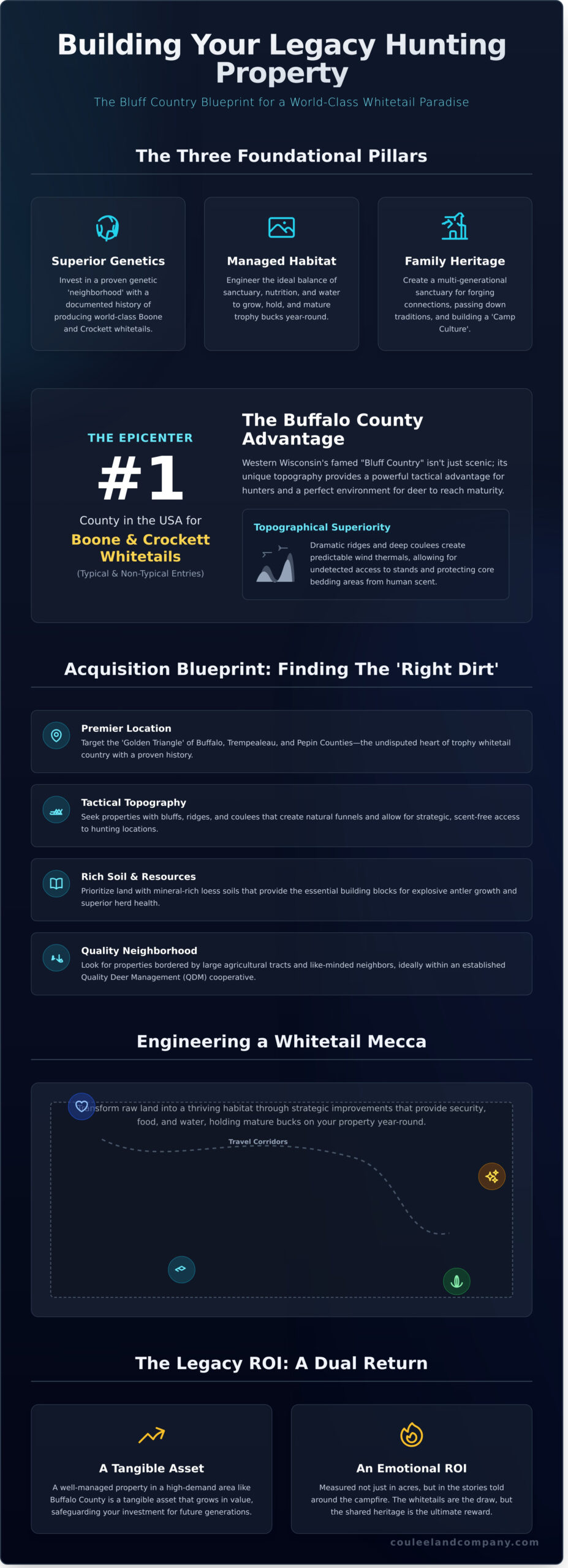
Since record-keeping began in 1830, a single 900-square-mile area in Western Wisconsin has produced more Boone and Crockett whitetails than any other county on the planet. This isn’t an accident; it’s the result of superior genetics and topography found only in the famed Bluff Country. It’s a dream many hunters share: owning a piece of ground that consistently produces mature, world-class deer. Yet, the path is filled with uncertainty. You worry about investing your life’s savings into a parcel with poor genetics or difficult neighbors, and the sheer scope of land management can feel overwhelming.
This guide removes that uncertainty. We’re going to show you the proven, step-by-step process for building a legacy hunting property that not only puts 160-inch bucks in front of your stand but also becomes a cherished family retreat and a tangible asset that grows in value for generations. From identifying premier dirt with unmatched wildlife capabilities to implementing a strategic management plan, we’ll cover the critical decisions that transform a simple plot of land into a true whitetail paradise.
Key Takeaways
- Pinpoint premier hunting tracts by understanding the unique topographical advantages of Western Wisconsin’s famed “Bluff Country.”
- Implement expert-level habitat engineering techniques to create the ideal balance of sanctuary and nutrition required to grow and hold trophy whitetails.
- Go beyond a simple hunting lease by mastering the core principles of building a legacy hunting property founded on superior genetics, sustainable habitat, and family heritage.
- Discover the essential legal structures and succession planning strategies needed to safeguard your investment for generations to come.
What Defines a Legacy Hunting Property in 2026?
Any tract of timber with a deer stand can be called a ‘hunting spot’. It’s a place for a season, a temporary escape. A legacy estate is an entirely different class of asset. It’s a multi-generational institution, an outdoor sanctuary engineered for the future. By 2026, the distinction has never been clearer, resting on three foundational pillars: superior whitetail genetics, a meticulously managed habitat, and a deep-rooted family heritage. This isn’t just about owning land; it’s about becoming a steward of a living, breathing inheritance.
The process of building a legacy hunting property requires a long-term vision that transcends simply buying acreage. It demands a commitment to enhancing the land’s biological potential. This begins with location. There’s a reason Western Wisconsin’s Bluff Country, particularly Buffalo County, dominates the Boone and Crockett whitetail entries with more typical and non-typical records than any other county in the United States. It’s the epicenter of trophy genetics, a place where the impossible becomes a realistic goal for the diligent landowner.
The Biological Foundation: Genetics and Soil
The world-record whitetails of the Mississippi River valley are not an accident; they are a product of the earth itself. The region’s mineral-rich loess soils provide the essential building blocks for explosive antler growth and superior herd health. Serious investors don’t just buy a property; they buy into a proven genetic ‘neighborhood’. We identify specific travel corridors and watersheds that have a documented history of producing 170-class bucks, ensuring your investment is grounded in a biological certainty that can’t be replicated elsewhere.
Of course, elite genetics are only half of the equation. A property’s true potential is unlocked through active stewardship grounded in proven wildlife management principles. This involves strategic timber stand improvement (TSI), establishing perennial food sources, and creating a sanctuary that holds mature bucks year-round. The most successful legacy properties exist within a network of like-minded neighbors. Joining an established Quality Deer Management (QDM) cooperative is a powerful force multiplier, creating a landscape-level effect where the entire neighborhood works together to allow bucks to reach their maximum age and genetic potential.
The Emotional ROI: More Than Just a Title Deed
Beyond the biological assets, a true legacy property delivers an unparalleled emotional return on investment. It becomes the family’s sanctuary, a private refuge from the noise of urban centers where connections are forged and traditions are passed down. This ‘Camp Culture’ of shared stories, successful hunts, and land improvement projects is the glue that binds generations. It’s the real reason you invest in a legacy property. The whitetails are the draw, but the heritage is the reward.
A legacy property is measured not in acres, but in the stories told around the fire for decades.
Acquisition Strategy: Finding the ‘Right Dirt’ in the Right Place
The dream of building a legacy hunting property begins with a single, critical decision: the dirt itself. Not all acreage is created equal, and the long-term success of your vision hinges on acquiring a parcel with the right genetics, topography, and location. In Wisconsin, serious land buyers inevitably turn their attention to the famed ‘Golden Triangle’ of Buffalo, Trempealeau, and Pepin Counties, the undisputed heart of trophy whitetail country.
The defining feature of this region is its ‘Bluff Country’ topography. These dramatic ridges and deep coulees aren’t just scenic; they are a tactical advantage. The elevation changes create predictable thermals and wind currents, allowing a savvy hunter to access stands without spreading human scent into core bedding areas. A property’s access is paramount. You must be able to enter and exit your best spots undetected, regardless of wind direction. A parcel with limited, poorly placed access points will forever be a challenge, constantly educating the very deer you hope to mature. Equally important is the neighborhood. A property surrounded by large agricultural fields and managed timber tracts has infinitely more potential than one bordering encroaching residential development.
The Buffalo County Advantage
There’s a reason Buffalo County consistently dominates the Boone and Crockett record books, holding the #1 spot in the nation for typical and non-typical whitetail entries. It’s a potent combination of superior genetics, rich agricultural food sources, and a landscape that allows bucks to reach maturity. This reputation creates intense demand and a scarcity factor that drives land values. The key is identifying ‘sleeper’ properties, parcels that may lack established food plots or trail systems but possess the fundamental bone structure: good access, diverse habitat, and a solid neighborhood. These are the canvases upon which a true legacy can be painted.
Partnering with a Hunter’s Realtor
Evaluating these complex variables is a task for a specialist, not a general residential agent. A standard realtor sees square footage and road frontage; a hunter’s realtor sees pinch points, bedding cover, and the wildlife capabilities of a property. They understand that the true value lies in how the land hunts. This specialized expertise is critical, especially in a tight-knit community where the best properties often trade hands before ever hitting the public market. Access to these off-market ‘pocket listings’ is a massive advantage for any serious buyer.
The process of acquiring the land is just the first step in a multi-generational journey. True legacy is built not only on soil but on a solid plan for the future. Thinking through the details of succession planning for family land ensures that the stewardship and enjoyment of the property continue for decades to come. To secure the right foundation for your family’s future, you need an expert who lives and breathes this world. The specialists at Coulee Land, like Mike Law or Bryan Lemke, possess the deep, on-the-ground knowledge required to evaluate a property’s true potential and guide you through this monumental purchase. Before you begin your search, exploring properties they’ve represented can provide a clear benchmark for what a premier hunting parcel truly looks like.
Engineering the Habitat: From Raw Land to Whitetail Mecca
Acquiring the deed is just the beginning. The true art of building a legacy hunting property lies in sculpting the land itself, transforming a passive piece of real estate into a dynamic, high-performance whitetail habitat. This isn’t about luck; it’s about strategic engineering. The blueprint for this transformation is the proven 70/30 rule: dedicate roughly 70% of your acreage to thick, impenetrable sanctuary and bedding cover, with the remaining 30% devoted to high-protein food sources. This balance is the engine that drives deer movement and holds mature bucks on your side of the fence.
Creating that 70% sanctuary foundation starts with aggressive Timber Stand Improvement (TSI). In the famed Bluff Country of Wisconsin, this often means hinge-cutting less desirable trees like box elder and ironwood to create a dense jungle of horizontal cover at deer level. This strategy not only provides immediate security but also promotes a flush of new browse. Couple this with strategic water hole placement. In our ridge-top environments, a few well-placed 100-gallon stock tanks tucked just inside the timber off a food plot can be the single most effective way to dictate daytime movement patterns. Finally, you must manage the ‘Neighbor Factor.’ A 50-foot-wide screen of fast-growing Norway Spruce or White Pine planted along property lines creates a visual barrier that gives deer the confidence to stay on your property and minimizes pressure from adjacent lands.
Year-Round Nutrition and Food Plot Design
A successful food plot strategy provides year-round nutrition, not just a green field for opening day. Move beyond standard clover and embrace a multi-crop system. Design small, 1/4 to 1/2-acre ‘kill plots’ with quiet access, tucked into the timber for morning hunts. These should be planted with appealing greens. Contrast these with larger, 2- to 5-acre ‘destination plots’ planted with high-energy late-season crops like corn, soybeans, and brassicas. These destination sources are crucial for post-rut recovery and winter survival, ensuring a healthier herd for the next generation. None of this works without a proper soil test from your county extension office; it’s the single most important step for maximizing tonnage and attraction.
Sanctuary Creation and Pressure Management
The heart of your property must be a designated ‘Zero-Entry’ sanctuary. This core area, comprising up to 50% of your total acreage, must be completely off-limits to human intrusion from February through the end of hunting season. This is where mature bucks feel secure. Access is everything. A low-impact road system should follow the contours of the land, using topography to shield your entry and exit from feeding and bedding areas. Modern technology allows you to monitor these sanctuaries without contamination; cellular trail cameras send intel directly to your phone, providing critical data on buck movement without ever leaving a scent trail.
This meticulous habitat work is the physical foundation of your family’s outdoor heritage. Ensuring it passes seamlessly to the next generation requires an equally deliberate legal framework, a process detailed in resources like the University of Florida’s guide to the 8 Steps to Succession Planning. By combining intelligent habitat design with a thoughtful succession plan, you are not just buying land; you are truly building a legacy hunting property that will produce memories and trophy whitetails for decades to come.
The Human Legacy: Successional Planning and Infrastructure
A true legacy property is more than just soil and timber; it’s a living entity defined by the people who cherish it and the structures that support their traditions. The physical and legal framework you establish today dictates the viability of your vision for generations. The process of building a legacy hunting property requires forethought that extends far beyond food plots and stand locations. It demands a bulletproof plan for succession and infrastructure built to endure decades of Wisconsin winters.
The single most effective tool for ensuring a smooth transition is a Family Land LLC. This legal structure provides three critical advantages: it protects the land from being partitioned and sold off by a single heir, it shields family members from personal liability, and it creates a clear, enforceable operating agreement. This agreement becomes the constitution for the property, outlining ownership shares, responsibilities, and buy-out clauses, preventing the disputes that have fractured too many family lands.
Succession: Passing Down the Ethics
Your greatest legacy isn’t the land itself, but the stewardship ethic you instill in the next generation. This means mentoring goes beyond the hunt; it involves teaching the hard work of habitat management and the profound respect for wildlife. We advise clients to create a detailed ‘Property Bible’—a binder or digital file logging harvest history, buck age structures, food plot rotations, and timber stand improvement tasks. This living document connects future generations to the property’s history and management journey.
Infrastructure for Longevity
Long-term success requires permanent, high-quality infrastructure. Forget flimsy pop-up blinds. Invest in elevated, insulated box blinds like those from Redneck or build your own with treated lumber and LP SmartSide, ensuring they will last 20 years or more. A well-planned property needs a dedicated outbuilding, typically a 40×60 foot pole barn with a concrete floor, to house a compact tractor, implements, and ATVs, and to serve as a clean, efficient space for processing game. Many of the finest country homes with acreage already include these essential outbuildings, providing a powerful head start.
To preserve the quality of the hunt itself, you must establish ‘The Rules of the Land.’ This written code, agreed upon by all family members, is non-negotiable for maintaining a healthy deer herd. It should clearly define:
- Harvest Criteria: Set a minimum buck age for harvest, such as 4.5 years old, to allow your herd to reach its genetic potential.
- Doe Management: Establish an annual doe harvest quota based on camera surveys and herd health observations.
- Guest Policies: Outline clear rules for when and how guests can hunt to manage pressure on the property.
Finally, smart financial management is key. Wisconsin’s Managed Forest Law (MFL) is an essential program for owners of 10 or more wooded acres. By committing to a 25- or 50-year sustainable forest management plan, you can reduce your property taxes by over 80%. This significant savings frees up capital for habitat projects and ensures the property remains financially sustainable for your children and grandchildren. Planning this human legacy is just as critical as managing the habitat. Let our team of land specialists help you find the perfect foundation for your family’s legacy.
Why Coulee Land Company is Your Legacy Partner
Transforming a raw piece of land into a multi-generational hunting paradise is a monumental task. It demands more than just capital; it requires intimate knowledge of the terrain, a deep understanding of wildlife biology, and a network of proven experts. For over two decades, Coulee Land Company has been the definitive authority in Western Wisconsin’s Bluff Country, specializing in the very signature properties that become family legacies. We aren’t just real estate agents. We are the Hunter’s Realtor, a team of dedicated outdoorsmen who walk, scout, and hunt the same hallowed ground we represent. This firsthand experience gives us an unparalleled perspective on a property’s true potential.
Our approach is fundamentally different. We don’t see acres; we see ecosystems. We evaluate properties based on their intrinsic wildlife capabilities, from the quality of the thermal cover in a steep coulee to the strategic value of a south-facing slope for late-season food plots. This boots-on-the-ground diligence is why we have a proven track record of matching visionary owners with their perfect properties. The journey of building a legacy hunting property is complex, and our role extends far beyond the closing table. We provide our clients with exclusive access to our elite network of habitat consultants, land managers, and QDMA-certified professionals who can help execute a world-class land management plan.
Our Exclusive Buyer Representation
We guide our buyers through every stage of the acquisition process, from navigating the complexities of recreational land financing to conducting custom property searches based on your specific biological and topographical goals. Whether you’re seeking a property with established trophy whitetail genetics in Buffalo County or land with diverse waterfowl potential, we find it. Every listing that carries our name has undergone a rigorous vetting process, earning the ‘Coulee Land Co’ seal of approval and ensuring it meets our superior standards.
Start Your Legacy Today
The opportunity to secure a premier land holding has never been more compelling. With recreational land values in the Driftless Area projected to appreciate by 8-10% through 2026, the window for acquiring a foundational property at today’s values is narrowing. We invite you to explore our current portfolio of elite hunting properties, each one selected for its unique potential to become a cornerstone of your family’s future. The process of building a legacy hunting property begins with a single, decisive step.
Don’t let this opportunity pass. The traditions, the hunts, and the memories are all within reach. Your legacy is waiting in the bluffs of Western Wisconsin.
Forge Your Hunting Heritage on Hallowed Ground
The path to a multi-generational hunting paradise rests on three pillars: acquiring the right dirt, engineering a superior habitat for trophy whitetails, and establishing a human legacy through careful planning. The journey of building a legacy hunting property is complex, but the rewards are immeasurable. It’s a commitment that echoes for generations.
You don’t have to walk this path alone. The team at Coulee Land Company are not just agents; we are active land managers and dedicated hunters who understand this land’s unique potential. We specialize in Buffalo County, the #1 trophy whitetail county in the world, and our expertise is trusted and endorsed by leading hosts on outdoor television. We know what it takes because we live it every season.
The dream of passing down stories from the deer stand is within your reach. Begin your search for a legacy property with Coulee Land Company today.
Your story is waiting to be written on the bluffs of Western Wisconsin.
Frequently Asked Questions
What is the minimum acreage required for a legacy hunting property?
There’s no official minimum, but 40 acres is a widely accepted starting point for quality deer management in Wisconsin. The key isn’t just size; it’s the layout and habitat. A well-managed 40-acre parcel with diverse cover, food, and water can hunt much larger than a featureless 80-acre tract. Our specialists analyze a property’s unique topography and resources to determine its true potential, ensuring it can support your hunting goals for generations to come.
How does Buffalo County, WI compare to other top whitetail states like Iowa or Kansas?
Buffalo County, Wisconsin, stands alone by dominating the Boone and Crockett record book with more typical and non-typical whitetail entries than any other county in North America. While Iowa and Kansas produce incredible bucks, Buffalo County’s unique “Bluff Country” topography creates natural funnels and superior genetics. This combination provides a consistent opportunity to harvest world-class whitetails that few other regions can match, making it the undisputed king of trophy deer hunting.
Can I generate income from my hunting land through timber or agriculture?
Absolutely. Generating income is a key strategy for offsetting ownership costs. Well-managed timber harvests can yield substantial returns; for example, a select cut of mature oak can generate $1,500 to $3,000 per acre every 10-15 years. Leasing tillable acreage to local farmers for corn or soybeans can also provide steady annual income, often ranging from $150 to $250 per acre in Western Wisconsin, depending on soil quality and access.
What are the biggest mistakes people make when buying land for deer hunting?
The single biggest mistake is underestimating the importance of legal access; a landlocked parcel is nearly worthless. Another critical error is ignoring hunting pressure on neighboring properties, as it directly impacts your herd’s stability. When building a legacy hunting property, buyers often focus only on the land itself and overlook these external factors. Failing to verify easements and understand the local hunting culture can derail your entire vision before it even begins.
How do Wisconsin’s Managed Forest Law (MFL) programs affect property taxes?
Wisconsin’s Managed Forest Law (MFL) program can dramatically reduce your property taxes by over 80% in many cases. To qualify, you need at least 20 contiguous acres, with 80% being productive forest, and you must follow a written forest management plan. In exchange for this significant tax break, a portion of the enrolled land may need to be open to public access for hunting and fishing, though options exist for closed MFL plans.
Is it better to buy a ‘turnkey’ property or raw land that needs development?
A turnkey property offers immediate hunting gratification with established food plots, trail systems, and often a cabin. It’s a faster path to your dream. However, raw land provides a blank canvas for building a legacy hunting property precisely to your vision. While it requires more initial investment in time and capital for habitat improvement, the long-term satisfaction of crafting every detail yourself is unmatched. Your choice depends on your timeline, budget, and desire for customization.
How do I handle trespassers or boundary disputes on my legacy property?
The first step is prevention: invest in a certified survey and clearly mark your boundaries with durable signage every 100 yards, as per Wisconsin state recommendations. If trespassing occurs, document everything with trail cameras and immediately contact your local DNR warden, not the sheriff. For boundary disputes, open communication with your neighbor is the best initial approach. If that fails, a real estate attorney is your next call to protect your investment.
What should I look for in a land specialist realtor?
Look for a true “hunter’s realtor,” not just an agent who sells land. They must have a proven track record, with dozens of successful recreational land transactions in your target area. A superior land specialist understands wildlife biology, habitat management, and programs like MFL. They should be able to walk a property with you and identify its potential beyond the listing sheet, offering a vision for transforming it into a premier hunting destination.