
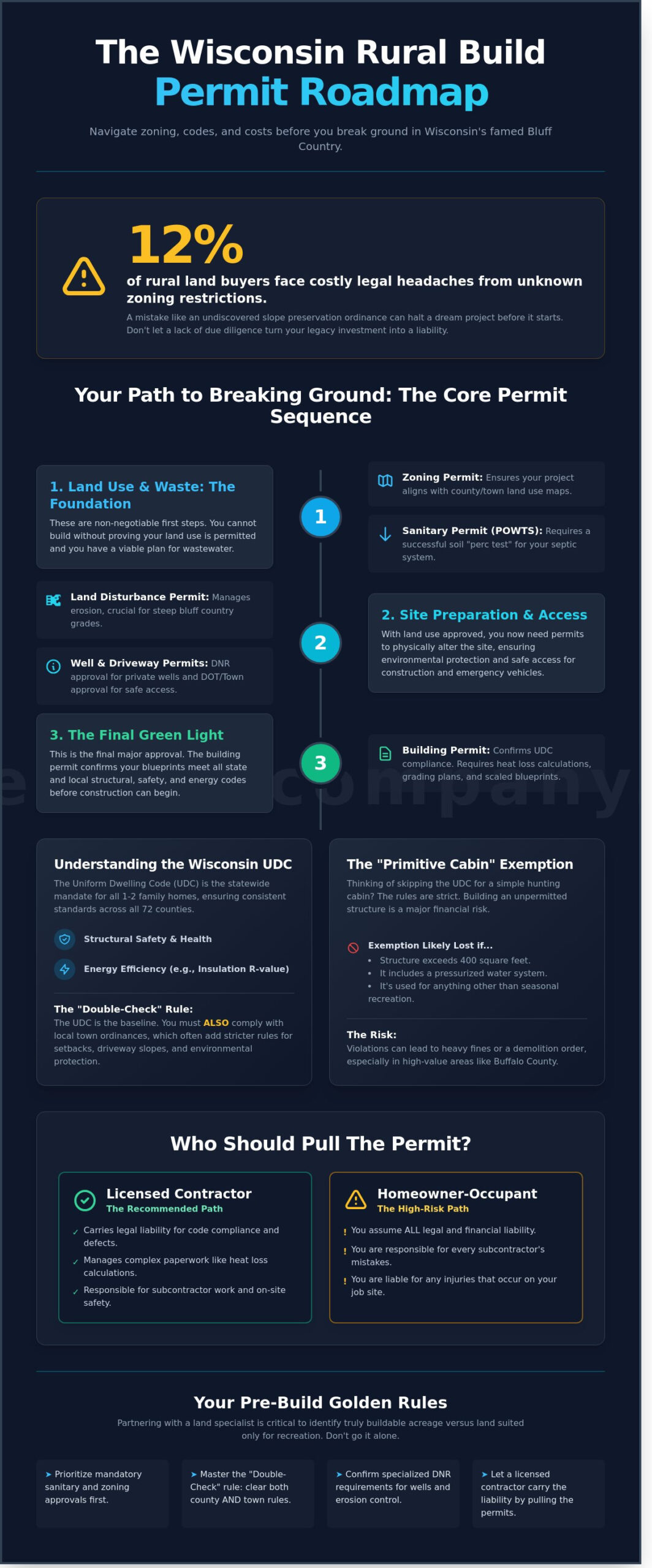
Last October, a buyer in Trempealeau County discovered that his dream ridge-top site was restricted by a 50 foot slope preservation ordinance he didn’t know existed. It’s a costly mistake that turns a legacy investment into a legal headache. Securing the correct building a home in rural wisconsin permits requires more than just a handshake at the local town hall. It demands an expert understanding of how Wisconsin’s unique topography and regulatory layers interact before you ever break ground. This scenario happens to approximately 12% of buyers who fail to verify zoning before closing.
You likely already believe that owning a piece of Bluff Country is the ultimate goal for any serious outdoorsman, but the maze of town versus county jurisdiction can feel like a thicket you can’t escape. We’re here to clear that path so you can focus on the hunt, not the paperwork. This guide provides a definitive roadmap for your permit timeline and breaks down the 2024 costs for essential site prep like septic systems and well drilling. You’ll learn exactly how to vet a property’s wildlife capabilities while ensuring it supports the structural vision for your legacy home.
Key Takeaways
- Understand how the Wisconsin Uniform Dwelling Code (UDC) establishes the essential safety and energy standards for any rural one- or two-family build.
- Navigate the complex landscape of building a home in rural wisconsin permits by prioritizing mandatory sanitary and zoning approvals for your raw land.
- Master the “Double-Check” rule to ensure your project clears both county-level zoning and specific town ordinances before construction begins.
- Identify the specialized DNR requirements for private wells and erosion control plans necessary to protect the rugged terrain of Western Wisconsin.
- Learn why partnering with a land specialist is critical for identifying truly buildable acreage versus land suited only for recreational use in the famed Bluff Country.
Understanding the Wisconsin Uniform Dwelling Code (UDC) for Rural Projects
Building your dream retreat in the heart of the Driftless Area starts long before the first shovel hits the dirt. Every residential project in the state must adhere to the Wisconsin Uniform Dwelling Code (UDC). This statewide mandate, established under Wisconsin Statute Chapter 101, provides a consistent framework for the construction of one- and two-family dwellings. It standardizes safety, health, and energy efficiency across all 72 counties, ensuring that a home built on a steep ridge in Buffalo County meets the same structural integrity as one in a suburban subdivision.
The UDC eliminates the confusion of varying regional construction standards. It dictates everything from the R-value of your insulation to the specific load-bearing requirements for floor joists. However, rural Wisconsin townships often layer their own “local-only” ordinances on top of these state rules. These local regulations frequently focus on land use and environmental impact, such as driveway slope requirements for fire trucks or specific setbacks from trout streams. The municipal building inspector acts as the primary authority in this process. This official reviews your plans, issues the building permit, and conducts mandatory inspections at critical stages, including foundation, framing, and final occupancy.
Does the UDC Apply to My Hunting Cabin?
Many land buyers in Western Wisconsin want to know if they can bypass the UDC for a seasonal basecamp. Wisconsin Statute 101.61(1) provides a “primitive cabin” exemption, but the criteria are strict. Generally, a primitive cabin is a structure used for seasonal recreation that lacks permanent plumbing and sometimes electricity. If your cabin exceeds 400 square feet or includes a pressurized water system, it likely loses its exempt status. In premier regions like Buffalo County, where property values are driven by elite land management, building an unpermitted structure is a significant financial risk. It can lead to heavy fines or even an order to raze the building if it doesn’t meet safety codes during a future sale.
Who Should Pull the Building Permit?
Securing building a home in rural wisconsin permits is a task usually best left to the experts. We recommend having a licensed Wisconsin Dwelling Contractor pull the permits. When a contractor signs the permit, they carry the legal liability for code compliance and structural defects. If you pull the permit as a homeowner-occupant, you’re acting as your own general contractor. This means you’re personally responsible for every sub-contractor’s mistakes and any injuries that occur on-site. The documentation required for a successful application is extensive. You must provide professional heat loss calculations, a detailed grading plan to manage runoff, and scaled blueprints that satisfy the inspector’s scrutiny before any timber is cut.
The Core Permits Required for Building a Home in Rural Wisconsin
Securing the right building a home in rural wisconsin permits is the mandatory first step in turning a rugged piece of bluff country into your permanent base camp. You cannot simply break ground because you own the deed. You need a sequence of approvals that start with the soil and end with the shingles. This process protects the integrity of the land and ensures your home stands the test of time in Wisconsin’s varied climate.
- Zoning Permits: These ensure your planned land use aligns with county and town maps. In places like Buffalo County, zoning protects the agricultural heritage of the region.
- Sanitary Permits: This is the non-negotiable first step for any site without municipal sewer access.
- Land Disturbance Permits: These manage erosion on the steep grades of Western Wisconsin. If you’re building on a signature bluff, you must prove you won’t wash the hillside away.
- Building Permits: This is your final green light for structural construction, confirming your blueprints meet the Wisconsin Uniform Dwelling Code.
- Driveway and Access Permits: You need permission from the DOT for state highways or the local town board for township roads to ensure safe entry and exit points.
Sanitary Permits and POWTS Requirements
In rural Wisconsin, your waste management relies on a Private Onsite Wastewater Treatment System, or POWTS. Before a building permit is even considered, you must conduct a soil percolation test. This “perc test” measures how quickly water moves through your soil, which ultimately determines your buildable area. If the soil is too shallow or dense, a standard system won’t work. By 2026, experts project costs for a standard septic system to range between $7,500 and $11,000. If your land requires a mound system due to high groundwater or bedrock, expect those costs to climb between $18,000 and $26,000.
Navigating County Zoning and Land Use
Understanding the difference between Agricultural and Residential zoning is vital. Building on “Ag” land often requires a rezone or a conditional use permit, especially if the parcel is part of the Farmland Preservation Program. Setback requirements are equally strict. Most counties require a minimum 50-foot setback from the centerline of a road and 15 to 25 feet from side property lines. Special considerations for waterfront properties are even more rigorous, often requiring a 75-foot setback from the ordinary high-water mark to protect the shoreline. If you are still searching for the perfect ridge-top site, our team can help you find hunting properties that are already perk-tested and ready for your vision.
Navigating Jurisdiction: County Zoning vs. Town Ordinances
Securing building a home in rural wisconsin permits requires a two-front strategy. You cannot assume that a green light from the county office guarantees a permit from the local town board. This is known as the Double-Check Rule. While the county handles broad categories like sanitary systems and shoreland protection, the town often controls the specific details of how land is used within its borders. If the town board hasn’t adopted the county’s zoning map, they might have their own unique set of ordinances that are even more restrictive.
Approximately 40% of Wisconsin townships remain unzoned for general land use. This offers a high degree of freedom for hunters looking to build off-grid cabins or custom homesteads. However, unzoned does not mean unregulated. Every property in the state is still subject to county-wide shoreland and floodplain ordinances. Before you sign a purchase agreement, call the County Zoning Department to pull the permit history. You want to see if any previous owners were denied a septic permit or if there are outstanding violations from a failed 2022 driveway installation.
Shoreland Zoning is a critical factor for any property within 1,000 feet of the Mississippi River or 300 feet of a navigable stream. These rules limit impervious surfaces like roofs and paved driveways to protect water quality. If your dream build sits on a bluff overlooking the river, you’ll likely face a 75-foot setback from the ordinary high-water mark. This can significantly shrink your available building envelope, making it vital to verify these boundaries before you hire an architect.
The Role of the Town Board in Rural Builds
Local relationships are the backbone of rural Wisconsin. You will likely need to attend a monthly town board meeting to secure a driveway permit. These boards focus on local infrastructure and aesthetics. Many towns in the Coulee Region now enforce minimum square footage requirements, often starting at 950 to 1,200 square feet, to prevent the proliferation of structures that might impact property values. In Bluff Country, conservation easements are common. These legal agreements might restrict building to specific envelopes to preserve the skyline and natural habitat for neighbors and wildlife alike.
Buffalo County Specific Building Regulations
Building in Buffalo County involves navigating some of the most dramatic topography in the Midwest. Ridge-top builds offer incredible views but require engineered erosion control plans because of the 30% slopes common in the area. Conversely, valley-bottom sites often require a professional survey to prove the structure sits above the 100-year flood elevation. Because this county is a premier destination for trophy whitetails, land use permissions often factor in wildlife management. Local officials understand that fragmenting large timber tracts with poorly placed homes can damage the hunting quality that defines the region. Getting your building a home in rural wisconsin permits in this area means proving your project won’t disrupt the natural corridors that produce Boone and Crockett class bucks.
Site Preparation Permits: Wells, Driveways, and Erosion Control
Before you break ground, you need a logical roadmap. Managing the logistics of building a home in rural wisconsin permits requires a specific sequence to avoid costly delays. You can’t drill a well if the heavy drill rig can’t reach the site, and you can’t build a driveway without a culvert permit from the township or county. The sequence of operations usually begins with the driveway access, followed by the well and septic installation, and finally the erosion control measures that protect the site during construction.
Securing Your Water Source
The Wisconsin Department of Natural Resources (DNR) regulates all private well construction under code NR 812. In the Coulee Region, the rugged geology dictates your costs. You’ll likely drill through layers of sandstone or limestone to reach a clean aquifer. Average well depths in Western Wisconsin range from 150 to 450 feet, with total costs for drilling, casing, and pump installation typically running between $15,000 and $28,000. Mandatory setbacks are non-negotiable. Your well must sit at least 50 feet from your septic tank and 100 feet from the soil absorption area. Water quality tests for bacteria, nitrates, and arsenic are required before the system is cleared for residential use.
Building on the Bluffs: Erosion and Grading
Western Wisconsin’s topography is world class for hunting and views, but steep terrain brings regulatory hurdles. If your building site has a slope exceeding 12 percent, most counties require a formal erosion control plan. This plan ensures that runoff doesn’t damage the watershed or neighboring properties. Standard requirements include the installation of silt fences and the use of erosion mats on disturbed banks. How you manage this runoff directly impacts your country home foundation design. Ridge-top builds often require specialized drainage systems or engineered retaining walls to ensure long term stability. Silt fences must stay in place until 70 percent of the vegetation is re-established on the site.
Driveway permits are the final piece of the site prep puzzle. Local municipalities require specific culvert diameters, often 15 to 18 inches, to prevent road washouts during heavy rains. These access points must be engineered to support the weight of a 75,000 pound fire truck. If your driveway is longer than 500 feet, you may also need to include turnarounds for emergency vehicles to satisfy local safety ordinances. Getting these permits in order ensures your project stays on schedule and avoids stop-work orders from the county inspector.
Contact our land specialists today to start your search.
From Raw Land to Dream Home: Planning with Coulee Land Company
Most real estate agents focus on bedroom counts and kitchen finishes. At Coulee Land Company, we look at the dirt first. You aren’t just buying a lot; you’re investing in a legacy. A general realtor might show you a beautiful 40-acre ridge in Buffalo County, but they often lack the technical expertise to determine if that ridge can actually support a septic system. We act as your land specialists, distinguishing between land that is strictly recreational and acreage that is truly buildable. Our team understands that Western Wisconsin’s “Bluff Country” presents unique challenges, from steep 30% slopes to specific soil compositions that dictate your construction timeline.
We help buyers navigate the complexities of land utility before any dirt is moved. Professional land management is vital during the construction phase to ensure your presence doesn’t disrupt the local ecosystem. While your home is being built, we provide guidance on maintaining the integrity of the habitat, ensuring the trophy whitetails that make this region famous stay on your property. Our goal is to ensure that your move to the country enhances the land rather than depleting its natural value.
Vetting Your Property Before the Closing Date
The “Contingency Period” is the most critical window in any land transaction. We recommend a 45 to 60-day study period to run exhaustive checks. This includes conducting perc tests to ensure the soil can handle a private onsite wastewater treatment system and verifying that the zoning allows for your specific residential plans. Consulting with experts like Mike Law gives you an edge because he understands how local topography affects utility placement. We’ve seen buyers fall into the “unbuildable” trap, where they purchase land only to find a 75-foot wetland setback or a restrictive easement makes their dream home impossible. We perform the due diligence early to prevent these costly permit denials.
The Hunter’s Dream: Building for Legacy
Building a home on your hunting property requires a strategic approach that most residential builders don’t consider. Smart home placement is about more than just the view. It’s about minimizing human pressure. If you place your driveway through a primary bedding area or upwind of a major food plot, you’ve compromised your hunting before you’ve even moved in. We help you site your home to keep your scent and noise away from the most productive parts of the land.
- Strategic Access: We plan driveways that follow natural terrain features to hide movement.
- Habitat Preservation: We identify building envelopes that leave the best timber and water sources untouched.
- Permit Efficiency: Understanding that building a home in rural wisconsin permits can take 3 to 6 months, we help you start the paperwork while finalizing your land management strategy.
Owning a piece of the driftless region is a rare opportunity. When you are building a home in rural wisconsin permits and regulations shouldn’t stand in your way. Contact Coulee Land Company today to find a build site that honors the land and your passion for the outdoors.
Secure Your Legacy in Wisconsin’s Bluff Country
Navigating the complex landscape of building a home in rural wisconsin permits requires a firm grasp of the Wisconsin Uniform Dwelling Code and specific county zoning laws. Success starts with mastering site preparation, from well placement to erosion control. Buffalo County leads the nation with more Boone and Crockett whitetail entries than any other region, making it the premier destination for hunters who demand superior land. You’ll need to coordinate with both town and county officials to ensure every ordinance is met before breaking ground.
Coulee Land Company stands as the undisputed authority in Western Wisconsin real estate. We’re endorsed by top outdoor television personalities who value our specialized knowledge in trophy whitetail management and rural development. Our team understands that raw land is an investment in your future; we provide the pragmatic expertise needed to navigate the regulatory hurdles of the Coulee Region. We’ve helped over 500 buyers secure property in these legendary hills, ensuring their builds are compliant and their hunting ground is optimized for maximum wildlife potential.
Find Your Perfect Buildable Acreage with Coulee Land Company
The path to your rural retreat is clear when you’re working with the hunters’ realtor. Let’s get to work on your Wisconsin dream today.
Frequently Asked Questions
How much do building permits cost for a home in rural Wisconsin?
Building permit costs for a 2,000 square foot home typically range from $800 to $2,500 depending on your specific county and township. You’ll pay a base fee for the Wisconsin Uniform Building Permit seal, which costs $100 as of 2024. Additional charges are calculated based on square footage, plumbing fixtures, and electrical circuits. Buffalo County, for example, uses a detailed fee schedule that scales with the complexity of your residential project.
Can I live in an RV on my land while building my house?
Most rural counties allow you to live in an RV for a maximum of 12 months provided you have an active building permit and a functioning septic system. Obtaining building a home in rural wisconsin permits requires you to follow local ordinances, like those in Trempealeau County, which strictly prohibit long term camping without a temporary use permit. You can’t simply park and stay; you must have a legal plan for waste disposal and water access.
How long does it take to get a building permit in Wisconsin?
Expect the approval process to take between 14 and 45 days from the date you submit a complete application. During the busy spring construction season, wait times often increase by 2 weeks because county inspectors are handling higher volumes of site visits. If your property is in a managed forest or a flood plain, the review process might take 60 days as multiple departments must sign off on your site plan.
What is a ‘perc test’ and why do I need one before building?
A perc test is a soil evaluation that measures how quickly water drains through your ground to determine what type of septic system you need. Wisconsin Administrative Code SPS 383 requires this test before any residential building permit is issued. A licensed soil tester will charge you between $450 and $900 for this service. The results dictate whether you can install a $7,000 standard system or a more complex $15,000 mound system.
Do I need a permit to build a pole barn or outbuilding?
Yes, you need a land use or zoning permit for any outbuilding larger than 100 square feet in most Wisconsin jurisdictions. In the Driftless Area, these permits ensure your hunting shed or equipment barn meets the 50 foot setback requirements from the center of the road. Permit fees for these structures generally start at a $75 flat rate plus an additional $0.10 per square foot for the total footprint of the building.
Can I build my own home in Wisconsin without a contractor’s license?
You can legally act as your own general contractor if you’re building a single family home that you intend to occupy yourself. The Wisconsin Department of Safety and Professional Services requires you to sign an owner-builder waiver form before construction starts. While you don’t need a license, you’re still responsible for ensuring the project meets all 2023 Uniform Dwelling Code standards. You must still hire licensed professionals for all master plumbing and electrical work.
What happens if I build without a permit in a rural area?
Building without a permit leads to immediate stop-work orders and financial penalties that often double or triple the original permit cost. In extreme cases, the county board may require you to remove sections of the structure so inspectors can verify footings or electrical rough-ins. Fines can reach $500 per day for every day the violation exists. This creates a massive headache when you eventually try to sell your property or obtain homeowners insurance.
Are there specific permits for building near a trout stream or lake?
Construction within 300 feet of a navigable stream or 1,000 feet of a lake requires a Shoreland Zoning Permit under Wisconsin DNR NR 115 regulations. These rules protect our world class trout streams by enforcing a 75 foot setback from the ordinary high water mark. You’re also limited to a maximum of 15% impervious surface coverage on your lot. This ensures the water quality and trophy whitetail habitat in the Coulee Region stay protected.