
It’s a fact that solidifies a legend: Buffalo County, with just 689 square miles of land, has put more whitetails in the record book than 27 entire states combined. For any serious hunter, that number represents the ultimate dream, but it also creates immense pressure. You know the risk of overpaying for a parcel that looks the part but never delivers, and you’ve felt the intense competition in these hallowed hills. This isn’t about luck; it’s about science. We’re pulling back the curtain to reveal the precise formula that produces world-class Buffalo County Wisconsin Boone and Crockett bucks. By the end of this article, you will understand the unique biological engine driving these records and possess a strategic blueprint to identify land with true trophy potential for 2026. We’ll show you how to read the land like an expert, ensuring your investment aligns with your legacy.
Key Takeaways
- Learn how unique soil chemistry and bluff-country topography create the perfect biological conditions for growing world-record whitetails.
- Discover the three essential pillars-bedding, security, and nutrition-that you must identify on a property to assess its true trophy potential.
- Understand the data-driven metrics that prove why the density of Buffalo County Wisconsin Boone and Crockett Bucks is unmatched anywhere else in North America.
- Master the critical difference between “ridge top” and “valley bottom” access to hunt a property effectively while minimizing pressure on mature bucks.
The Legend of Buffalo County: Why It Dominates Boone and Crockett Records
For serious whitetail hunters, some names are spoken with reverence: Pike County, Illinois; Maverick County, Texas; and the king of them all, Buffalo County, Wisconsin. For decades, this rugged corner of the Driftless Area has been the undisputed epicenter for producing world-class bucks. It’s not a myth or a lucky streak; it’s a statistical certainty proven by the pages of the Boone and Crockett Club record book. To even qualify for “the book,” a typical whitetail must score a minimum of 170 inches, while a non-typical must reach an astounding 195 inches. The fact that the highest concentration of these giants comes from one specific county is a phenomenon worth exploring. The sheer number of Buffalo County Wisconsin Boone and Crockett bucks isn’t just impressive; it’s a testament to a perfect storm of genetics, habitat, and human culture.
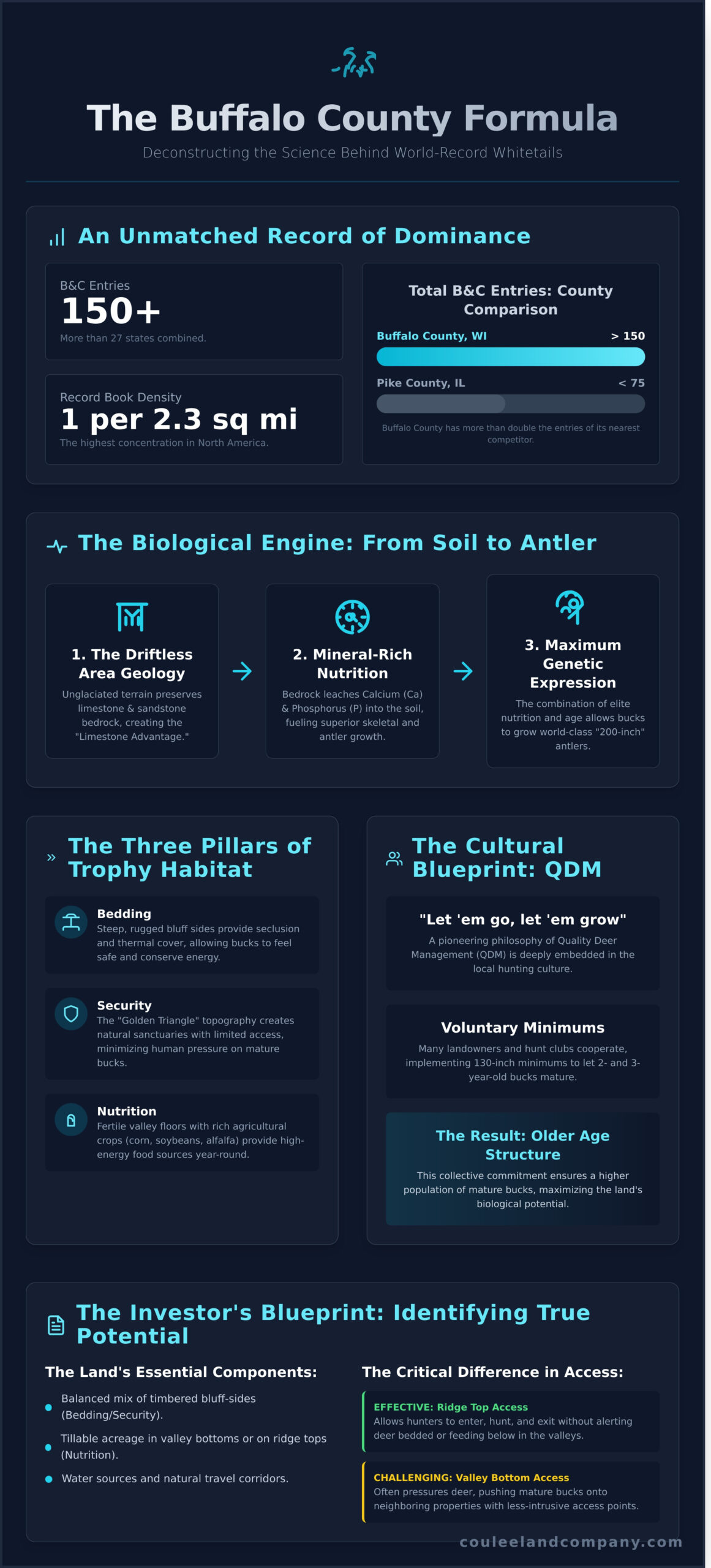
This dominance is most pronounced within what hunters call the ‘Golden Triangle,’ a cluster of townships where the unique topography creates the ideal whitetail sanctuary. The steep, wooded bluffs provide security and bedding, while the fertile valley floors offer rich agricultural food sources. This combination allows bucks to reach maturity with less pressure and superior nutrition. The Buffalo County Effect is best defined by its unparalleled B&C entry density, which as of 2026, stands at one record book buck for every 2.3 square miles of huntable habitat.
The Record Book Reality: By the Numbers
When you look at the raw data, the legend becomes fact. Buffalo County, Wisconsin, doesn’t just lead the nation in total B&C entries; it dwarfs the competition. With over 150 record-book whitetails, it holds a commanding lead over other famed destinations like Pike County, IL, which has less than half that number. It’s this incredible consistency, decade after decade, that truly sets the region apart. This sustained success is deeply woven into the fabric of the Buffalo County community, where a shared passion for wildlife has cultivated a unique hunting heritage found nowhere else.
The Cultural Component: Quality Deer Management (QDM)
While the land provides the foundation, the local culture provides the blueprint for growing mature deer. Long before QDM became a national buzzword, landowners here pioneered the “let ’em go, let ’em grow” philosophy. It’s an unwritten rule. This isn’t just a suggestion; it’s a cooperative effort among neighbors who understand that managing for an older age structure benefits everyone. Many landowners and hunt clubs implement voluntary 130-inch minimums, ensuring promising 2- and 3-year-old bucks get a pass. This collective commitment proves that culture is every bit as important as biology in producing legendary Buffalo County Wisconsin Boone and Crockett bucks.
The Biology of a Giant: Geography and Soil Chemistry in Bluff Country
The consistent production of world-class whitetails in Buffalo County isn’t an accident; it’s the direct result of a powerful biological engine fueled by a unique combination of geology, topography, and agriculture. This isn’t just good deer country. It’s a perfect storm of environmental factors that allows bucks to express their maximum genetic potential. The secret lies deep in the soil and is carved into the very bluffs that define the landscape, creating the ideal conditions for growing the legendary Buffalo County Wisconsin Boone and Crockett Bucks seen in the record books.
Understanding these foundational elements is the first step for any serious hunter or land buyer looking to own a piece of this whitetail paradise. The land itself provides the blueprint for growing giants. Everything from the minerals in the dirt to the direction a ridge faces plays a critical role in a buck’s life, health, and antler development.
Geology of the Driftless Area
Buffalo County sits in the heart of the “Driftless Area,” a region of the Upper Midwest that ancient glaciers failed to flatten. This unglaciated terrain left behind a dramatic landscape of steep, rugged bluffs and deep coulees. More importantly, it preserved a rich soil profile sitting atop a bedrock of limestone and sandstone. This is the ‘Limestone Advantage.’ This bedrock leaches crucial minerals into the soil and water supply, creating a nutrient-rich environment that directly impacts deer health. Scientific studies have consistently shown a direct correlation between soil rich in limestone-derived minerals, particularly calcium and phosphorus, and superior skeletal and antler development in whitetail deer. Since antlers are the fastest-growing bone tissue known to man, this mineral-rich foundation is non-negotiable for producing trophy-class headgear.
Nutrition and the 200-Inch Recipe
This rugged landscape provides more than just minerals; it creates a sanctuary. The steep, timbered bluffs offer exceptional thermal cover and security, allowing bucks to escape pressure and reach full maturity at 5.5 to 7.5 years of age. But sanctuary alone doesn’t build 250-pound bodies and 200-inch racks. That requires a high-octane diet. The valley floors and ridgetops of Buffalo County are dominated by agriculture, creating a perfect synergy of nutrition. This isn’t just any farming; it’s a specific combination that fuels growth year-round:
- Corn: Provides critical carbohydrates and late-season energy to survive harsh Wisconsin winters.
- Soybeans: Offer an incredible source of protein (up to 35%) during the crucial summer antler-growing months.
- Alfalfa: A high-protein forage that provides essential nutrition from early spring green-up through late fall.
This combination of high-protein, energy-rich food sources available 365 days a year is the recipe for success. The results of this unique synergy are not anecdotal; they are documented year after year in the official Boone and Crockett Trophy Records, where Buffalo County’s dominance is undeniable. For landowners, leveraging these natural advantages through strategic food plot placement and timber management is the key to maximizing a property’s wildlife capabilities. Our specialists excel at identifying properties where this perfect biological recipe already exists, giving you a head start on producing your own legendary buck.
Analyzing the Proof: Buffalo County vs. The Rest of Wisconsin
The record books don’t lie. While hunters across Wisconsin dream of a Boone and Crockett encounter, the data consistently points to one epicenter of trophy whitetail production. A head-to-head comparison shows that while counties like Trempealeau, Vernon, and Richland produce exceptional deer, they simply can’t match the sheer density of record-book entries originating from Buffalo County. The critical metric isn’t just total entries; it’s B&C bucks per square mile. On this front, Buffalo County operates in a class of its own, creating a concentration of world-class genetics that is statistically unmatched anywhere on the planet.
This proven track record is precisely why Western Wisconsin, with Buffalo County at its core, represents the most stable land investment for serious hunters heading into 2026. The demand for land with legitimate trophy potential is insulated from broader market fluctuations. It’s a passion-driven asset class, and the passion for Buffalo County Wisconsin Boone and Crockett Bucks has never been stronger.
Make no mistake, the neighboring counties are phenomenal hunting destinations. A property in Trempealeau or Vernon County can absolutely produce the buck of a lifetime, and for many buyers, they represent an outstanding value. Think of them as high-performing growth stocks with incredible potential. Buffalo County, however, remains the ‘Blue Chip’ asset. It’s the gold standard, backed by decades of irrefutable proof in the B&C record books. Investing here isn’t a gamble on potential; it’s a purchase of proven, historical performance.
Typical vs. Non-Typical Trends
Looking toward 2026, we see a distinct trend of massive non-typicals emerging from townships with a perfect mix of agriculture and rugged bluff country, specifically in the Modena, Nelson, and Alma areas. The question of a unique “Buffalo County Strain” often arises. While not a separate subspecies, the combination of elite genetics, mineral-rich soil, and an ideal age structure has created a distinct phenotype. The diverse Buffalo County Habitat, with its nutrient-dense browse in river bottoms and secure bedding cover in the bluffs, is the engine that fuels this incredible antler growth. For savvy investors, “sleeper” areas can be found bordering these famous townships, offering similar genetic potential often at a lower price per acre.
The Economic Value of a B&C Buck
The correlation between trophy potential and land value is direct and quantifiable. A property with a documented history of producing 170+ inch bucks can command a premium of 20-30% per acre over a comparable tract without that pedigree. This isn’t just about a photograph on the wall; it’s a tangible asset that significantly enhances resale value. A documented history of giant bucks becomes part of the property’s legacy, assuring future owners of its genetic and habitat quality. You can see these market values reflected in the current hunting properties for sale, where a history of trophy production is a prime selling feature.
Investing in the Dream: Identifying B&C Potential on Private Land
Owning land in Buffalo County is more than a purchase; it’s an investment in a legacy of whitetail hunting. But not every parcel holds the same potential. The key to producing world-class deer lies in understanding the landscape’s DNA. Truly exceptional properties are built on three foundational pillars: Bedding, Security, and Year-Round Nutrition. In the rugged Driftless Area, security and bedding are intertwined within the steep, timbered bluffs, while nutrition is often found in the fertile valley floors. The magic happens when a property offers all three in a layout that allows for undetectable hunter access.
Access is everything. A property with ‘ridge top’ access allows a hunter to park on high ground and slip into a stand using morning thermals that carry scent up and away from deer bedded below. Conversely, ‘valley bottom’ access, while often easier, can send your scent swirling up the very draws you intend to hunt. The most coveted parcels offer multiple access routes for different wind directions. Just as critical are water sources. While the Buffalo River carves the main valley, don’t overlook hidden springs and seeps high on the bluffs. These often become crucial watering holes for mature bucks who are hesitant to expose themselves in open valleys during daylight.
Learning to read a topographic map is the single most valuable skill for an aspiring landowner. It reveals a property’s secrets before you ever set foot on it. Here’s how to decode the lines to find a B&C buck sanctuary:
- Find the Benches: Look for wider-spaced contour lines halfway up a steep bluff. These flat ‘benches’ are natural travel corridors and prime bedding locations for mature bucks.
- Identify Points and Knobs: A ridge that juts out into a valley creates a point. Bucks love to bed on the tips of these points, where they can use the wind and their eyes to detect danger from multiple directions.
- Pinpoint Saddles: A low spot or ‘saddle’ between two ridges is a natural funnel. Deer consistently use these land features to cross from one drainage to the next with minimal effort.
- Locate the Thick Stuff: South and southwest-facing slopes receive the most sunlight, often resulting in thicker, nastier undergrowth. A topo map that shows a steep, south-facing point is a five-star location for a reclusive buck’s bedroom.
Land Management for Record-Book Results
The raw potential of a property is just the start. Unlocking its ability to produce Buffalo County Wisconsin Boone and Crockett Bucks requires hands-on management. Timber Stand Improvement (TSI), such as hinge-cutting less desirable trees, can transform an open woods into a thick bedding sanctuary in a single season. Food plot strategies should be layered; large ‘destination plots’ of corn or soybeans in a valley provide season-long tonnage, while small, secluded ‘kill plots’ of clover or brassicas tucked near bedding areas create predictable opportunities for harvest. Always consult the current year’s Wisconsin DNR hunting regulations regarding the use of mineral sites and supplemental feeding.
The ‘Neighbor Factor’ in Buffalo County
In this legendary county, your neighbors are a critical part of the trophy equation. A 40-acre parcel can consistently produce record-book deer if it’s surrounded by several hundred acres of land owned by others who also practice Quality Deer Management (QDM). By creating the absolute best bedding cover and the most desirable food sources on your 40 acres, you can effectively pull mature bucks from the entire neighborhood. Vetting the local commitment to letting young bucks walk is a vital piece of due diligence. True trophy potential is a community effort. Understanding this dynamic is crucial to maximizing your investment. Let our land specialists analyze a property and its neighborhood for you.
Navigating the Buffalo County Market with Coulee Land Company
Owning land in the whitetail capital of the world is more than a transaction; it’s the acquisition of a legacy. The path to securing a premier hunting property in Buffalo County, however, is filled with complexities that a standard residential agent simply isn’t equipped to handle. You don’t need a realtor who sells houses. You need a specialist who understands topography, access, soil quality, and the subtle signs that mark a piece of ground as truly world-class. This is the ‘Hunter’s Realtor’ advantage, and it’s the foundation of our entire approach.
Our process begins long before a property is publicly listed. We leverage a deep network built over decades to identify and vet trophy-caliber parcels off-market. We don’t just look at acreage and price. We walk the land, analyzing pinch points, bedding areas, and potential food plot locations. Our valuation goes beyond comparable sales, incorporating critical hunting data to assess a property’s true potential. We analyze years of trail camera history and historical harvest records to determine the age structure and genetic quality of the local herd. This meticulous due diligence is how we identify grounds capable of producing Buffalo County Wisconsin Boone and Crockett Bucks, ensuring our clients invest in land with a proven history and a promising future.
Looking ahead, savvy investors should have their eyes on 2026. Wisconsin’s County Deer Advisory Councils (CDACs), which set crucial population objectives and management strategies, operate on review cycles. The major framework established around 2015 is approaching a pivotal review period. Anticipated changes in herd management goals and regulations could significantly influence land values and hunting pressure in the coming years. Securing a property before these shifts are finalized provides a strategic advantage, positioning you to maximize your investment and hunting opportunities for the decade to come.
Meet Your Buffalo County Experts
Our team lives and breathes this region. Specialists like Mike Law aren’t just agents; they are deeply integrated into the community, with family roots in the area that provide unparalleled local knowledge. This expertise is complemented by the practical, on-the-ground guidance from agents like Bryan Lemke, who offer superior land management advice to help you maximize your property’s wildlife capabilities from day one.
Ready to Own a Piece of the Bluff Country?
Your search for the perfect property starts with a simple conversation. From that initial consultation, we guide you through every step: identifying your goals, locating exclusive properties, and navigating the complexities of closing. In a competitive market where the best parcels sell before they are ever advertised, having a dedicated buyer’s agent working for you isn’t just an advantage; it’s a necessity. We act as your strategic partner, ensuring you’re the first to know about the opportunities that matter.
The dream of hearing a monster buck crunching leaves in the pre-dawn stillness of your own Buffalo County land is within reach. Contact us today to find your Buffalo County legacy property.
Secure Your Place in Whitetail History
The evidence is undeniable. Buffalo County’s legendary status isn’t folklore; it’s a direct result of its unique Bluff Country geology and mineral-rich soils that consistently produce world-class whitetails. The science and statistics confirm why the record books are filled with Buffalo County Wisconsin Boone and Crockett Bucks. This is a legacy built from the ground up, and owning a piece of it requires more than just a map. It demands specialized, local expertise.
For over 20 years, Coulee Land Company has been the definitive expert in this legendary territory. Endorsed by top outdoor TV personalities, we leverage our proprietary database of trophy harvest history to identify parcels with proven potential. We don’t just find you land; we connect you with your dream property. Your opportunity to hunt a record-book buck is closer than you think. Explore Exclusive Buffalo County Hunting Land Listings and see the properties producing giants today.
The next chapter in this legendary story is waiting. Make it yours.
Frequently Asked Questions
Is Buffalo County still the #1 county for Boone and Crockett bucks in 2026?
Yes, Buffalo County is projected to maintain its #1 national ranking for Boone and Crockett entries through 2026. This long-standing dominance is not an accident; it’s the direct result of superior genetics, nutrient-rich soil, and decades of proven quality deer management practices by dedicated landowners. The county’s unique topography and agricultural landscape consistently produce the nation’s biggest whitetails, a trend we are confident will continue for years to come.
What is the minimum score for a Boone and Crockett whitetail entry?
The minimum score for a typical whitetail to enter the Boone and Crockett all-time record book is 170 inches. For a non-typical whitetail, the minimum required score is 195 inches. These net scores are determined after an official B&C measurer applies all necessary deductions. The club also maintains a separate awards book for three-year periods, with slightly lower minimums of 160 typical and 185 non-typical, recognizing exceptional animals harvested more recently.
How much does hunting land in Buffalo County, WI cost per acre?
As of late 2025, premier hunting land in Buffalo County typically ranges from $7,000 to over $12,000 per acre. The final price is determined by key factors like road access, the percentage of tillable acreage versus timber, and existing habitat improvements. Turnkey properties with established food plots, trail systems, and a cabin or pole shed will command prices at the top of this range, reflecting their immediate readiness for a serious hunter.
Can a small 40-acre property in Buffalo County actually produce a 170-inch buck?
Absolutely. A strategically located 40-acre parcel in Buffalo County can consistently produce opportunities at 170-inch bucks. Success on a smaller property depends entirely on its features and neighborhood. If your 40 acres contains the primary bedding cover, a critical travel corridor, or the only water source in the section, it will attract and hold mature bucks from surrounding properties. It’s about hunting smarter, not necessarily bigger.
What are the best townships in Buffalo County for trophy whitetail hunting?
Townships like Modena, Nelson, Alma, and Gilmanton are legendary for consistently producing a high number of record-book whitetails. These areas contain the perfect blend of rugged bluff country for secure bedding and fertile agricultural valleys for year-round nutrition. While these townships have a strong track record, any part of the county can hold a giant. The key is identifying a property with the right habitat and topography, which our specialists excel at.
How do Wisconsin deer hunting regulations in 2026 impact Buffalo County land owners?
The 2026 Wisconsin DNR regulations continue to empower landowners through programs like the Deer Management Assistance Program (DMAP). This program offers greater flexibility in herd management, including additional harvest opportunities and guidance for achieving specific habitat goals. Landowners should remain aware of any Chronic Wasting Disease (CWD) management zone updates and baiting regulations, as these are critical for maintaining a healthy local herd and maximizing a property’s potential.
Why is the soil in Buffalo County better for antler growth than other regions?
The soils in Buffalo County are exceptionally rich in calcium and phosphorus, the two most critical minerals for massive antler development. As part of the unglaciated “Driftless Area,” the region retains its deep, fertile loess and silt loam soils. This ground supports incredibly nutrient-dense crops and native browse, providing the fuel that creates the legendary Buffalo County Wisconsin Boone and Crockett bucks. This superior nutrition is the foundation of the area’s trophy potential.
Should I use a land specialist or a regular real estate agent to buy in Buffalo County?
You should always use a dedicated land specialist who lives and breathes hunting to buy property in Buffalo County. A residential agent sees lot lines; we see deer funnels, bedding thickets, and thermal hubs. We understand how topography dictates buck movement and which habitat improvements provide the highest return on investment. This specialized, on-the-ground knowledge is essential to finding a property that truly meets your trophy whitetail goals.