
In Buffalo County, the perfect ridge-top view can be the quickest way to ruin a world-class hunting property if you don’t place the home site with surgical precision. You’ve likely spent years dreaming of a cabin tucked into these limestone bluffs, but the reality of securing buffalo county buildable acreage often feels like a minefield of steep slope regulations and the looming fear of a failed perc test. It’s frustrating to find a “dream” lot only to discover that running utilities up a coulee with a grade exceeding the 12% limit will cost more than the land itself.
We understand that you’re looking for more than just a plot of dirt; you’re looking for a legacy that balances structural feasibility with the preservation of the land’s legendary hunting heritage. You can have the million-dollar view and the trophy whitetail habitat without the permit headaches. This guide breaks down the essential zoning requirements, from the ANR-40 density rules to the $400 conventional sanitary permit costs. We’ll show you exactly how to evaluate a site so your path to a building permit is as clear as a crisp November morning in the stand.
Key Takeaways
- Define buffalo county buildable acreage by identifying the critical intersection of local zoning ordinances and the physical demands of Western Wisconsin’s rugged topography.
- Learn to evaluate the “buildable envelope” of a property, focusing on soil suitability and slope analysis to prevent costly excavation surprises in steep coulees.
- Discover how to utilize low-impact home placement to secure a million-dollar view without compromising the sanctuary or security of your trophy whitetail habitat.
- Gain expert insight into how ridge-top development affects wind-scenting and thermal cover, allowing you to build your dream home without pressuring the local wildlife.
Defining Buildable Acreage in Buffalo County’s Bluff Country
In the heart of the Driftless Area, buffalo county buildable acreage represents the ultimate prize for land stewards and outdoor enthusiasts. True buildability isn’t just a marketing claim; it’s a precise status where land meets both local zoning ordinances and the physical requirements for a stable foundation and a functioning private onsite wastewater treatment system. Buffalo County remains the gold standard for buyers because of its unique geological makeup. You’ll find fertile valley bottoms that transition sharply into rugged, timber-heavy ridges, offering a diversity of habitat and building potential that’s unmatched across the Midwest.
It’s vital to distinguish between a premier hunting tract and a residential build site. While a 40-acre parcel may offer world-class whitetail genetics, it doesn’t automatically qualify for a home permit. The 2026 market outlook shows a sustained surge in demand for lifestyle properties where buyers want to live where they hunt. As interest in Buffalo County, Wisconsin continues to climb, identifying tracts that already possess a documented buildable envelope is the most effective way to protect your long-term investment.
To better understand this concept, watch this helpful video showing the scale of these properties:
Zoning and Minimum Acreage Requirements
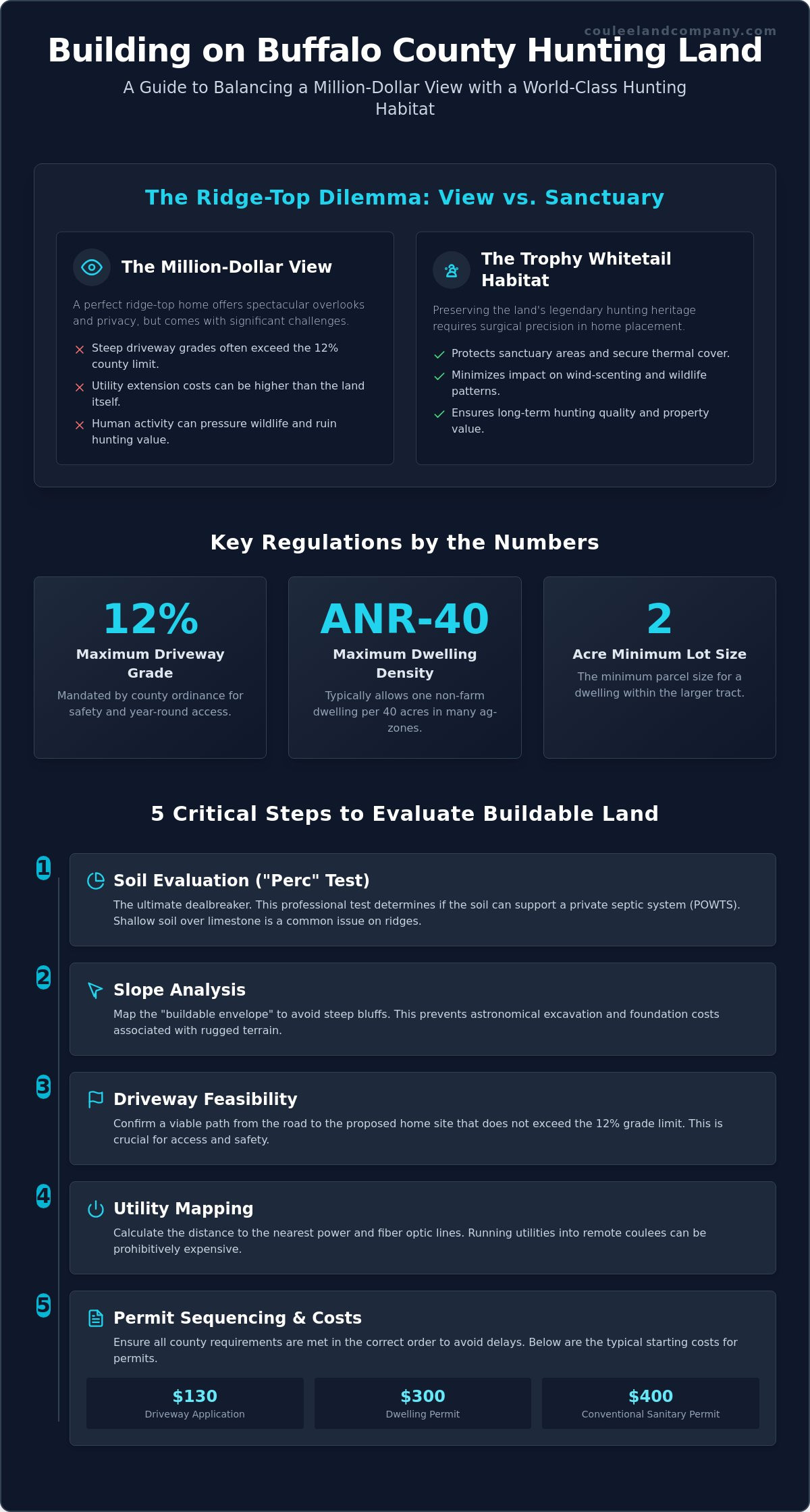
Most rural land here falls under specific agricultural or natural resource classifications. In many agricultural zones like ANR-40, the county maintains a maximum non-farm dwelling density of one dwelling per 40 acres, with a minimum lot size of two acres. You can’t assume a parcel is buildable simply because it’s large enough. Always verify the specific dwelling density and zoning status with the Buffalo County Zoning Department before you commit to a purchase. Our Buffalo County community page provides more insight into how these regulations shape local land use.
The Appeal of the Driftless Topography
The steep bluffs and deep coulees create natural privacy and views that are impossible to replicate in flatter regions. However, these same features present unique engineering hurdles. A ridge-top home site offers a spectacular overlook, but it requires a driveway that adheres to the 12% maximum grade limit mandated by county ordinance. You must balance the desire for a scenic overlook with the practicalities of winter access and the significant costs of running utilities to a remote ridge. Finding buffalo county buildable acreage that combines accessibility with a high-value view requires a deep understanding of the local terrain.
5 Critical Steps to Evaluate Buffalo County Land for Building
Securing buffalo county buildable acreage requires more than a visual inspection of a ridge top. The rugged beauty of the Driftless Area brings specific technical challenges that can derail a project before the first shovel hits the dirt. To ensure your home site is both legal and functional, you must follow a disciplined evaluation process that respects the local topography. This begins with verifying the physical “buildable envelope” where soil, slope, and access intersect.
Successful buyers typically prioritize these five steps to avoid costly mistakes:
- Soil Evaluation: Conduct a professional “perc” test to determine if the ground can support a private onsite wastewater treatment system (POWTS).
- Slope Analysis: Map out the building site to ensure it avoids the steepest bluffs, which can lead to astronomical excavation and foundation costs.
- Driveway Feasibility: Confirm that a path exists from the road to the home site that doesn’t exceed the 12% grade limit mandated by local safety standards.
- Utility Mapping: Calculate the distance to the nearest three-phase power or fiber optic lines, as running these services into remote coulees can often exceed the cost of the land itself.
- Permit Sequencing: Coordinate the $130 driveway application with the $300 dwelling permit to ensure all county requirements are met in the correct order.
Soil and Septic: The Ultimate Dealbreaker
Soil types in the Bluff Country vary wildly. You might find deep, well-draining silt in the valley floor, while a ridge just a few hundred yards away consists of shallow soil over solid limestone. This variation dictates your septic options. While a conventional system carries a $400 sanitary permit fee, many ridge-top sites require pressurized mound systems with a $550 permit fee. Before you close on a property, paying the $75 soils and site evaluation filing fee is the best insurance policy you can buy. If you are unsure how to coordinate these tests, our land specialists can help you navigate the local contractor network.
Driveway Construction and Erosion Control
The Buffalo County Zoning Ordinance is clear about access. No part of a new driveway may exceed a 12% grade. This isn’t just a suggestion; it’s a requirement for emergency vehicle access. In the Coulee region, building a compliant driveway often requires significant switchbacks and professional erosion control measures to prevent washouts during heavy Wisconsin rains. Whether you choose gravel for its drainage properties or pavement for easier winter maintenance, your access plan must be approved before you can move forward with construction.
Home Placement: Protecting Your Hunting Investment
Securing buffalo county buildable acreage is a significant milestone, but the placement of your home determines whether your property remains a premier hunting destination or becomes a high-priced suburban lot. Mature whitetails in the Driftless Area are notoriously sensitive to human pressure. A home site placed in the center of a parcel effectively carves out a “dead zone” of human activity that can push trophy bucks onto the neighbor’s land. Instead, prioritize low-impact building by tucking the home near existing road frontage to keep your interior sanctuary undisturbed.
Building on a ridge top offers an undeniable view, but it often creates a scent-dispersal tower. In Buffalo County’s deep coulees, wind patterns are complex. A ridge-top chimney or deck allows your scent to carry across entire valleys, alerting every deer in the drainage to your presence. We recommend working with Wisconsin land specialists to map out how your daily routine will interact with bedding areas and travel corridors before you pour a foundation. Finding the right buffalo county buildable acreage is as much about wind direction as it is about property lines.
Managing Human Pressure and Scent
Successful land stewards use the natural limestone bluffs and steep topography to their advantage. By building on the “edge” of the property or behind a topographical fold, you create a physical barrier that shields the deer woods from the noise of a lawnmower or the glow of porch lights. This “edge building” strategy preserves the security of your thermal cover and ensures that the deer feel safe using the property even when you’re home. It’s about living with the land, not just on top of it.
Enhancing Your Acreage Post-Build
Once construction is complete, your focus should shift to healing the site. Landscaping with native species like oak, hazelnut, or dogwood provides aesthetic beauty while offering high-quality forage for wildlife. Your home site should feel like a natural extension of a broader Wisconsin land management plan. Integrating food plots and bedding thickets around the perimeter of your residential footprint creates a cohesive environment where hunting and home life coexist seamlessly. Proper management ensures your build site enhances the land’s value rather than detracting from its wild character.
Securing Your Legacy in the Driftless Area
Navigating the complexities of buffalo county buildable acreage requires a specialized perspective that looks beyond the property lines. You now understand that a successful build site must satisfy strict dwelling density rules and slope requirements while simultaneously protecting the sanctuary of your whitetail habitat. By prioritizing edge-building strategies and conducting rigorous soil evaluations before you close, you ensure that your dream home doesn’t come at the cost of your hunting success. Balancing these technical demands with the natural movement of wildlife is the hallmark of a true land steward.
As specialists in Buffalo County since our inception, we’ve built a reputation for helping buyers identify tracts where structural feasibility meets visionary land management. Our team is endorsed by industry-leading hunters and land managers who trust our proven track record in Western Wisconsin’s Bluff Country. We don’t just sell dirt; we help you steward a legacy that will last for generations. Explore our current Buffalo County land listings and find your build site today. Your future home in the bluffs is waiting for the right set of boots to find it.
Frequently Asked Questions
Is all land in Buffalo County buildable?
No, a significant portion of land in the region is classified as strictly recreational or agricultural and does not carry building rights. Buildability is a legal status determined by the Buffalo County Zoning Department based on dwelling density, soil suitability for septic systems, and road access. You must verify the specific zoning classification and available “splits” for any parcel to ensure it qualifies as buffalo county buildable acreage.
How much does a perc test cost in Western Wisconsin?
While the county charges a $75 filing fee for a soil and site evaluation, the total cost for a certified soil tester typically ranges from $600 to $1,200 depending on the terrain. This test is a mandatory prerequisite for a sanitary permit. It determines whether your site requires a $400 conventional system or a more complex $550 pressurized mound system, which can cost between $7,500 and $11,000 to install in the 2026 market.
What is the minimum acreage required to build a house in Buffalo County?
In the common ANR-40 agricultural zoning district, the minimum lot size for a residential building is 2 acres. However, this is subject to a density requirement of only one non-farm dwelling per 40 acres of land. This means you could own 20 acres but still be unable to build if the original 40-acre parent parcel has already utilized its allotted dwelling right.
Can I build on a steep slope in the Bluff Country region?
Building on steep slopes is permitted but heavily regulated by ordinances designed to prevent erosion and ensure emergency vehicle access. The most critical constraint is the driveway grade, which cannot exceed a 12% slope at any point. Ridge-top sites often require extensive engineering and switchback driveways, which significantly increases the initial investment compared to building on flatter valley-bottom acreage.
How does building a house affect the property’s hunting value?
Home placement is the single most important factor in preserving the hunting integrity of buffalo county buildable acreage. Placing a home in the center of a property or on a prominent ridge can broadcast human scent and noise across the entire coulee, displacing mature whitetails. Strategic “edge building” near existing roads keeps the core of your land as a quiet sanctuary, maintaining the world-class trophy potential the region is known for.
Are there specific building permits required for Buffalo County?
Yes, new construction requires a structured sequence of permits including a $300 dwelling permit, a $130 driveway permit, and a $175 uniform address number. You must also secure a sanitary permit and a state building permit. The Buffalo County Zoning Department typically completes the review process for these applications within one to two weeks once all soil tests and site plans are submitted.