
According to a survey of Wisconsin DNR Foresters, deer browse is actually the single greatest threat to successful reforestation in our state. It’s a frustrating irony; the very animals you’re trying to attract can often be the reason your habitat project fails before it even takes root. If you want to transform your acreage into a premier hunting destination, you need to look beyond the local garden center and focus on the best trees to plant for deer in Wisconsin that are hardy enough to survive our brutal winters and productive enough to hold mature bucks.
You’ve likely spent hard-earned money on seedlings that didn’t make it through their first January, or perhaps you’re tired of waiting two decades for an oak to drop its first acorn. We understand that as a landowner, your goal is to build long-term land equity while creating a diverse, year-round food source. This 2026 habitat guide provides a strategic roadmap for selecting hard and soft mast trees that thrive in our specific regional soils. We’ll explore how to balance immediate attraction with generational growth, ensuring your property remains the most desirable habitat in the county for years to come.
Key Takeaways
- Learn why specific native oak species are the non-negotiable foundation for keeping trophy bucks on your land during the late-season freeze.
- Identify the high-sugar soft mast varieties that act as early-season magnets and the conifers essential for providing thermal security in sub-zero temperatures.
- Discover the best trees to plant for deer in Wisconsin to transform your acreage into a diverse, year-round nutritional powerhouse.
- Master the art of strategic habitat design by using “destination trees” and natural funnels to dictate deer movement past your favorite stand locations.
- Understand how professional-grade habitat improvements directly translate into increased land equity and long-term property value.
Hard Mast Foundations: The Best Oaks for Wisconsin Whitetails
Hard mast is the definitive gold standard for any serious habitat manager. While food plots offer a seasonal draw, the nutritional powerhouse of an acorn crop provides the high-fat energy required for winter survival. Understanding deer biology and diet reveals that these ruminants prioritize calorie-dense forage as temperatures plummet. In the Driftless Area, the best trees to plant for deer in Wisconsin are those that anchor them to your ridge-tops during the rut and beyond.
Soil pH is a critical variable in Western Wisconsin. Ridge-tops often feature thinner, more acidic soils, while valley floors collect rich, neutral deposits. Matching species to these specific microsites is a core tenet of effective Wisconsin land management for wildlife. Without this foresight, you risk slow growth or seedling mortality. To better understand this concept, watch this helpful video:
The White Oak Group: Immediate Attraction
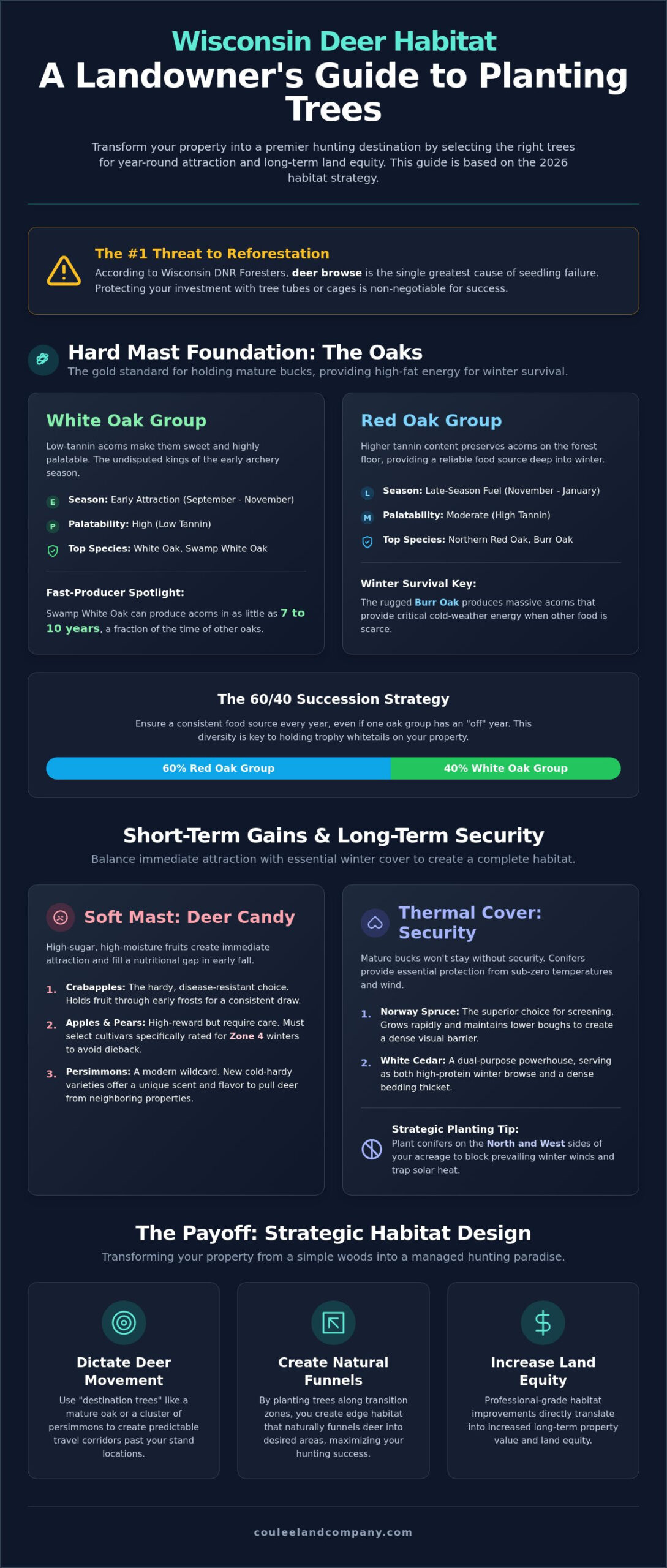
White Oaks (Quercus alba) are the undisputed kings of the early archery season. Their acorns contain lower tannin levels, making them sweet and immediately palatable. For landowners with creek bottoms or heavier soils, Swamp White Oak is a superior choice. It grows faster than its upland cousins and can produce mast in as little as 7 to 10 years under ideal conditions. Plant these on well-drained slopes in Bluff Country to create high-traffic staging areas.
The Red Oak Group: Late-Season Reliability
If White Oaks are the dessert, the Red Oak group is the main course that lasts through January. Northern Red Oak acorns have higher tannin content, which means they stay preserved on the forest floor longer. Burr Oaks are the rugged survivors of the Wisconsin landscape. They produce massive, fringe-capped acorns that provide critical cold-weather energy. To ensure a consistent food source, implement a 60/40 succession strategy. Mixing White and Red oak groups ensures that even if one species has an “off” year, your property still provides the best trees to plant for deer in Wisconsin to hold trophy whitetails.
Soft Mast and Thermal Cover: Short-Term Gains and Security
While oaks provide the long-term foundation, soft mast trees deliver the high-sugar, high-moisture “deer candy” that creates immediate attraction in the early fall. These fruits fill a critical nutritional gap before the primary acorn drop. By planting soft mast along the transition zones between your timber and food plots, you create a diverse edge habitat that encourages daylight movement. However, the best trees to plant for deer in Wisconsin are only effective if they survive the first year. A 2005 survey of Wisconsin DNR Foresters confirmed that deer browse is the leading cause of seedling failure. You must invest in physical protection, such as tree tubes or wire cages, to ensure your saplings aren’t destroyed before they can produce.
Fast-Producing Fruit Trees for Wisconsin
Crabapples are the hardy, disease-resistant choice for our climate. They often hold fruit through the first several frosts, providing a consistent draw when other sources vanish. For larger fruit like apples and pears, you must select cultivars specifically rated for Zone 4 winters to avoid frost crack and dieback. Persimmons are the current wildcard in the industry. While traditionally a southern tree, newer cold-hardy varieties are proving viable for Buffalo County deer hunting properties. These trees offer a unique scent and flavor that can pull deer from miles away during the late October transition.
Thermal Cover: Norway Spruce and White Cedar
Food alone won’t hold mature bucks if they don’t feel secure. Conifers are essential for providing thermal protection during our sub-zero January stretches. Norway Spruce is the superior screening tree for Wisconsin land. It grows rapidly and maintains its lower boughs to the ground, creating a permanent visual barrier. White Cedar is another excellent option, serving as both a high-protein winter browse and a dense bedding thicket. Strategically plant these on the north and west sides of your acreage to block prevailing winds and trap heat. If you are evaluating hunting properties for purchase, look for existing coniferous stands that can be augmented with these species to maximize security.
Strategic Habitat Design: Maximizing Hunting Success and Land Equity
Successful habitat management in Wisconsin’s Driftless Area requires more than just putting roots in the dirt; it requires engineering movement across your specific topography. By aligning tree rows with the natural benches and saddles of our unique Bluff Country terrain, you can create natural funnels that dictate exactly where a mature buck travels. The best trees to plant for deer in Wisconsin serve as biological anchors, turning a generic hillside into a high-traffic corridor. We often utilize the concept of “Destination Trees,” which involves planting a single, high-yield mast producer in a strategic opening to create a precise, repeatable stand location for the archery season.
Planting for the Wind: Strategic Screening
We recommend using fast-growing Hybrid Poplars for immediate visual barriers from road edges or neighboring fields. Pairing these with evergreen corridors creates a “quiet entry” path that keeps your presence a secret from the bedding areas. Strategic screening is the most overlooked aspect of 2026 land management because it allows you to access stands without alerting every deer on the property. This level of design ensures that your best trees to plant for deer in Wisconsin are actually huntable, rather than just feeding the neighbors’ herd during the night.
Building Land Equity Through Timber Management
The financial disparity between unmanaged scrub land and a property with high-quality timber is substantial. When evaluating Wisconsin hunting land for sale, savvy buyers look for diverse age classes and healthy mast production that signals long-term potential. Participating in government cost-share programs like the Managed Forest Law (MFL) or Environmental Quality Incentives Program (EQIP) can offset planting costs while providing a structured plan for forest health. Consulting with a land specialist like Bryan Lemke helps align your habitat goals with current market values, positioning your property as a turn-key trophy destination. This professional approach doesn’t just improve your hunt; it builds tangible equity in one of the most desirable natural landscapes in the Midwest.
Building Your Legacy in Wisconsin’s Bluff Country
Transforming a standard piece of acreage into a premier whitetail sanctuary is a strategic investment that requires a long-term vision. By prioritizing the best trees to plant for deer in Wisconsin, you’re doing more than providing a simple food source; you’re engineering a complex ecosystem that supports trophy bucks through the most brutal winter months. You now understand how the sweet attraction of white oaks and the late-season reliability of red oaks form a nutritional foundation, while soft mast and thermal cover provide the security mature deer crave to stay on your side of the fence.
At Coulee Land Company, we specialize in Western Wisconsin’s Bluff Country and possess an unmatched expertise in Buffalo County trophy whitetail land. Our professional land specialists are more than brokers; they’re expert guides who understand the intersection of habitat quality and market value. If you’re ready to find a property with the potential to become a generational hunting destination, we’re here to help you navigate the market with confidence.
View Our Exclusive Wisconsin Hunting Land Listings
The right trees will grow alongside your property’s equity, ensuring your investment pays dividends for years to come. Start planting for the future today.
Frequently Asked Questions
What is the fastest-growing tree for deer cover in Wisconsin?
Hybrid Poplars are the fastest-growing choice for landowners seeking immediate visual screening and bedding cover. These trees can grow several feet per year in our regional climate, making them ideal for blocking road noise and creating “soft edges” along food plots. While they don’t offer the multi-generational longevity of an oak, they provide the rapid vertical growth needed while your slower-growing mast trees establish their root systems.
When is the best time of year to plant trees for deer in Wisconsin?
Early spring is the optimal window for planting, specifically from late March through early May before the trees break dormancy. This timing allows the root systems to establish in moist soil before the stress of the summer heat. The Wisconsin DNR is scheduled to reopen seedling orders on October 5, 2026, for the spring 2027 planting season, so it’s vital to have your habitat plan finalized before the fall ordering rush begins.
How many trees should I plant per acre for optimal deer habitat?
For a balanced habitat that provides both nutrition and travel corridors, aim for 300 to 500 trees per acre. If your primary goal is creating dense thermal cover or a visual screen, you may increase this density to 800 trees per acre. The best trees to plant for deer in Wisconsin require enough spacing to develop full, productive crowns, as overcrowding can actually limit acorn production and fruit yields over time.
Do I need to fence off my new trees from the deer?
You must provide some form of physical protection, such as tree tubes, wire cages, or bud caps, to ensure seedling survival. A 2005 survey of Wisconsin DNR Foresters identified deer browse as the single greatest barrier to successful tree planting in our state. Without these protections, the very animals you’re trying to attract will likely destroy your investment during the first winter when other food sources are scarce.