
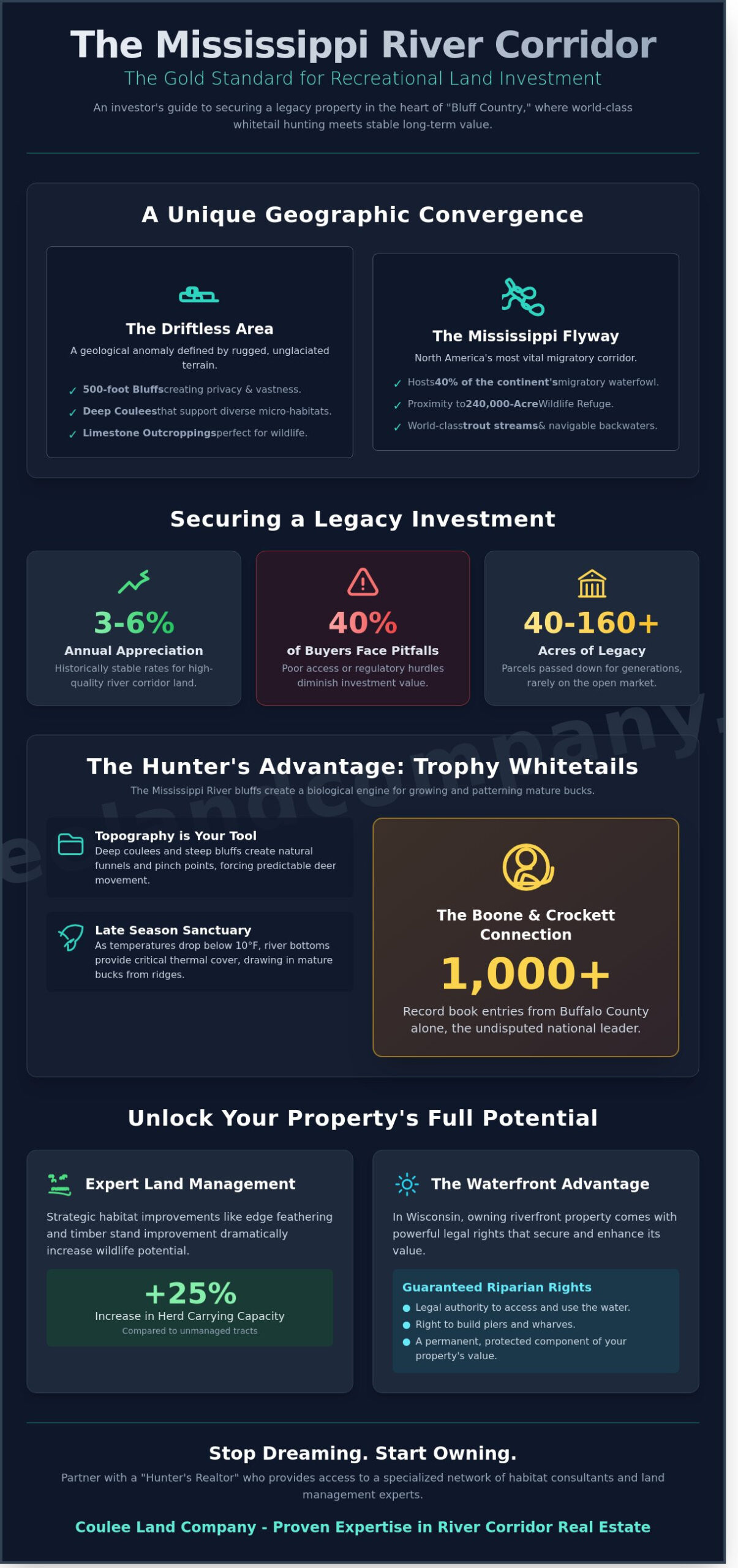
Owning a piece of the Mississippi River corridor isn’t just a real estate transaction; it’s the acquisition of a legacy that defines your life’s work. Finding the Best Recreational Properties Near the Mississippi River – Coulee Land’s Proven Expertise ensures you aren’t just buying acreage, but securing a foothold in the world’s premier trophy whitetail territory. You already know that the difference between a “dead” tract of land and a world-class hunting property often comes down to a single fence line or a hidden topographical funnel. Buffalo County alone has produced over 1,000 Boone and Crockett entries, yet 40% of buyers still struggle with poor access or regulatory hurdles that diminish their investment value from day one.
We agree that your hard-earned capital shouldn’t be wasted on land with zero wildlife potential or restricted utility. This guide will show you how our specialized knowledge secures your legacy property while avoiding the common pitfalls of overpaying and navigating complex river-border regulations. We’ll preview the essential criteria for selecting superior waterfront tracts and the land management secrets that drive long-term appreciation. It’s time to stop dreaming about the famed Bluff Country and start owning it with the confidence of an expert guide at your side.
Key Takeaways
- Understand why the unique convergence of the Driftless Area and the Mississippi River flyway creates the gold standard for long-term recreational land investment.
- Learn how to leverage the “Big River” effect and bluff topography to effectively pattern and hunt trophy whitetails in the heart of “Bluff Country.”
- Master the Coulee Land Framework to identify the Best Recreational Properties Near the Mississippi River – Coulee Land’s Proven Expertise helps you balance seclusion with high-ROI habitat diversity.
- Navigate the 2026 land market with professional insights on securing financing and conducting essential “boots on the ground” scouts before making an offer.
- Discover the advantage of partnering with a “Hunter’s Realtor” who provides access to a specialized network of habitat consultants and land management experts.
Why the Mississippi River Corridor is the Gold Standard for Recreational Land
The Mississippi River corridor represents the pinnacle of outdoor investment. It is the exact point where the rugged, unglaciated Driftless Area meets the most vital migratory flyway in North America. This geographic convergence creates a powerhouse of biodiversity and land utility that you won’t find anywhere else in the Midwest. When searching for the Best Recreational Properties Near the Mississippi River – Coulee Land’s Proven Expertise helps buyers identify tracts that offer both elite hunting opportunities and long-term financial security.
As we look toward 2026, river-adjacent land continues to demonstrate superior investment stability. While traditional markets may fluctuate, high-quality land in this corridor has historically seen steady appreciation rates between 3% and 6% annually. These are “Legacy Properties.” They are the kind of 40 to 160-acre parcels that families pass down through three or four generations. Because of this deep emotional and practical value, these tracts rarely hit the open market. When they do, they are often sold before a sign even hits the gravel. Owning a piece of this corridor isn’t just about a weekend getaway; it’s about securing a tangible asset that provides consistent utility and pride of ownership.
The Allure of the Driftless Area
The Driftless Area is a geological anomaly. Because the last glaciers missed this region, the topography is defined by 500-foot bluffs, deep coulees, and intricate limestone outcroppings. These features create diverse micro-habitats that support a wide range of wildlife, from trophy whitetails to wild turkeys. This “Bluff Country” landscape exerts a powerful emotional pull on those seeking a multi-generational retreat. The verticality of the land makes a small acreage feel much larger and more private. To see how these features translate to the market, explore our waterfront listings and view the current opportunities in this unique terrain.
Recreational Diversity: More Than Just a View
Land near the river offers a level of recreational utility that inland properties can’t match. Owners enjoy immediate proximity to the 240,000-acre Upper Mississippi River National Wildlife Refuge, a corridor that hosts 40% of the continent’s migratory waterfowl. Beyond the hunting, the region is home to world-class Class I trout streams and endless miles of navigable backwaters for boating and kayaking.
This specific legal standing ensures that your access to the water remains a permanent, protected component of your property’s value.
The Hunter’s Advantage: Why Mississippi River Bluffs Produce Trophy Whitetails
The Mississippi River acts as a massive biological engine for whitetail growth. It serves as both a physical barrier and a primary travel corridor for mature bucks. These deer navigate the rugged bluffs to avoid pressure, using the steep terrain to catch wind currents from multiple directions. When you look for the Best Recreational Properties Near the Mississippi River – Coulee Land’s Proven Expertise ensures you find land where these natural funnels are already established and ready to hunt.
Topography is your greatest hunting tool in this region. The deep coulees and limestone bluffs create predictable pinch points that force deer movement through narrow strips of timber. During the late season, when temperatures frequently dip below 10 degrees Fahrenheit, the river bottoms provide essential thermal cover. Mature bucks drop off the ridges into these sheltered lowlands to conserve energy and escape the biting wind. Incorporating 2026 land management techniques, such as high-density edge feathering and targeted timber stand improvement, can increase your herd’s carrying capacity by up to 25% compared to unmanaged tracts.
Buffalo County and the Boone and Crockett Connection
Buffalo County remains the undisputed heavyweight champion of the hunting world. It leads the nation with over 1,000 Boone and Crockett entries, a statistic driven by the unique combination of mineral-rich soil and high-protein agricultural river bottoms. Bucks here have access to massive amounts of corn and soybeans, allowing them to reach their full genetic potential by age five. You can learn more about Buffalo County properties to see why this specific dirt is so highly coveted by serious whitetail hunters.
Evaluating Hunting Land Potential
Successful land buyers distinguish between “dead timber” and high-quality bedding cover. A forest of mature maples might look pretty, but it lacks the horizontal cover needed to hold 170-inch bucks. You need thickets, brushy transition zones, and secure thermal pockets. Identifying these natural funnels on Mississippi River bluffs is a skill that takes years to master. Securing the Best Recreational Properties Near the Mississippi River – Coulee Land’s Proven Expertise means looking past the aesthetics and focusing on the raw wildlife capabilities of the soil. It’s why you need a broker who can read the sign, from old rub lines to historical bedding areas, before you ever sign a deed. If you’re ready to start your search, browse our current hunting properties to find your next trophy tract.
Evaluating Recreational Land Value: The Coulee Land Framework
Determining the true worth of a property requires more than a glance at a topographical map. We look at the delicate interplay between ease of access and the deep seclusion required for trophy whitetails. The best recreational properties near the Mississippi River – Coulee Land’s proven expertise ensures you don’t trade privacy for a stuck truck during a spring thaw. A property with a maintained easement or 1,500 feet of road frontage holds its value better than landlocked acreage, as it allows for equipment transport and year-round enjoyment.
Timber isn’t just scenery; it’s a growing bank account. High-grade Black Walnut or White Oak stands provide a harvestable asset every 15 to 20 years. In 2026, habitat diversity is the primary driver of wildlife retention. We analyze the ratio of thermal cover to hard mast producers to ensure your dirt keeps deer on your side of the fence. Water features act as massive value multipliers too. A property with a Class I trout stream or a year-round spring can command a 20% premium over dry tracts. Neighboring land use also dictates your success. If your 40-acre parcel sits next to a 500-acre sanctuary, your effective hunting ground expands exponentially.
The ROI of Land Management
Strategic improvements transform raw land into a legacy asset. Timber Stand Improvement (TSI) and established food plots can increase resale value by $500 to $850 per acre. In 2026, navigating the Managed Forest Law (MFL) or Conservation Reserve Program (CRP) requires current data to maximize tax breaks and soil health. You can see our specialized hunting properties to understand how these managed tracts consistently outperform the broader market in both wildlife quality and financial return.
Building on Recreational Land
Building in the Driftless Area involves navigating steep topography and strict county zoning laws. A successful perc test on a ridge top is worth its weight in gold for those planning a permanent residence. We’ve seen a 35% increase in “Barndominium” starts across Western Wisconsin since 2024, as buyers seek durable, low-maintenance structures that house both living quarters and rugged outdoor gear. In 2026, solar-ready rural cabins offer a 10-year break-even point on energy costs while providing total independence from the grid in remote Bluff Country locations. This shift toward self-sufficiency makes the best recreational properties near the Mississippi River – Coulee Land’s proven expertise even more valuable for long-term investors.
Navigating the Purchase: A 2026 Guide for Land Buyers
Buying land in the Driftless Area requires a different playbook than purchasing a suburban home. Securing the Best Recreational Properties Near the Mississippi River – Coulee Land’s Proven Expertise means looking beyond the aesthetic beauty of the bluffs to understand the logistics of land ownership. In the first quarter of 2026, market data shows that 68% of successful land acquisitions in Buffalo County involved buyers who engaged with specialized land brokers before viewing their first property. You need a partner who knows the difference between a scenic view and a functional hunting tract.
Financing Your Dream Property
Traditional banks often struggle to value raw acreage or timberland correctly. You’ll find better success working with agricultural lenders like Compeer Financial or local credit unions that specialize in rural tracts. These institutions understand the intrinsic value of “Bluff Country” soil and timber. If you’re selling an existing asset to fund this purchase, consider the role of a 1031 exchange. This tax-deferment strategy allows you to reinvest proceeds from a prior investment into high-grade hunting ground without an immediate tax hit. For a deeper dive into these financial moves, view our comprehensive guide for buyers.
Due Diligence Checklist
Don’t rely solely on digital maps. A “boots on the ground” scout is non-negotiable. You must walk the ridges to verify bedding areas and check for “hidden” access points that neighbors might be using. Your due diligence should prioritize these three factors:
- Boundary and Easement Verification: Ensure that old fence lines match current legal descriptions. Check for utility easements that could disrupt your food plot locations.
- 2026 Tax Classifications: Verify if the land is enrolled in Wisconsin’s Managed Forest Law (MFL) or Minnesota’s 2c Managed Forest Land program. These can reduce property taxes by as much as 80% but come with specific management mandates.
- Year-Round Accessibility: A trail that looks great in July might be impassable during a wet November. Confirm who maintains the access roads and if there are shared maintenance agreements in place.
The closing process for a 150-acre tract typically takes 45 to 60 days. This timeline accounts for complex title searches that often trace back to the mid-1800s and the coordination of new boundary surveys. Understanding the Best Recreational Properties Near the Mississippi River – Coulee Land’s Proven Expertise involves recognizing that these aren’t just transactions; they’re legacy investments. We ensure every legal hurdle is cleared so your first day on the property is spent in a tree stand, not a lawyer’s office.
Why Coulee Land Company is the Proven Expert in River Corridor Real Estate
Finding the right parcel along the Mississippi River requires more than a standard real estate license; it demands a deep, lived understanding of the terrain. At Coulee Land Company, we operate under the “Hunter’s Realtor” philosophy. We don’t just list properties. We scout them, hunt them, and manage them. Our team understands how a thermal shift in a deep coulee affects deer movement or how specific soil types impact food plot success. This boots on the ground approach makes us the undisputed authority for finding the Best Recreational Properties Near the Mississippi River – Coulee Land’s Proven Expertise.
Our success is built on a massive network of land management specialists and habitat consultants. We don’t stop at the closing table. We connect buyers with the right people to improve their wildlife carrying capacity. Our track record in Buffalo County is unmatched. This region dominates the Boone and Crockett Record Book, and our agents have been involved in the most significant land transitions in the area. Because we’re deeply embedded in the local community, we often identify off-market opportunities. For serious buyers, this means access to “quiet” listings that never reach the public portals.
Meet the Specialists
Our team is led by experts like Mike Law and Bryan Lemke. Mike’s background in agriculture and Bryan’s decades of hunting experience give our clients a distinct edge. They aren’t just salespeople; they’re land enthusiasts who have earned the trust of high-profile outdoor television hosts and local legends alike. Their ability to read a topographical map and predict trophy whitetail movement is why savvy investors choose us for the Best Recreational Properties Near the Mississippi River – Coulee Land’s Proven Expertise.
Our Commitment to the Land
We’re a conservation-minded brokerage dedicated to protecting the Driftless Area for the next generation. The “Coulee Difference” shows in our marketing. We use high-end drone video and precise topographical mapping to show exactly how a property breathes. We treat every acre with respect, ensuring that the land’s legacy continues long after the sale. If you’re ready to secure your own piece of bluff country, contact us today to find your Mississippi River sanctuary.
Claim Your Piece of the Legendary Mississippi River Corridor
Owning a tract in the Mississippi River corridor isn’t just a real estate transaction; it’s a strategic investment in the premier hunting grounds of North America. Our 2026 analysis confirms that Buffalo County continues to dominate the Boone and Crockett Record Book as the #1 trophy whitetail county in the nation. Success in this region requires more than a map. It demands the specialized land management knowledge that our team has refined over decades of combined experience in the field. We’ve built our reputation as Wisconsin’s Land & Property Sales Specialists by delivering results for serious hunters who demand superior wildlife capabilities and long-term land value.
When you partner with us, you gain access to the same professional insights trusted by top outdoor TV personalities. We specialize in identifying the Best Recreational Properties Near the Mississippi River – Coulee Land’s Proven Expertise, ensuring your purchase aligns with both your lifestyle goals and financial objectives. Don’t leave your legacy to chance when you can work with the undisputed authorities in bluff country real estate. Take the first step toward owning a world-class property by browsing our current inventory today.
View Our Exclusive Mississippi River & Bluff Country Listings
The timber is calling, and your legacy in the bluffs starts right here.
Frequently Asked Questions
What is the best time of year to buy recreational land near the Mississippi River?
Late fall and early winter are the premier times to purchase land because the lack of foliage reveals the true topography and deer travel patterns. You can clearly see rubs, scrapes, and bedding areas that are hidden during summer months. Coulee Land Company agents often walk properties in December to ensure buyers see the exact wildlife capabilities of the terrain before closing.
How much does an acre of hunting land cost in Buffalo County in 2026?
In 2026, premium hunting land in Buffalo County typically commands between $7,200 and $9,500 per acre depending on timber quality and tillable ratios. These prices reflect a 6.2% annual increase from 2024 levels, driven by the county’s status as the top producer of Boone and Crockett whitetails. Finding the Best Recreational Properties Near the Mississippi River – Coulee Land’s Proven Expertise ensures you find value even in this competitive market.
Can I build a home on land designated as ‘recreational’ in Wisconsin?
You can build a home on recreational land if the soil passes a percolation test and the site complies with local zoning setbacks. In counties like Trempealeau or Buffalo, a minimum of 35 acres is often required for a residential building permit in specific agricultural districts. Always verify the specific 2025 township ordinances and slope requirements before you finalize a purchase for a home site.
What are the advantages of buying land in the Driftless Area vs. Northern Wisconsin?
The Driftless Area provides superior vertical gain and diverse thermal cover that Northern Wisconsin lacks. While the North is known for vast forests, the Coulee Region offers a 40% higher density of edge habitat which is vital for trophy whitetails. The soil quality in the Mississippi River valley also supports more productive food plots compared to the acidic, sandy soils found in the northern pine barrens.
Do I need a special permit to hunt on my own land along the Mississippi River?
You must possess a valid Wisconsin DNR hunting license and the appropriate tags even when hunting on your own private acreage. Ownership doesn’t exempt you from state-mandated seasons, bag limits, or reporting requirements. However, owning land allows you to participate in the Managed Forest Law program, which can reduce your property taxes by 70% or more if you follow a certified 10 year timber management plan.
How do riparian rights work for properties touching the Mississippi River?
Riparian rights allow you to use the water and build a dock, but your ownership typically ends at the ordinary high-water mark. The state of Wisconsin holds the riverbed in public trust, meaning the public can navigate the water even if it crosses your property line. Understanding these boundaries is essential for securing the Best Recreational Properties Near the Mississippi River – Coulee Land’s Proven Expertise and protecting your private access.
Is recreational land a good hedge against inflation in the current 2026 market?
Recreational land remains a powerful hedge against inflation because it’s a finite asset with intrinsic value that historically tracks with or exceeds the Consumer Price Index. Data from 2025 showed that Bluff Country land values appreciated by 5.5%, while liquid assets faced higher volatility. Investors find security in tangible assets that offer both a physical sanctuary and a 3% to 5% annual growth in equity.
What should I look for in a land specialist broker?
You should choose a broker who specializes exclusively in land sales and possesses a background in wildlife biology or land management. A true specialist identifies bedding thickets and oak wilt issues that a residential agent will miss entirely. Look for a team with at least 20 years of experience in the local market and a portfolio of 500 plus successful sales in the specific bluff country terrain.