
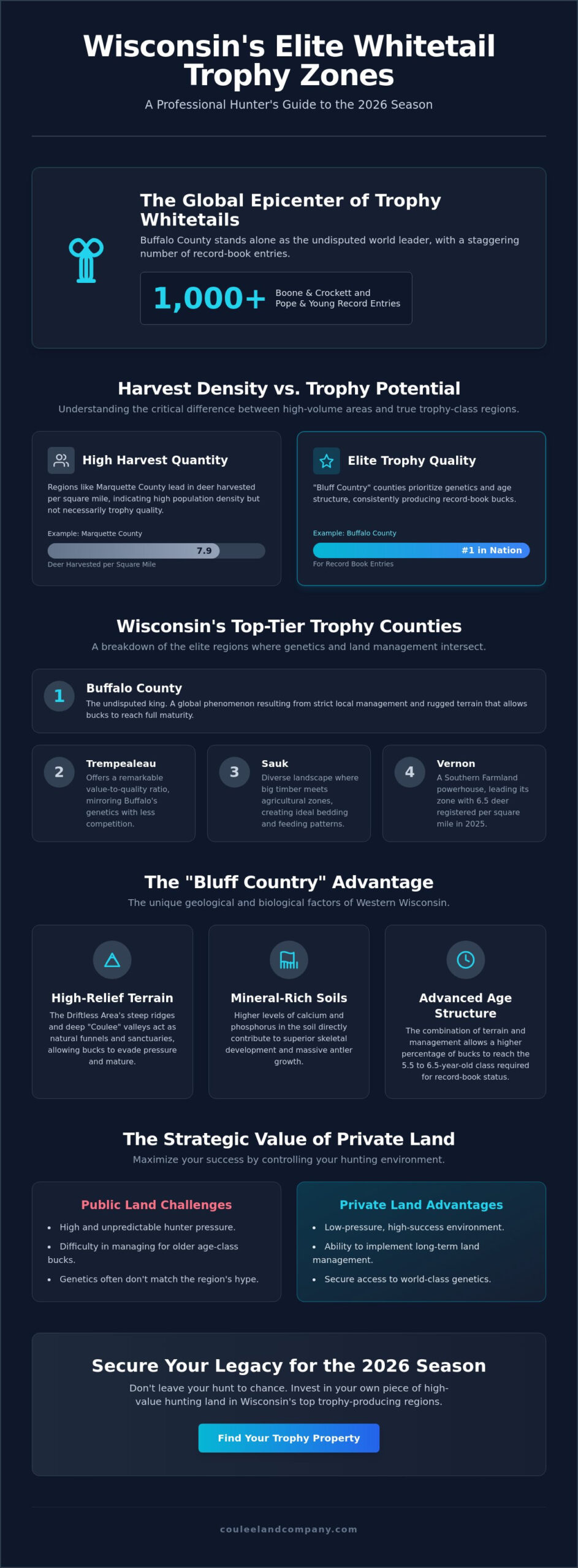
Buffalo County alone boasts over 1,000 record-book entries in the Boone and Crockett and Pope and Young clubs, a staggering statistic that cements its status as the undisputed world leader in trophy whitetails. You likely feel the frustration of digging through endless DNR spreadsheets only to end up on high-pressure public land where the genetics simply don’t match the hype. It’s exhausting trying to separate high-harvest zones from the true trophy producers when you’re searching for the best counties for deer hunting in Wisconsin. We understand that your time and resources are valuable. You deserve a hunting experience that reflects your dedication to the sport.
This guide identifies the specific regions where elite genetics and superior land management intersect for the 2026 season. We’ll break down the legendary “Bluff Country” dominance, compare harvest density against trophy potential, and provide professional guidance on where to invest in your own piece of high-value hunting land. From the fertile valleys of Trempealeau to the record-breaking ridges of Buffalo, we’ll show you exactly where the giants are bedding down. The 2026 season is your opportunity to secure a legacy.
Key Takeaways
- Pinpoint the specific counties that dominate national record books, led by the unmatched trophy density found in Buffalo County.
- Explore how the Driftless Area’s unique topography and Coulee systems provide the natural protection and funnels necessary for bucks to reach world-class maturity.
- Evaluate the statistical advantages of the best counties for deer hunting in wisconsin to distinguish between high-volume harvest areas and true trophy-class regions.
- Recognize the impact of hunter pressure on public lands and the strategic benefits of securing private hunting land for a low-pressure, high-success environment.
- Prepare for the 2026 season by understanding the genetic and environmental factors that make Western Wisconsin a global destination for whitetail enthusiasts.
The Top-Tier Wisconsin Counties for Trophy Whitetails
Identifying the best counties for deer hunting in wisconsin requires looking beyond simple harvest totals. While some regions produce high numbers of deer, true trophy hunters prioritize age structure and record-book entry density. Wisconsin consistently claims eight of the top ten whitetail trophy counties in the nation. This dominance is rooted in the specific biology of the white-tailed deer and the unique, mineral-rich soils found throughout the Driftless Area.
Data from the 2025 and 2026 seasons reveal a clear distinction between quantity and quality. For example, Marquette County led the state in harvest density with 7.9 deer per square mile, yet it doesn’t match the trophy output of the western ridges. You need to distinguish between seeing plenty of deer and encountering a once-in-a-lifetime buck. To better understand this concept, watch this helpful video:
The Unrivaled Dominance of Buffalo County
Buffalo County isn’t just a local favorite; it’s a global phenomenon. With over 1,000 entries in the Boone and Crockett and Pope and Young record books, it holds the top spot for trophy production. This success stems from a culture of strict local management and the rugged terrain that allows bucks to reach full maturity. If you’re looking for the pinnacle of whitetail habitat, explore our Buffalo County community page for deeper insights into this legendary region. The land here is an investment in world-class genetics.
The Supporting Cast: Trempealeau, Sauk, and Vernon
Trempealeau County offers a remarkable value-to-quality ratio, often mirroring Buffalo’s genetics without the same level of land competition. It’s a top producer of trophy bucks for a reason. Sauk County provides a diverse landscape where big timber meets agricultural transition zones, creating ideal bedding and feeding patterns. Vernon County also remains a powerhouse, leading the Southern Farmland Zone in 2025 with 6.5 deer registered per square mile. These areas are the best counties for deer hunting in wisconsin for those who value consistent, high-quality encounters over sheer volume.
Evaluating Wisconsin Regions: Why Bluff Country Wins
The Driftless Area of Western Wisconsin offers a unique geological landscape that isn’t found anywhere else in the Midwest. This region, often called “Bluff Country,” provides the perfect environment for producing the heavy-antlered bucks that define the best counties for deer hunting in wisconsin. Unlike the flat expanses of the Central Farmland or the dense, uniform cover of the Northern Forest, the high-relief terrain of the western counties creates natural sanctuaries. Mature bucks utilize the steep ridges and deep valleys to evade pressure, allowing them to reach the 5.5 and 6.5-year-old age classes required for record-book status.
The “Coulee” system is the secret weapon for hunters in this territory. These narrow valleys act as natural funnels, directing deer movement with predictable precision. When you combine this topography with the mineral-rich soils of the region, you get a recipe for massive antler growth. The calcium and phosphorus availability in the Driftless soil is significantly higher than in the sandy regions of the state, which directly impacts skeletal development and antler mass. It’s a biological advantage that hunters simply can’t find elsewhere.
The Tactical Advantage of High-Relief Terrain
Success in the bluffs depends on understanding how whitetails use the wind and terrain. Thermal hubs and mid-slope benches serve as preferred bedding areas for mature bucks, as they allow for multiple exit routes and a constant scent stream from the valley floor. Survival rates for bucks older than 2.5 years are notably higher in these rugged areas because the terrain itself limits human intrusion. For those looking to master these land features, check out our expert guide on scouting tips for Bluff Country terrain. Identifying these pinch points is the first step in managing your own high-performance hunting property.
Agricultural Synergy in the Western Counties
The best counties for deer hunting in wisconsin aren’t just about cover; they’re about the perfect marriage of corn and acorns. The fertile valleys are often filled with high-protein crops like corn and soybeans, while the ridge tops provide a steady supply of mast. This dual-source diet fuels rapid growth and helps deer maintain body mass through the harsh winters. Even if you own a smaller parcel, bordering large-scale agricultural operations can provide the nutritional foundation your herd needs. Stay updated on the latest regulations and season dates through the Wisconsin DNR to ensure your property management plan aligns with state standards. If you’re ready to explore these opportunities, our team specializes in finding premier hunting properties that capitalize on these natural advantages.
Securing Your Hunt: Public Access vs. Private Land Ownership
Public land in the best counties for deer hunting in wisconsin often feels like a lottery with poor odds. While the state offers vast acreage, the most productive trophy zones in the Driftless Area are predominantly private. High hunter density on public ground often pushes mature bucks onto neighboring private parcels where they find the security they need to reach 160 or 170 inches. If you’re tired of seeing another orange vest every time you find a promising ridge, it’s time to consider the benefits of exclusive access.
Owning land in the best counties for deer hunting in wisconsin allows you to control the variables. You decide the pressure, the food sources, and the age class of bucks harvested. This level of control is the only way to guarantee a low-pressure environment for your 2026 season and beyond. Investing in recreational land within the “Golden Triangle” is a pragmatic financial move. These properties hold their value because the demand for elite whitetail genetics is permanent. A land specialist can often find off-market opportunities that never reach public sites, giving you a distinct advantage.
The Benefits of Managed Private Property
Stewardship transforms a property from a simple woodlot into a whitetail factory. Implementing Timber Stand Improvement (TSI) and strategically placed food plots ensures year-round retention of the local herd. Professional management creates the security mature deer crave. As Mike Law often says, “A true sanctuary on private land is the only place a world-class buck feels safe enough to move during daylight hours.” You can explore current hunting properties for sale to begin your own management journey.
Navigating the 2026 Land Market in Wisconsin
The 2026 market shows steady demand for high-quality tillable and timber mixes. For out-of-state buyers, partnering with a Wisconsin land specialist is essential to understand local tax laws and land use programs. We help you identify “hidden gem” properties that offer the right topography and soil quality for trophy production. For a deeper dive into the acquisition process, read our sibling article on hunting land for sale in wisconsin: the ultimate buyer’s guide. Securing your own ground is the ultimate way to ensure your hunting legacy remains intact.
Owning Your Piece of Wisconsin’s Whitetail Legacy
The path to a record-book whitetail begins with understanding the specific geological and genetic advantages found within the Driftless Area. As we’ve explored, the rugged topography of the bluffs provides the essential security mature bucks need to reach their full potential. While total harvest numbers fluctuate across the state, the best counties for deer hunting in wisconsin remain those where high-relief terrain and mineral-rich soil intersect. Securing a private parcel in these regions is the only way to escape the pressure of public lands and implement the long-term management strategies required for elite trophy production.
Our team has specialized in Buffalo County and the surrounding Bluff Country since our inception, establishing a reputation as the recognized authority in record-book whitetail properties. Agents like Mike Law and Bryan Lemke bring a deep, pragmatic understanding of land stewardship that goes far beyond a simple transaction. We don’t just sell property; we help you invest in a lifestyle rooted in the outdoors. View Our Exclusive Western Wisconsin Hunting Land Listings today to find a property that matches your vision. Your 2026 trophy season starts with the right ground under your feet.
Frequently Asked Questions
Which Wisconsin county has the most Boone and Crockett entries?
Buffalo County holds the title for the most Boone and Crockett entries in both the state and the nation. This sustained success is the result of mineral-dense soil and a rugged landscape that naturally protects bucks until they reach maturity. While neighboring counties like Trempealeau and Sauk are strong contenders, Buffalo remains the statistically superior choice for hunters targeting world-class whitetails.
Is Buffalo County really the best place to hunt whitetails in the world?
Statistically, the answer is yes for hunters seeking record-book bucks. The county’s unique “Coulee” topography and local management traditions create an environment where bucks can reach the 5.5 to 6.5-year-old age class. It’s consistently recognized as one of the best counties for deer hunting in wisconsin because it prioritizes trophy quality over simple harvest volume, a distinction that sets it apart from other Midwestern regions.
What is the best county for public land deer hunting in Wisconsin?
For hunters seeking high deer density on public ground, Marquette and Vernon counties are top-tier choices. Marquette County recently led the Central Farmland Zone with 7.9 deer registered per square mile, while Vernon County led the Southern Farmland Zone with 6.5 deer per square mile. Success in these areas requires a tactical approach to find pockets of low pressure, as high harvest rates often attract significant hunter interest.
How do I find hunting land for sale in the best Wisconsin counties?
Securing a premier parcel in the best counties for deer hunting in wisconsin requires partnering with a brokerage that specializes in recreational land. You need an expert who understands soil productivity, thermal cover, and how to identify off-market opportunities. Our team focuses on the Driftless Area, helping buyers find high-value properties that offer the right genetics and topography to sustain a world-class hunting legacy for years to come.