
While Wall Street analysts predict a 14 percent swing in market volatility for 2026, the deep silt loam of Wisconsin’s Bluff Country quietly generates wealth without the noise. You likely realize that traditional portfolios feel increasingly fragile, and the competition for prime tillable acreage has driven supply to a 10 year low. Mastering your agricultural land investment wisconsin strategy requires more than a casual interest; it demands a technical understanding of NCCPI soil ratings and localized cash rent trends.
We’ve designed this strategy guide to help you secure a stable 3 to 5 percent annual yield alongside the long-term appreciation that only legacy-grade dirt provides. You’ll learn how to identify properties that offer world-class trophy whitetail hunting while simultaneously paying for themselves through sophisticated land management. We’re moving past the basics to analyze the specific financial nuances and tax advantages that will define the 2026 market.
Key Takeaways
- Understand why prime Wisconsin acreage serves as a superior hard-asset hedge against 2026 inflationary pressures and how to navigate the current inventory crunch.
- Master the technical nuances of the National Commodity Crop Productivity Index (NCCPI) to accurately value soil quality and ensure your investment yields maximum returns.
- Discover the triple-threat income model that optimizes your agricultural land investment wisconsin by balancing cash rent, CRP programs, and world-class hunting leases.
- Implement a rigorous due diligence checklist to verify zoning, easements, and boundaries, protecting your legacy property from unforeseen legal and topographical issues.
- Learn how to access exclusive “pocket listings” through a dedicated land specialist to secure high-quality parcels that never reach the open market.
The State of Wisconsin Agricultural Land Investment in 2026
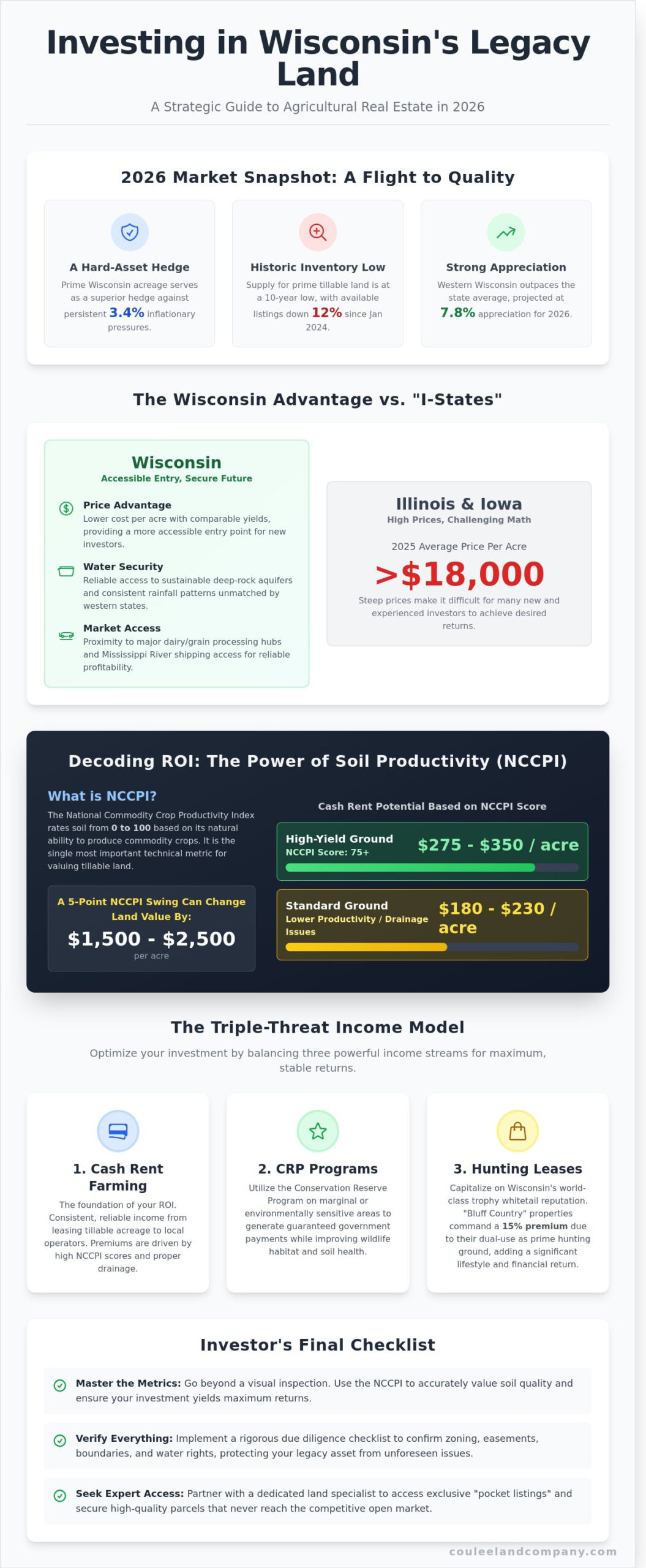
In 2026, agricultural land investment wisconsin has emerged as the definitive hedge against persistent 3.4% inflationary pressures. It’s a hard asset that doesn’t just store value; it produces. Current market data shows a record-low inventory of prime parcels, with available listings down 12% since January 2024. This scarcity has triggered a “flight to quality” across the Midwest. High-productivity soils with superior Corn Suitability Ratings are consistently outperforming marginal lands in both rent yields and resale value. While the state average for land appreciation is projected at 5.2% for the year, Western Wisconsin is on track for a 7.8% increase, driven by intense demand in the Driftless Area.
Why Wisconsin is the 2026 Investment Frontier
Wisconsin is the smart alternative to overpriced “I-state” neighbors. In 2025, average prices in Illinois and Iowa exceeded $18,000 per acre, making the math difficult for many new investors. Wisconsin offers a more accessible entry point without sacrificing yield potential. The state’s sustainable aquifers provide a level of water security that western states simply can’t match in the current climate. Combined with a robust network of processing hubs and Mississippi River shipping access, the infrastructure is built for long-term, reliable profitability.
- Price Advantage: Lower cost per acre compared to IL/IA with comparable yields.
- Water Security: Reliable access to deep-rock aquifers and consistent rainfall patterns.
- Market Access: Proximity to major dairy and grain processing centers in the Chippewa Valley.
The Shift Toward Institutional and “Legacy” Buyers
We’re seeing a massive shift as family offices and institutional funds move away from short-term speculation. They’re treating Wisconsin farmland as a 50-year asset. The 2026 buyer wants security over volatility. This is why “Bluff Country” properties command a 15% premium over standard flatland. These parcels offer more than just tillable acreage; they provide the prestige of owning world-class trophy whitetail ground. Expert agents like Mike Law understand that these tracts represent both a financial fortress and a lifestyle legacy. For those buying land today, the focus is on multi-generational wealth rather than quick flips.
The psychology of the market has changed. Investors aren’t just looking at bushels per acre; they’re looking at the land’s total utility. In Western Wisconsin, that means valuing the timber, the topography, and the wildlife capabilities alongside the harvest data. This holistic approach is what keeps the Coulee Region at the top of the investment charts heading into the second half of the decade.
Evaluating ROI: Soil Productivity, NCCPI, and Yield Potential
Successful agricultural land investment wisconsin requires looking beneath the surface. While “black dirt” looks impressive, professional investors rely on the National Commodity Crop Productivity Index (NCCPI) to quantify actual performance. This index scores soil from 0 to 100 based on its inherent capacity to grow crops without irrigation. In the current market, a mere 5-point difference in an NCCPI rating can swing land value by $1,500 to $2,500 per acre. High-quality ground isn’t just about what grows; it’s about the efficiency of every input you apply.
Protecting your 2026 investment ROI means prioritizing drainage and tiling. Modern subsurface drainage systems allow for earlier planting and more consistent yields during wet springs. These improvements often pay for themselves through increased cash rent premiums. Currently, high-yield Wisconsin tillable land with NCCPI scores above 75 commands cash rents between $275 and $350 per acre. Standard ground with lower productivity or drainage issues typically fetches between $180 and $230 per acre. If you’re looking to acquire high-performance ground, you can browse our current land listings to see available parcels with detailed soil profiles.
Technical Due Diligence for the Investor
You must decode soil maps before making an offer. In Western Wisconsin, identifying Tama and Muscatine silt loams is the goal, as these series are legendary for their water-holding capacity. If you’re looking in “Bluff Country,” you’ll face steeper slopes that require specialized erosion control and contour farming. Always ask the current operator for a minimum of five years of historical yield data. This reveals how the land performs during drought years versus wet years, which is a truer test of value than a single record-breaking harvest.
Tillable vs. Non-Tillable: The Value Split
Determining the “weighted average” value is essential for mixed-use parcels. You might pay $10,000 per acre for the tillable portion but only $4,500 per acre for the wooded acreage. In Wisconsin, wooded draws and coulees hold more value than similar land in the Great Plains because they function as primary travel corridors for trophy whitetails. Don’t overlook “hidden” tillable potential either. Overgrown pastures or old fence rows can often be cleared to add 5% to 10% more tillable acreage, instantly boosting the property’s capitalization rate. Our team helps investors identify these value-add opportunities by analyzing topographic maps and historical land use patterns.
The Triple-Threat Income Model: Farming, CRP, and Hunting
Owning Wisconsin land isn’t just about the view; it’s about a balanced ledger. Successful agricultural land investment wisconsin relies on three distinct pillars: row crop production, government conservation payments, and recreational leases. This trifecta ensures the property covers its own property taxes and debt obligations while building equity for the long term. You aren’t just buying dirt. You’re acquiring a multi-functional asset that produces revenue from the soil, the government, and the wildlife habitat simultaneously.
Local operators in the Driftless Area currently pay between $150 and $275 per acre for tillable ground, depending on the soil productivity rating (PI). Structuring a cash lease for the 2026 season now allows for predictable cash flow. These agreements typically require a 50% down payment in the spring, providing the liquidity needed for early-season expenses. For marginal acres, the Conservation Reserve Program (CRP) offers a steady alternative. In 2024, Wisconsin CRP rental rates averaged $120 to $180 per acre in key agricultural counties, providing a government-backed income stream that remains stable even when commodity prices fluctuate.
Maximizing the Recreational Lease
Wisconsin’s reputation for giant bucks creates a massive secondary market for landowners. High-quality hunting properties generate an additional $25 to $50 per acre through recreational leases. In regions like Buffalo County, which holds the record for the most Boone and Crockett entries in the nation, these premiums often hit the top of that range. Smart investors use a “Farm and Hunt” dual-lease strategy. This clearly defines access dates so the farmer can harvest crops before the hunter enters the woods for the November rut, preventing any operational conflict.
Government Programs and Tax Incentives
Wisconsin’s Use-Value Assessment is a critical tool for your agricultural land investment wisconsin strategy. It taxes agricultural land based on its income potential rather than its market value, often keeping taxes as low as $5 to $10 per acre. Additionally, the Managed Forest Law (MFL) can reduce property taxes by nearly 80% on wooded tracts in exchange for a long-term forest management plan. Looking toward 2026, carbon credit programs are emerging as a fourth income stream. Large-scale owners are already seeing offers of $15 to $30 per metric ton of sequestered carbon, rewarding sustainable tillage and cover crop practices.
Due Diligence Checklist for Wisconsin Farmland Buyers
Success in agricultural land investment wisconsin requires more than a handshake and a map. You need a boots-on-the-ground assessment of the property’s legal and physical status. Verify the current zoning immediately; specific parcels may be locked into the Wisconsin Farmland Preservation Program, which offers tax credits but limits non-farm development. Surveying is non-negotiable in the rugged, wooded terrain of the Driftless Area. Encroachments from neighboring fences or logging trails can lead to decade-long legal disputes if not identified before the closing date.
Inspect every piece of infrastructure with a critical eye. A 60-foot silo might look iconic, but its structural integrity affects your liability and insurance premiums. Ensure road access points are at least 24 feet wide to accommodate modern combines and grain carts. Environmental risks are often hidden. Check for historical fuel tanks near old machine sheds; a single leak can cost $20,000 or more in soil remediation. As we look toward 2026 climate projections, prioritize properties with high-capacity well permits or documented irrigation potential to ensure long-term yield stability.
- Zoning: Confirm if the land is under exclusive ag-zoning or local easements.
- Boundaries: Conduct a fresh survey to prevent timber theft or encroachment.
- Infrastructure: Evaluate the load-bearing capacity of existing bridges and culverts.
- Environmental: Screen for old chemical mixing sites or buried refuse.
- Water: Verify riparian rights and groundwater depth for future irrigation needs.
Navigating the Acquisition Process
Securing the right capital is a specialized hurdle. Traditional banks often struggle with the nuances of raw acreage, whereas lenders like Farm Credit understand the intrinsic value of soil productivity. If you’re transitioning out of commercial or residential assets, a 1031 Exchange is a powerful tool to defer capital gains while building a legacy in the dirt. Our team helps you identify replacement properties within the strict 45-day identification window. Learn more about our buyer services to see how we streamline these complex transactions.
Local Nuances: Bluff Country vs. Central Sands
The geography of your agricultural land investment wisconsin dictates your management strategy. In Western Wisconsin, the steep topography of the “Bluff Country” requires specialized contour farming and heavy-duty equipment capable of handling 18-percent grades. Conversely, the Central Sands region offers flat terrain but demands intensive nutrient management due to rapid drainage. Don’t ignore biological factors like Chronic Wasting Disease (CWD). In counties where CWD prevalence exceeds 25 percent in the adult buck population, recreational lease values can fluctuate. Finally, vet the neighborhood reputation. In tight-knit Wisconsin farming communities, having a “good neighbor” status is essential for securing reliable tenants.
Partnering with a Wisconsin Land Specialist for Long-Term Success
Most real estate agents understand how to pull comps for a three-bedroom ranch home, but they often fail when analyzing the complexities of agricultural land investment wisconsin. A standard residential realtor cannot accurately value a property’s National Commodity Crop Productivity Index (NCCPI) or its specific hunting potential. If an agent doesn’t know the difference between a 0.55 and a 0.85 NCCPI rating, they cannot tell you if a field is priced for profit or destined for a loss. At Coulee Land Company, we look beyond the acreage to evaluate the actual caloric output of the soil and the strategic wildlife corridors that drive long-term value.
The best Wisconsin farmland rarely reaches public listing portals. In 2023, a significant percentage of high-quality tillable tracts moved through private “pocket listings” or handshake deals at local diners. We occupy the space where technical farming expertise meets investment ROI, ensuring our clients access these off-market opportunities. Transitioning from a passive investor to a true steward of the land requires more than just a capital injection; it requires a partner who understands how to manage the dirt for future generations.
The Coulee Land Company Advantage
Our team leverages deep roots in Buffalo County to find off-market deals that never hit the open market. We specialize in identifying hunting properties that double as high-yield investments, capitalizing on the region’s reputation for producing world-class whitetails. Expert agents like Mike Law and Bryan Lemke evaluate every property through a dual lens of agricultural production and recreational capability. They analyze drainage tile maps and bedding thickets with equal precision to ensure your investment is secure and productive.
Your Next Steps Toward Land Ownership
Your journey begins by setting clear investment criteria. You must decide if you prioritize a yield-heavy 160-acre tract for consistent cash rent or a recreation-heavy bluff property with a smaller tillable footprint. We help you navigate these choices by providing data-driven insights into current lease rates and land appreciation trends. Once your goals are defined, we schedule private consultations to view exclusive listings that align with your portfolio needs. Owning Wisconsin land is about more than a financial return; it’s about securing a tangible legacy in the heart of the Midwest. Contact us today to start your Wisconsin land search and partner with the specialists who know the Bluff Country best.
Secure Your Future in the Wisconsin Bluff Country
Success in the 2026 market hinges on a data-driven approach to soil productivity and diversified income streams. You’ve learned that maximizing ROI requires a balance between high NCCPI ratings and the triple-threat revenue model of row crops, CRP payments, and trophy whitetail leases. Navigating an agricultural land investment wisconsin isn’t a solo endeavor if you want to win in Buffalo County or the surrounding Driftless region. It’s about leveraging specialized habitat valuation to ensure your dirt performs as hard as your capital.
Coulee Land Company has facilitated over $500M in land sales across the region, earning the trust of top outdoor television personalities through relentless diligence. We don’t just look at boundary lines; we analyze the specific wildlife capabilities and yield potential that define a legacy property. Our team uses expert NCCPI analysis to separate average tracts from superior investment-grade acreage. It’s time to put our expertise to work for your portfolio.
View Our Exclusive Wisconsin Agricultural Listings
The right piece of Wisconsin is waiting for you to claim it.
Frequently Asked Questions
Is agricultural land a good investment in Wisconsin for 2026?
Yes, agricultural land investment wisconsin remains a robust choice for 2026 because of the state’s 14.3 million acres of diverse, productive ground. Wisconsin farmland values rose 14% between 2022 and 2023, and the limited availability of high-quality “Bluff Country” tracts continues to drive appreciation. Investors are targeting the 2026 window to capitalize on the 3% to 5% projected annual growth in land values driven by global food demand.
How much does an acre of farmland cost in Wisconsin right now?
The average cost of Wisconsin farmland is $6,200 per acre according to the 2023 USDA Land Values report. Prices fluctuate significantly based on the specific region and soil quality. You’ll find that premium tillable tracts in the Western Coulee Region often exceed $9,000 per acre, while recreational timberland in the same area typically ranges from $3,500 to $5,000 per acre depending on trophy whitetail potential.
What is the average cash rent for tillable land in Western Wisconsin?
Average cash rent for tillable land in Western Wisconsin typically falls between $180 and $265 per acre. In top-tier counties like Buffalo County, a unique dual-income opportunity exists for savvy investors. You can collect $225 per acre from a farmer for corn production while simultaneously leasing the timber sections to hunters for $30 to $50 per acre, maximizing the total return on your investment.
Can I use a 1031 exchange to buy Wisconsin agricultural land?
You can definitely use a 1031 exchange to acquire agricultural land investment wisconsin opportunities while deferring capital gains taxes. This IRS provision allows you to swap “like-kind” properties, such as an apartment complex or commercial building, for a farm or ranch. It’s a strategic move that preserves 100% of your equity, allowing you to transition into the stable, long-term growth of the Driftless Area’s land market.
What is the difference between tillable and non-tillable land value?
Tillable land usually commands a value 50% higher than non-tillable acreage because it generates immediate, annual cash flow. In the 2023 market, high-grade cropland averaged $7,500 per acre, whereas non-tillable pasture or woods averaged $3,200 per acre. We evaluate soil productivity indexes to determine if a tract’s wildlife capabilities or its harvest potential will be the primary driver of its future market price.
Do I need a special license to lease my land for hunting in Wisconsin?
Landowners don’t need a specific professional license to lease their private property for hunting in Wisconsin. You simply need a well-drafted lease agreement to define boundaries and expectations. Wisconsin Statute 895.52 provides significant liability protection for owners who open their land for recreational use, though many of our clients choose to require hunters to carry a private $1 million liability insurance policy.
How do property taxes work for agricultural land in Wisconsin?
Wisconsin property taxes for agricultural land are calculated using the “Use Value Assessment” system established in 1995. This law ensures that your tax bill is based on the land’s income potential from farming rather than its speculative market value for development. Because of this, it’s common to see annual taxes as low as $5 to $10 per acre for land that’s actively used for crop production.
What are the risks of investing in farmland?
The primary risks include commodity price volatility and shifting weather patterns that can impact annual crop yields. Farmland is also an illiquid asset, meaning it often takes 90 to 120 days to finalize a sale in the Coulee Region. While the asset class has shown a 10.2% total return over the last 20 years, you must be prepared for the slower pace of real estate transactions.