
Your path to a trophy-producing deer camp doesn’t require outbidding a billionaire for a ridge in the center of Buffalo County. While land prices in Wisconsin’s most famous big-buck corridors saw a 12% jump between 2023 and late 2024, the smartest buyers are currently looking where the crowds aren’t. You’ve likely felt the sting of rising per-acre costs and the pressure from out-of-state investors, which makes finding affordable hunting land for sale wisconsin feel like an impossible hunt.
It’s a common fear that “affordable” means buying a dead zone, but we believe every hunter deserves a piece of the Bluff Country dream. This guide shows you how to secure high-quality ground without the premium price tag by identifying undervalued regions and specific habitat features that hide true potential. We’ll show you the top “sleeper” counties for 2026. You’ll learn how to value “fixer-upper” parcels and build a clear roadmap to ownership before next season opens.
Key Takeaways
- Learn why the total cost of ownership is a more critical metric than price-per-acre when evaluating the true value of Wisconsin acreage.
- Identify high-potential “sleeper” regions outside of Buffalo County to find affordable hunting land for sale wisconsin without sacrificing trophy quality.
- Understand the “neighborhood effect” and how a well-positioned 20-acre parcel can out-hunt a low-quality 80-acre tract.
- Master advanced scouting techniques using LiDAR and neighbor analysis to spot hidden funnels and undervalued “diamonds in the rough.”
- Discover how partnering with a dedicated land specialist provides access to off-market pocket listings that general realtors often miss.
Defining Affordability in the 2026 Wisconsin Hunting Land Market
The 2026 real estate landscape has shifted the goalposts for sportsmen seeking their own piece of the Northwoods or the Driftless Area. Identifying affordable hunting land for sale wisconsin often means prioritizing habitat quality and strategic location over sheer acreage. We define affordable hunting land as tracts that offer viable harvest opportunities while remaining within the financing reach of average earners. You don’t need 500 acres to kill a world-class buck; you need the right 40 acres that work harder than the surrounding sections.
To better understand how these properties look on the ground, watch this land tour of a viable hunting tract:
The 2026 Price Benchmark
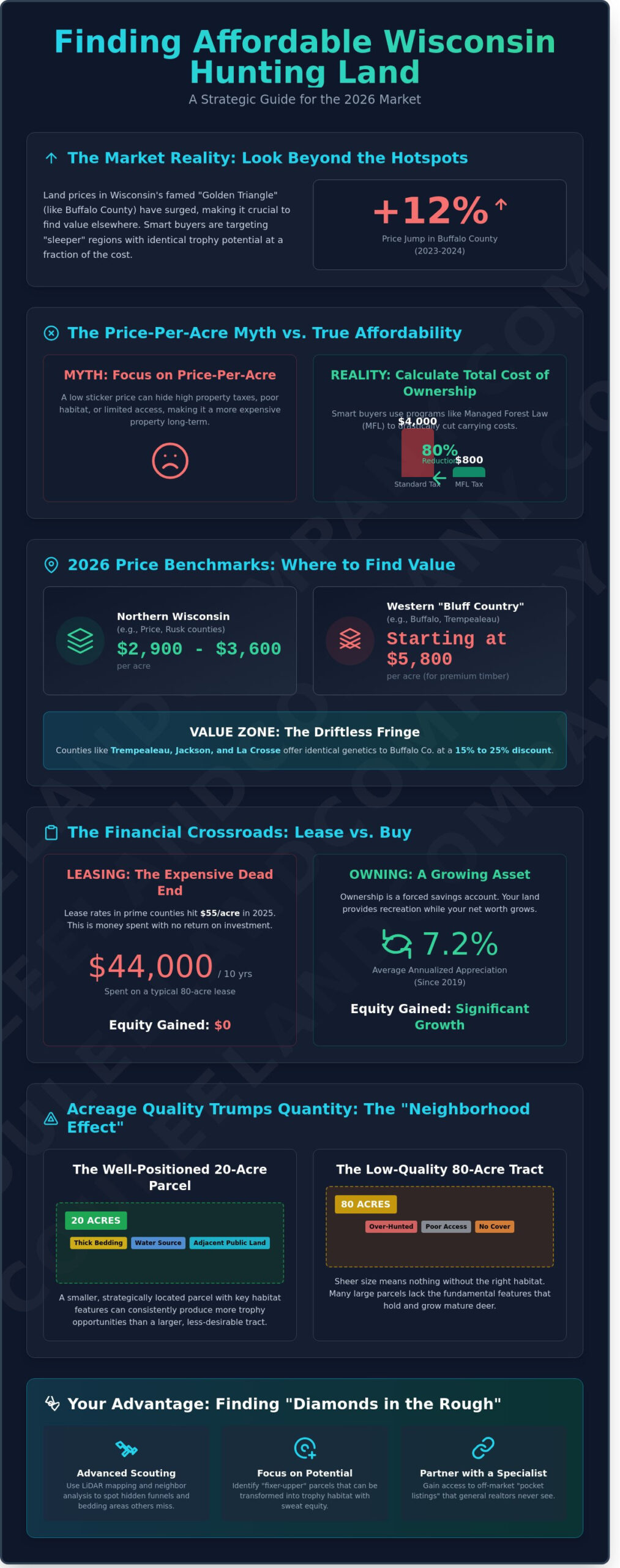
Current market data from early 2026 shows a distinct split in pricing. In Northern Wisconsin counties like Price or Rusk, recreational tracts are trading between $2,900 and $3,600 per acre. Western Wisconsin, specifically the “Bluff Country” of Buffalo and Trempealeau, commands a premium, often starting at $5,800 per acre for top-tier timber. Smart buyers look for parcels adjacent to the 5.8 million acres managed by the Wisconsin Department of Natural Resources (DNR). This proximity allows a small, affordable private parcel to act as a gateway to thousands of public acres, effectively expanding your huntable footprint for free.
The Price-Per-Acre Myth
Total cost of ownership dictates true affordability. A low price-per-acre often hides high carrying costs or poor utility. We focus on the Managed Forest Law (MFL) program, which is a game changer for budget-conscious buyers. Enrolling your land in MFL can reduce your annual property tax burden by 80 percent. This program turns a $4,000 tax bill into an $800 fee, significantly increasing your long-term borrowing power. Don’t buy a swamp just because it’s cheap; buy a smaller, higher-quality ridge that utilizes MFL to stay within your monthly budget.
The Lease vs. Buy Financial Crossroads
Leasing hunting rights has become an expensive dead end. In 2025, lease rates in prime Western Wisconsin counties hit $55 per acre. If you lease an 80-acre tract for 10 years, you’ve spent $44,000 and own nothing but old memories. Purchasing affordable hunting land for sale wisconsin in 2026 allows you to capture equity growth. Since 2019, Wisconsin recreational land has seen an average annualized appreciation of 7.2 percent. Owning land is a forced savings account that provides a place to hunt while your net worth grows. It’s a pragmatic move for any serious outdoorsman.
Setting Realistic Expectations
Budget tracts require a management mindset. On a lower-cost parcel, you might not see 10 mature shooters on every sit, but the “Coulee Region” genetics are present across the board. Success on affordable land comes down to layout and pressure. We help buyers identify “sleeper” properties with thick bedding cover and thermal hubs that hold deer even when the neighbors are over-hunting. By focusing on these wildlife capabilities rather than just road frontage or cabin sites, you can secure a property that punches well above its weight class in the Boone and Crockett record books.
Top “Sleeper” Regions for Budget-Friendly Wisconsin Land
Buffalo County remains the gold standard for Boone and Crockett entries, but the 2026 market shows savvy buyers shifting their focus. Land prices in the famous “Golden Triangle” have seen a 12% steady climb over the last three years, pushing entry-level hunters to look elsewhere. If you want affordable hunting land for sale wisconsin, you must look where the dirt is just as rich but the zip code is less famous. Value in the current market is found by identifying properties with high wildlife capabilities that lack “curb appeal” for traditional developers.
The Value of the Driftless Fringe
Counties bordering Buffalo County, such as Trempealeau, Jackson, and La Crosse, offer nearly identical genetics and topography at a 15% to 25% discount. We often direct clients toward “unbuildable” lots in these areas. A 40-acre parcel with a 35% slope or significant wetlands might be useless for a cabin site, but it serves as a perfect sanctuary for a mature buck. These tracts stay on the market longer and offer a lower price per acre. You can effectively double your huntable acreage by finding a small private parcel that borders the Public Access Lands program, allowing you to own the “hub” while hunting the “spokes” of the surrounding state land.
Central Wisconsin: The High-Density Alternative
Juneau, Adams, and Wood counties are the workhorses of the state’s annual harvest numbers. These counties consistently post higher deer-per-square-mile counts than the rugged western bluffs. The Central Sands region offers flat, manageable terrain where 20 acres of thick tag alders adjacent to a commercial cornfield can hunt like an 80-acre wilderness tract. Timber value here is typically tied to pulpwood rather than high-grade oak. This keeps the initial purchase price lower while still providing the thick thermal cover necessary for wintering herds.
- Juneau County: Known for high success rates on small parcels due to heavy agricultural intersections.
- Adams County: Offers some of the best entry-level pricing for tracts under 40 acres.
- Wood County: Ideal for hunters looking for a mix of marsh bedding and hard timber edges.
The Northern Forest region remains the last frontier for large-scale affordability. In counties like Price or Douglas, you can still find tracts for under $2,200 per acre. These areas require a different strategy, focusing on wilderness hunting and large-scale land management. While the deer density is lower than in the central corridor, the pressure is significantly reduced. It’s a trade-off that appeals to the hunter who values solitude and a true backcountry experience. You’ll find that affordable hunting land for sale wisconsin is still plentiful if you’re willing to trade a 20-minute drive for a 2-hour trek into the big timber.
Finding the right balance between your budget and your hunting goals requires a boots-on-the-ground perspective. You can view our latest property listings to see how these different regions compare in the current market. Identifying hidden terrain traps like internal benches and hidden oxbows in these sleeper regions is the fastest way to build equity in your hunting legacy without overextending your finances.
Small Acreage vs. Low-Quality Large Tracts: The Value Analysis
Most buyers assume that more acreage equals better hunting. This is a common trap. A 20-acre “Killer” tract situated in a primary travel corridor between bedding and high-protein agricultural fields will outproduce an 80-acre block of “Empty Woods” every single season. When searching for affordable hunting land for sale wisconsin, you have to look past the boundary lines. We focus on “neighborhood effects.” If your 24-acre parcel borders a 500-acre private sanctuary that sees zero hunting pressure, you’ve essentially inherited the benefits of that sanctuary without the massive tax bill. You aren’t just buying your dirt; you’re buying the habits of the deer in the surrounding 1,000 acres.
Access is the primary driver of land value. It doesn’t matter if you own 160 acres if the only way into the property is a single trail that blows your scent across the entire holding. A 30-acre parcel with multiple ingress and egress points allows you to hunt 90% of the ground effectively. On large, poorly shaped tracts, you might only be able to hunt 20% of the land without spooking every deer in the county. Effective huntable acreage is the only metric that truly matters for the serious whitetail hunter. High-quality small parcels often cost 15% more per acre, but the return on your investment in terms of trophy quality is significantly higher.
Many hunters find success by utilizing the Wisconsin Public Access Lands Program to supplement their private holdings. By purchasing a smaller, affordable private tract that adjoins thousands of acres of public land, you secure a private “home base” while gaining access to a massive backyard. This strategy allows you to own 20 acres but hunt 2,000.
Why 40 Acres is the Wisconsin “Sweet Spot”
The “forty” is the foundational unit of Wisconsin land surveying, dating back to the mid-1800s. It remains the ideal size for land management. You can effectively transform a 40-acre tract into a whitetail mecca with a modest budget. For approximately $4,500, a landowner can install two 0.75-acre food plots and 5 acres of security cover. This creates a self-contained ecosystem that holds deer on your property during the daylight hours. You can browse our current hunting properties to find 40-acre tracts that offer this exact management potential without breaking your bank account.
Identifying “Junk Land” to Avoid
Not all cheap land is a bargain. You must distinguish between huntable “security cover” swamps and non-navigable cattail bogs. If 90% of a property is under six inches of water year-round, it’s a liability, not an asset. Avoid “cattail traps” where you can’t even reach a tree to hang a stand. Other red flags include neighborhoods with high hunter density or parcels that are completely land-locked. A land-locked 40-acre parcel might be priced 45% below market value, but without a recorded legal easement, you’re buying a legal nightmare. Always verify that your affordable hunting land for sale wisconsin includes a deeded 66-foot wide easement for ingress and egress. Without it, the land is essentially worthless for long-term investment.
Strategic Due Diligence: Finding “Diamonds in the Rough”
Finding affordable hunting land for sale wisconsin requires a shift in perspective. You aren’t looking for a finished product; you’re looking for raw potential that others have overlooked. Start your search at your desk using LiDAR imagery to strip away the leaf canopy. This technology reveals hidden benches and narrow drainage ditches that don’t show up on standard satellite views. A property with a 20 foot elevation change might look flat on a basic map, but LiDAR shows the micro-topography where mature bucks move during daylight. These hidden funnels allow you to hunt effectively on smaller, more budget-friendly parcels by placing stands exactly where the terrain forces movement.
Your neighbors’ habits dictate your land’s ceiling. If the 80 acres next door is a sanctuary with zero pressure, your 20 acres becomes a high-value intercept point. Conversely, if the neighbors hunt the fence lines every weekend, your tract might be a dead zone regardless of the price. We analyze plat maps to see if surrounding parcels are held by long-term owners or LLCs focused on quality deer management. A 40-acre parcel surrounded by 500 acres of “no-hunt” private land is worth 30% more in actual hunting value than a 40-acre parcel surrounded by heavy public access. Knowing who is next door is just as important as knowing the property lines.
Don’t ignore the standing timber value. A selective harvest of mature Red Oak or Walnut can provide an immediate rebate on your purchase price. In 2023, some Wisconsin landowners saw timber returns of $1,800 to $2,500 per acre on well-managed stands. This cash flow offsets your mortgage while improving the forest floor for deer by letting in sunlight. Check the USDA Web Soil Survey before you sign. Even cheap land can have Class II or III soils in the valleys. These areas are perfect for 1-acre clover or brassica plots that pull deer from neighboring properties during the late season.
The DIY Habitat Assessment
A diamond-in-the-rough property is defined by its ability to provide the three essentials, food, water, and security cover, that the surrounding square mile lacks. Focus on edges where thick brush meets mature timber. These transition zones are where the 2023 WI DNR harvest data shows the highest success rates. Use the DNR’s Wisconsin Deer Metrics System to verify that your specific county, like Buffalo or Jackson, is trending upward in buck age structure.
Financial Readiness for the Land Buyer
Securing affordable hunting land for sale wisconsin involves specialized lending. Most recreational loans require a 25% down payment; this differs from the 3% or 5% typically seen in residential markets. Sellers of rural tracts often prefer quick closings over the highest offer. Having a pre-approval from a rural lender like Compeer Financial gives you a 15% edge in negotiations. Review our buyer’s resources for financing tips.
Why a Wisconsin Land Specialist is Your Secret Weapon
Buying a 40-acre parcel isn’t like buying a three-bedroom ranch in the suburbs. A city realtor might look at a map and see “woods,” but they won’t see the thermal cover or the 15-foot elevation change that creates a perfect ambush spot. Relying on a generalist often leads to overpaying for “dead” ground that lacks the wildlife capabilities you need. Specialists understand that finding affordable hunting land for sale wisconsin requires boots-on-the-ground knowledge. We track historical deer movement and soil quality, ensuring you don’t buy a swamp when you wanted a sanctuary.
Specialists also provide access to “pocket listings” that never reach the public portals. In the tight-knit communities of Western Wisconsin, many of the best deals happen through a handshake at the local feed mill. Our deep roots in the region mean we often hear about a farmer looking to sell a back 40 before the sign ever hits the gravel. This insider access is the only way to secure affordable hunting land for sale wisconsin before it’s bid up by out-of-state buyers.
Your investment offers a triple return, often referred to as the “Hunter’s ROI.” First, there’s the tangible value of the meat in your freezer and the priceless memories made with family. Second, there’s the monetary appreciation. Wisconsin land values in the Driftless Area have seen steady annual growth, with many tracts exceeding 6% appreciation year-over-year since 2019. Closing these deals requires a specialist who can navigate Wisconsin-specific land contracts. We handle the complexities of Managed Forest Law (MFL) transfers and agricultural tax credits so your closing day is as smooth as a crisp November morning.
The Coulee Land Company Advantage
Our “Hunter First” philosophy means we don’t just sell dirt; we sell potential. Our team, led by Mike Law, specializes in identifying undervalued Bluff Country properties that others overlook. We evaluate every listing through the lens of whitetail biology. We look for specific habitat features like north-facing slopes for bedding and south-facing benches for late-season food plots. This scientific approach ensures your “affordable” tract has the same trophy-producing power as a property twice its price.
Next Steps: From Search to Stand
Success in the land market requires speed and preparation. Don’t wait for the October opener to start your search. The most effective time to walk a potential property is during the “off-season” between February and April. This window reveals the raw skeleton of the land, showing clear rub lines and winter bedding areas without the camouflage of summer foliage. You can see exactly how the deer used the property during the previous season’s peak rut.
- Set up automated alerts to receive notifications the second a property matching your budget hits the market.
- Secure your financing early so you can make a clean, cash-like offer when the right parcel appears.
- Walk the land with a specialist who can point out the “hidden” value in the topography.
If you’re ready to move from the digital search to the deer stand, contact our specialists to start your search today. We’ll help you find the piece of Wisconsin that you’ll be proud to call your own for decades to come.
Claim Your Piece of the Wisconsin Bluff Country in 2026
Securing a high-quality property doesn’t require an unlimited budget if you target the right sleeper regions and prioritize habitat quality over total acreage. Success in the 2026 market depends on recognizing that a 40-acre tract with superior land management potential often outperforms 100 acres of low-quality cover. Coulee Land Company serves as your expert guide, specializing in the legendary Buffalo County terrain that consistently leads the Boone and Crockett Record Book in trophy whitetail entries. Our team provides deep expertise in whitetail habitat and wildlife capabilities to help you identify affordable hunting land for sale wisconsin that others might overlook. We’re proud to be endorsed by leading outdoor television personalities who trust our diligent, hands-on approach to Western Wisconsin real estate. Don’t settle for a generic agent when you can work with specialists who live and breathe the hunt. It’s time to turn your aspirations into a tangible legacy on the ridge. Find Your Affordable Wisconsin Hunting Land with Coulee Land Company and start your next chapter in the woods today.
Frequently Asked Questions
Is 10 acres enough for hunting in Wisconsin?
Yes, 10 acres is sufficient for hunting in Wisconsin if the property features a natural pinch point or a primary travel corridor. A 10-acre square tract measures 660 feet per side; this provides enough depth to hunt safely while maintaining the 50-foot legal setback from buildings for firearm discharge. In regions like Buffalo County, a small parcel on a steep ridge can yield more trophy opportunities than 100 acres of flat pasture.
What is the cheapest county to buy hunting land in Wisconsin?
Douglas and Iron counties offer the lowest price per acre for hunting land, with 2023 averages ranging from $1,800 to $2,400. While northern regions provide vast public access, buyers seeking affordable hunting land for sale wisconsin often look toward Juneau or Adams counties. These central locations provide a balance of lower prices and productive habitat, often selling for 30 percent less than premium bluff country properties.
Can I build a cabin on affordable recreational land?
You can build a cabin on most recreational land, but you’ve got to verify the zoning and complete a soil percolation test first. Wisconsin Shoreland Zoning rules require structures to be set back at least 75 feet from the ordinary high-water mark of navigable waters. Don’t forget to confirm the property isn’t classified as exclusive agricultural; these designations strictly limit residential footprints to 1 or 2 percent of the total acreage.
How does Managed Forest Law (MFL) affect my property taxes?
The Managed Forest Law (MFL) program reduces your property taxes by approximately 80 percent in exchange for following a sustainable timber management plan. Owners choose between 25-year or 50-year contracts, with current 2024 rates for closed acreage set at $11.43 per acre. This program is a vital tool for those searching for affordable hunting land for sale wisconsin because it lowers the annual cost of ownership while improving wildlife habitat through scheduled harvests.
What should I look for in a 40-acre hunting tract?
Look for a 40-acre tract that offers a 3-to-1 ratio of thick bedding cover to open ground for food plots. You’ll need at least 2 distinct access points from the north and south to account for shifting winds without spooking deer. Look for properties that share a border with larger timber tracts or state land; this effectively expands your hunting range beyond your surveyed 1,320-foot by 1,320-foot boundaries.
Are there grants or programs to help with land management costs?
The Environmental Quality Incentives Program (EQIP) and the Conservation Reserve Program (CRP) provide financial assistance for land improvements like prairie restoration or timber stand improvement. In 2023, the NRCS allocated millions in funding to Wisconsin landowners for projects that enhance wildlife habitat. These federal programs can reimburse up to 75 percent of the costs for removing invasive species like buckthorn, making professional land management much more affordable for private owners.
How do I check if a property has a history of trophy whitetails?
Start by searching the Boone and Crockett and Pope and Young record books for historical entries in the specific township where the land sits. Buffalo County leads the nation with over 1,500 recorded trophy entries, which serves as a biological benchmark for the area’s potential. You should also analyze 5 years of historical satellite imagery to identify established trail systems and talk to neighbors about the age structure of bucks they’ve harvested.
What are the financing options for “raw” hunting land in WI?
Financing raw land usually requires a 20 to 30 percent down payment through specialized agricultural lenders like Compeer Financial or local community banks. Conventional residential lenders often avoid raw land, but Wisconsin land contracts offer a flexible alternative where the seller acts as the bank for a set term, typically 3 to 5 years. These contracts allow buyers to secure property quickly with negotiated interest rates that mirror current commercial benchmarks.