
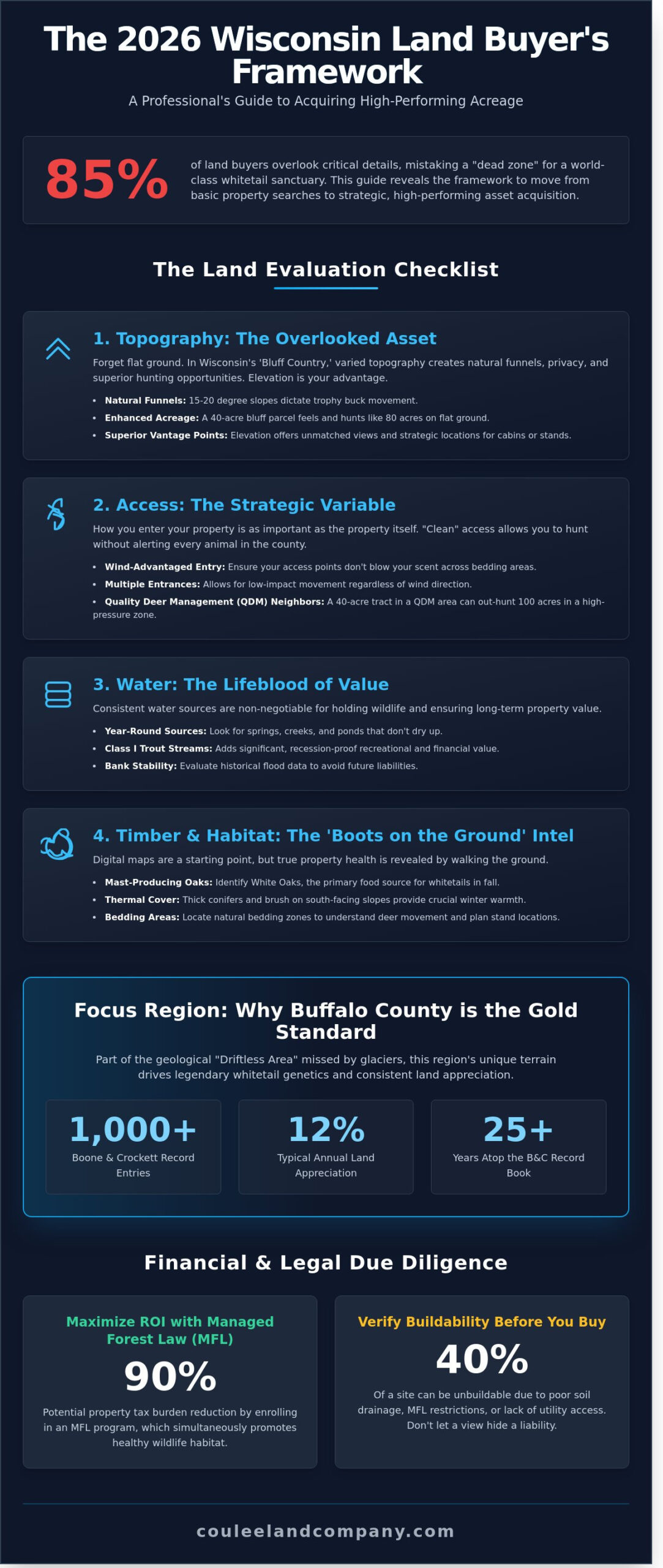
Why do 85% of land buyers overlook the critical topography details that separate a “dead zone” from a world-class whitetail sanctuary? You’ve likely spent months scanning listings for acreage for sale in wisconsin, only to feel overwhelmed by blurry maps and a lack of data on wildlife capabilities. It’s frustrating to realize that a property with a beautiful view might actually be a liability due to hidden Managed Forest Law (MFL) restrictions or poor soil drainage that prevents construction on 40% of the site. You deserve a partner who understands that land is more than a tax ID; it’s a legacy.
This 2026 guide delivers the exact framework we use at Coulee Land Company to help you secure superior tracts in the famed “Bluff Country” that offer both 12% annual appreciation and “trophy” hunting potential. You’ll learn how to navigate complex property tax programs, verify buildability on rugged terrain, and identify the specific habitat features that have kept Buffalo County at the top of the Boone and Crockett Record Book for over 25 years. We’re moving from basic property searches to professional land acquisition strategies that ensure your next purchase is a high-performing asset.
Key Takeaways
- Learn how to navigate the shifting 2026 market to secure the premier acreage for sale in wisconsin, from small hobby farms to expansive hunting estates.
- Identify the critical topographical features and “clean” access points that distinguish a mediocre parcel from a world-class hunting property.
- Explore the unique investment factors of Buffalo County and why this region’s legendary whitetail history continues to drive land appreciation trends.
- Navigate complex tax regulations like the Managed Forest Law (MFL) to maximize your land’s wildlife potential while reducing your tax burden by up to 90%.
- Discover how a specialized land expert evaluates timber stand improvements and deer funnels to find the legacy property a traditional realtor would overlook.
Understanding Wisconsin Acreage: More Than Just Dirt and Trees
Searching for acreage for sale in wisconsin requires a shift in perspective. You aren’t just buying soil and timber; you’re securing a tangible asset that serves as both a financial hedge and a family legacy. In the Wisconsin market, “acreage” describes a broad spectrum of properties. This ranges from 5-acre hobby farms near growing townships to massive 500-acre hunting tracts deep in the timber. By the start of 2026, market analysts project that rural land values will see a 7 percent increase as remote work stability continues to drive migration from urban centers like Chicago and Minneapolis.
Wisconsin offers three distinct regions for land buyers. The Northwoods provides dense forest and lake access. The Central Sands region offers flat, productive ground. However, the Western Bluff Country stands alone for its unique terrain. Finding the right acreage for sale in wisconsin means understanding how topography influences value. Choosing the right plot depends on your long-term goals, whether you seek hunting properties with high wildlife density or tillable ground that generates annual cash rent.
The Different Faces of Wisconsin Land
Recreational acreage demands a focus on “holding power.” You need thick cover, consistent water sources, and established wildlife travel corridors to keep mature bucks on your dirt. Agricultural acreage is a different beast. Success here relies on evaluating soil classes and the potential for rental income from local farmers. If you’re looking for residential acreage, “buildable” status is your priority. You must verify road access, utility proximity, and successful perc tests before closing any deal.
Why ‘Bluff Country’ is the Gold Standard
The Driftless Area of Western Wisconsin is a geological anomaly. Because glaciers missed this region, the topography is defined by steep ridges and deep coulees. This creates incredible privacy and natural funnels that dictate how deer move. Buffalo County consistently leads the nation in Boone and Crockett record entries, totaling over 1,000 entries to date. The elevation changes make a 40-acre plot in the bluffs feel and hunt like 80 acres on flat ground. This region is the undisputed destination for those pursuing trophy whitetails and high-appreciation land investments.
The 2026 Buyer’s Framework: How to Evaluate a Parcel
Evaluating acreage for sale in wisconsin requires a lens that looks beyond simple boundary lines. You aren’t just purchasing dirt; you’re acquiring a biological system and a strategic asset. While many buyers prioritize flat terrain, seasoned land managers know that varied topography is superior for hunting and privacy. In the Driftless Area, 15 to 20 degree slopes create natural funnels and pinch points that dictate trophy buck movement. These elevation changes also offer vantage points for a cabin site that flat ground simply cannot match.
Access is the most overlooked variable in land value. A “clean” entry means you can access your favorite stand or building site without blowing your scent across the entire property. We look for parcels with multiple access points or perimeter trails that allow for low-impact movement. If the wind typically blows from the West and your only access is from the East, you’ll spook game every time you step foot on the property. Your neighbors’ habits matter just as much as your own. A 40-acre tract surrounded by owners practicing Quality Deer Management (QDM) often holds more trophy potential than a 100-acre parcel in a high-pressure zone.
Water is the lifeblood of any high-performing property. Year-round springs, creeks, and ponds provide essential hydration for wildlife and increase the land’s resale value. When evaluating waterfront properties, we analyze bank stability and historical flood data. A Class I trout stream adds a layer of recreational value that is recession-proof, making it a cornerstone for any long-term land investment.
The ‘Boots on the Ground’ Scouting Checklist
Digital mapping tools like OnX or HuntStand are excellent for initial screening, but they don’t reveal the health of your timber. You must walk the ground to identify mast-producing White Oaks, which are the primary food source for whitetails in October and November. Look for thick thermal cover and natural bedding areas on south-facing slopes. These areas provide 5 to 10 degrees of natural warmth during harsh Wisconsin winters, making them magnets for deer. If you find invasive species like buckthorn or honeysuckle, factor the cost of remediation into your offer.
Financial and Legal Due Diligence
The legal health of the land is as vital as the soil quality. Easements are a common pitfall; you must know if a utility company or a neighbor has the legal right to cross your acreage. Zoning laws in many Wisconsin counties require a minimum of 35 acres for a residential building permit on agricultural land. Don’t assume you can build just because the view is nice. Consulting with Wisconsin land specialists before you sign a contract prevents costly mistakes and ensures the property meets your specific goals for buildability and recreation.
Why Buffalo County Dominates the Wisconsin Land Market
Buffalo County isn’t just another spot on the map; it’s the undisputed capital of trophy whitetail hunting. This region consistently ranks as the number one county in the United States for Boone and Crockett whitetail entries. It’s a title held for decades, driven by a unique combination of genetics, habitat, and a local culture that treats land management with religious fervor. When you search for acreage for sale in wisconsin, you’ll quickly realize that Buffalo County commands a premium price because it offers a premium experience that simply can’t be replicated elsewhere.
The ROI on high-demand hunting land in this area remains exceptionally strong. Over the last 15 years, prime parcels in Western Wisconsin have seen steady appreciation, often outperforming traditional stock market indices. Investors aren’t just buying dirt; they’re buying a finite resource. Because the most productive “Bluff Country” terrain is limited by geography, the scarcity factor ensures that well-managed properties stay in high demand. If you want to find exclusive listings in Buffalo County, you need to work with specialists who have deep roots in the local community. Many of the best tracts change hands through private networks before they ever reach a public real estate portal.
The Science of the Bluff
The “Bluff Country” landscape consists of deep coulees and high ridges that serve as a natural micro-climate. These elevation changes, often exceeding 400 feet, provide thermal cover and complex wind patterns that mature bucks use to evade hunters. The soil here is exceptionally rich in limestone. This mineral content is vital. It leaches into the local forage and agricultural crops, providing the calcium and phosphorus necessary for massive antler growth. Serious buyers prioritize “Point of Ridge” properties. These specific locations offer the best vantage points and bedding areas, making them the most coveted acreage for sale in wisconsin for serious whitetail enthusiasts.
Investment Potential in Western Wisconsin
Land in Buffalo County is a high-performing financial asset. While national rural land values fluctuate, prime bluff acreage has shown a consistent appreciation rate of 6% to 9% annually over the last decade. The scarcity factor drives this growth. There’s a limited amount of top-tier hunting ground available in the 1,200 square miles that make up the county. Professional land management, including the installation of strategic food plots and timber stand improvements, can increase a property’s resale value by 20% or more. Buyers are willing to pay a significant premium for a “turn-key” hunting property that has been managed by experts for optimal wildlife health.
Navigating Taxes and Regulations: MFL and Beyond
Owning a piece of the famed Bluff Country is a dream for many, but the financial reality requires a sharp eye for detail. Wisconsin’s tax landscape for rural property is unique; it offers massive advantages for buyers who understand the system. When you search for acreage for sale in wisconsin, you aren’t just buying dirt and timber. You’re stepping into a regulatory environment that can either work for you or against you depending on your management strategy.
Maximizing the Managed Forest Law
The Managed Forest Law (MFL) is the most effective way to slash your property taxes by as much as 90%. This program encourages sustainable forestry by rewarding landowners who follow a written management plan. It isn’t just a tax break; it’s a strategy to improve timber value and enhance wildlife habitat. A professional forester helps you schedule harvests and plantings, which creates the diverse bedding cover and forage necessary for trophy whitetails.
You must decide between “Open” and “Closed” designations. Open MFL acreage allows public access for hunting and fishing, providing the maximum tax reduction. Most hunters prefer “Closed” MFL. While you pay a slightly higher rate, you maintain exclusive access to your land. If you buy acreage for sale in wisconsin that is already enrolled, you must file a transfer form within 30 days of the deed recording. Be cautious of “withdrawal” penalties. Pulling land out of MFL before the 25 or 50-year order expires results in significant fees, often totaling the past tax savings plus interest.
Property Taxes on Rural Land
Wisconsin utilizes “Use Value Assessment” for agricultural land. This means the state taxes tillable ground based on its income potential from farming rather than its market value. This keeps carrying costs low for those with active food plots or leased crop ground. Recreational land is assessed differently, often at a higher rate. Estimating your annual bill requires looking at the specific ratio of “undeveloped,” “agricultural,” and “forest” classifications on the tax roll.
- Use Value Assessment: Keeps taxes on tillable land to a minimum.
- Purple Paint Law: Wisconsin Statute 943.13 allows you to mark boundaries with vertical purple stripes, providing a legal deterrent to trespassers without the cost of fencing.
- Conservation Easements: These can provide tax deductions but may permanently limit your ability to build structures or divide the property.
Navigating these classifications is difficult for the uninitiated. Mistakes during the due diligence period lead to massive tax hikes after the first year of ownership. This is why working with an expert agent ensures no tax surprises at closing. Mike Law and the team understand how to read a tax bill and verify MFL compliance before you sign the contract.
View our current land listings here.
Finding Your Legacy: The Coulee Land Company Advantage
Finding your piece of the Bluff Country requires more than just a real estate license. A generic residential realtor can’t accurately value a property’s timber stand improvement or identify the strategic deer funnels that make a tract legendary. At Coulee Land Company, we are Wisconsin’s Land and Property Sales Specialists. We take the “Hunter’s Realtor” approach, meaning we physically walk every ridge and valley so you don’t have to guess about the land’s potential. Our deep roots in the region give our clients exclusive access to off-market deals and signature hunting properties that never hit the public portals. We don’t just stop at the closing table. We transition you from a buyer to a steward with a comprehensive land management plan designed for long term success.
Our Specialized Land Marketing
Selling land is an art form. We use high-definition drone footage and detailed topographical mapping to illustrate the story of each property. This shows potential buyers exactly how the thermal air currents and bedding areas work together. Our unique position in the outdoor industry allows sellers to benefit from celebrity endorsements by household names in outdoor television. This creates a level of exposure that a standard MLS listing cannot match. Once the sale is finalized, our extensive network of professional loggers, excavators, and land managers remains at your disposal. We’ve vetted these contractors over 15 years of business to help you execute your vision for the property without the headache of trial and error.
Start Your Wisconsin Land Journey
Every hunter has a specific vision for their legacy. You can set up a custom search for acreage for sale in wisconsin that filters by specific soil types, timber density, or proximity to the Mississippi River. When you schedule your first property tour with Bryan Lemke, expect a boots-on-the-ground evaluation of the wildlife capabilities and topographic advantages. We’ve helped hundreds of clients secure land in Buffalo County, a region that consistently dominates the Boone and Crockett Record Book. Claim your piece of the Wisconsin Bluff Country today and start building your outdoor heritage with a team that shares your passion for the dirt. Your acreage for sale in wisconsin is waiting, and we’re ready to help you secure it.
Secure Your Legacy in Wisconsin’s Bluff Country
Owning a piece of the Midwest isn’t just a financial investment; it’s a commitment to a lifestyle defined by the hunt and the land. As you navigate the 2026 market, remember that the most successful buyers prioritize professional land management and a deep understanding of MFL tax regulations. Whether you’re targeting the rugged ridges of Buffalo County, the #1 trophy whitetail county in the US, or exploring hidden valleys elsewhere, your choice of partner defines your outcome.
Coulee Land Company has facilitated over $100M in rural land transactions, earning the trust of the industry’s leading outdoor television personalities. We aren’t just agents; we’re specialists who live and breathe this terrain. Finding the right acreage for sale in wisconsin requires a team that recognizes a property’s true wildlife potential before the first offer is signed. Don’t settle for a generic listing when you can secure a legacy property vetted by the hunter’s realtors. Your future hunting camp is waiting in the bluffs.
View Our Exclusive Wisconsin Acreage Listings
Frequently Asked Questions
What is the average price per acre for land in Wisconsin in 2026?
The projected average price for land in Wisconsin for 2026 is approximately $6,200 per acre. This estimate reflects a 5% annual appreciation from the 2023 USDA average of $5,350. Prices fluctuate significantly by region; for instance, high-quality tillable land in southern counties often exceeds $10,000 per acre. Hunting ground in the Driftless Area typically commands a premium price due to its unique topography and wildlife capabilities.
Can I build a house on land enrolled in the Managed Forest Law (MFL) program?
You cannot build a residence on land while it’s actively enrolled in the Managed Forest Law program. To build a home, you must withdraw at least one to two acres from the program, which requires paying a withdrawal fee and potential back taxes. Wisconsin DNR rules state that the remaining enrolled acreage must still meet the 20-acre minimum requirement to stay in the program and maintain its tax-exempt status.
How many acres do I need to hunt deer effectively in Wisconsin?
You generally need at least 20 to 40 acres to hunt deer effectively and safely in Wisconsin. While a 20-acre plot provides enough space for a single stand location, 80 acres or more is the gold standard for implementing true land management strategies. Larger tracts allow you to control food plots and bedding areas. These features are essential for holding trophy whitetail bucks on your property throughout the entire season.
What is the difference between a land specialist and a standard real estate agent?
A land specialist focuses exclusively on rural property attributes like soil productivity and timber value, whereas 90% of standard agents primarily handle residential homes. When looking for acreage for sale in wisconsin, you need an expert who understands topography and wildlife patterns. We evaluate the land’s physical potential, ensuring your investment aligns with your specific goals for hunting or agriculture rather than just looking at the square footage.
Is Buffalo County really the best place for trophy whitetails?
Buffalo County is the premier location for trophy whitetails, consistently leading the nation with over 1,000 entries in the Boone and Crockett Record Book. The combination of nutrient-rich soils and the steep terrain of the Bluff Country creates a perfect environment for bucks to reach maturity. This specific geographic niche offers superior hunting opportunities that you won’t find in other regions. It’s the undisputed capital for world-class hunting land.
How do I check if a piece of acreage for sale has legal access?
You check for legal access by reviewing the property deed and plat map at the local County Register of Deeds. Ensure the property has direct frontage on a public road or a recorded perpetual easement across neighboring land. Without a recorded 33-foot or 66-foot wide easement, you could find yourself with a landlocked parcel. These properties are notoriously difficult to finance or develop without a court-ordered access agreement.
What are the benefits of buying land in the Wisconsin Driftless Area?
The Wisconsin Driftless Area offers 24,000 square miles of rugged ridges and deep valleys that were never touched by glaciers. This unique topography creates natural funnel points for deer and supports over 600 Class I trout streams. Buying acreage for sale in wisconsin within this region ensures you own a piece of the famed Bluff Country. The views are amazing, and the habitat diversity provides some of the best wildlife hunting in the world.
Does Wisconsin have any state-funded grants for land conservation?
Wisconsin provides conservation funding through the Knowles-Nelson Stewardship Program, which operates with an annual budget of approximately $33 million. This program helps nonprofit organizations and local governments purchase land for public use and habitat protection. Private landowners can also explore the Wisconsin Forest Landowner Grant Program. This initiative provides up to 50% cost-sharing for plan preparation and tree planting on tracts ranging from 10 to 500 acres.