
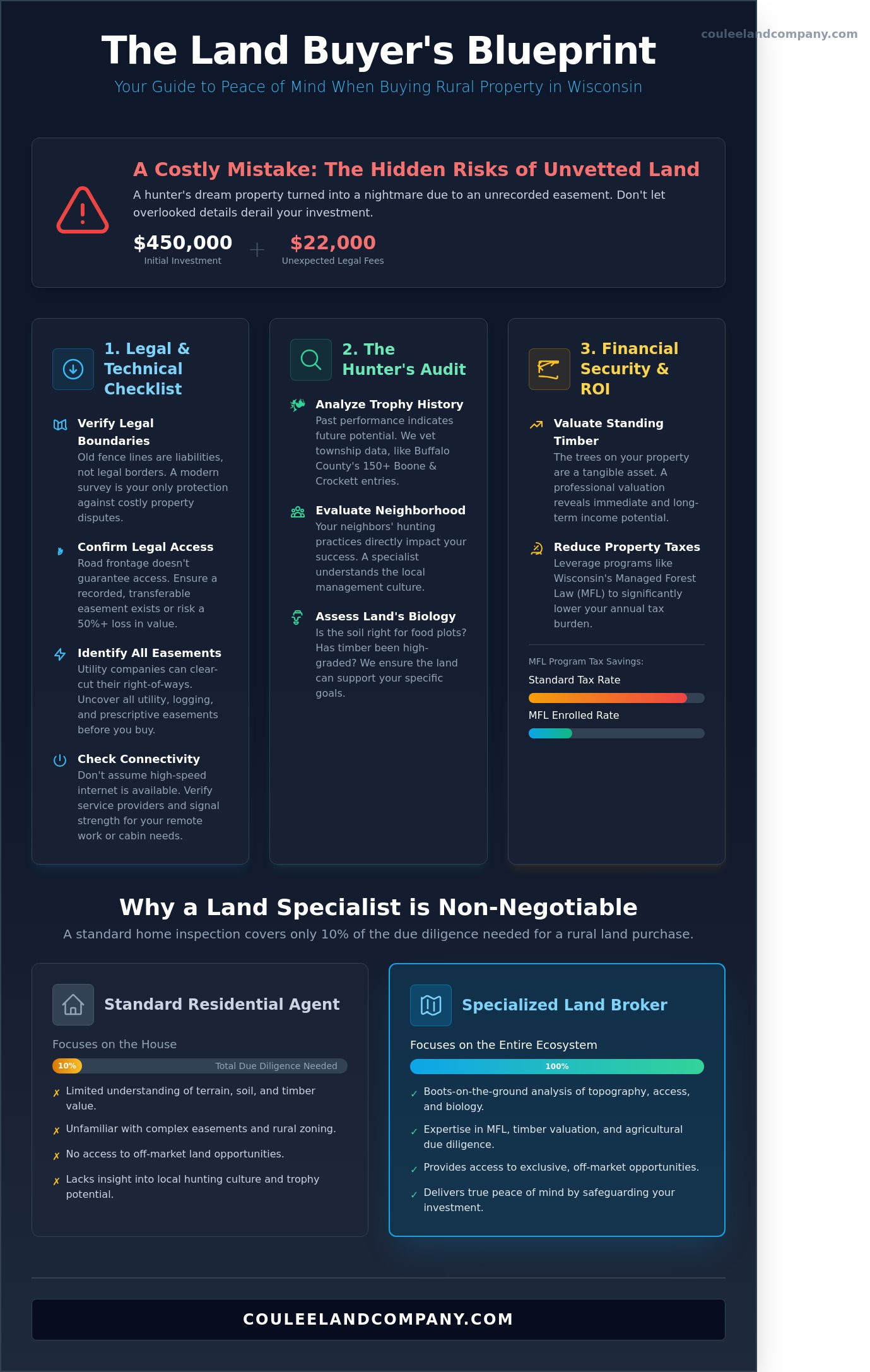
On a crisp morning in November 2025, a hunter standing on a pristine ridge in Buffalo County realized his dream property was missing a critical component: legal access. He had invested $450,000 only to find an unrecorded easement dispute that cost him an additional $22,000 in legal fees before he could even hang a stand. True peace of mind when buying rural property isn’t found in a glossy brochure; it’s built through rigorous, boots-on-the-ground due diligence. You shouldn’t have to wonder if your 2026 investment will be plagued by property line disputes or if your remote work will fail because the local internet provider stops three miles down the road.
We understand that you’re looking for more than just acreage; you’re looking for a legacy in Wisconsin’s Bluff Country where the trophy whitetails are as reliable as the sunsets. This guide reveals the exact strategies our specialists use to vet land for biological potential and market stability. You’ll get a clear checklist to navigate hidden land management costs and confirm high-speed connectivity before you sign the closing papers. We’re going to break down the essential steps to ensure your piece of the Driftless Area is a source of pride rather than a source of stress.
Key Takeaways
- Learn why relying on old fence lines is a liability and how to verify legal boundaries and easements to protect your investment.
- Gain true peace of mind when buying rural property by conducting a professional “Hunter’s Audit” to evaluate township trophy history and neighborhood management practices.
- Discover how to leverage the Wisconsin Managed Forest Law (MFL) to significantly reduce property taxes while valuing your land’s standing timber assets.
- Understand the critical distinction between a standard residential agent and a specialized land broker who provides access to exclusive, off-market opportunities.
- Master the essential due diligence strategies needed to confidently navigate the unique complexities of Wisconsin’s legendary Bluff Country.
Understanding the Foundations of Peace of Mind When Buying Rural Property
True peace of mind when buying rural property is the byproduct of verified data and local insight. It’s the certainty that your investment is both legally secure and biologically capable of meeting your specific goals. For most buyers, the transition from an urban environment to the rugged terrain of Western Wisconsin requires a total recalibration of expectations. In a suburban setting, the city handles the road maintenance, the sewer lines, and the zoning. On a rural tract, you’re the manager of your own infrastructure. You’re responsible for the culverts, the ridge-top access trails, and the long-term health of the timber stand.
Understanding the legal definition of real property is your first essential step. This isn’t just about a deed; it’s about water rights, access easements, and the specific boundaries that define your kingdom. Without this clarity, your dream retreat can quickly become a legal headache. A Land Specialist acts as the ultimate safeguard for your investment, providing a level of scrutiny that standard residential agents simply don’t possess. They look past the scenic views to analyze the “bones” of the land, ensuring the property’s biological productivity matches its price tag.
Western Wisconsin’s “Bluff Country” demands this specialized approach. The terrain here isn’t just a backdrop; it’s a living system that dictates how you’ll use the land. A 30% grade on a ridge affects everything from where you can build a cabin to how you’ll extract a trophy buck in November. Buying here without a specialized guide is like navigating the Mississippi without a chart. You need someone who understands the dirt as well as the market.
The Shift from Residential to Recreational Thinking
A standard home inspection represents roughly 10% of the due diligence needed for a land purchase. You aren’t just buying a building; you’re buying an entire ecosystem. You must know if the soil quality supports 180-bushel corn or if the timber has been high-graded by a previous owner. Peace of mind comes from knowing your primary goal, whether it’s a trophy whitetail hunt or an agricultural investment, aligns with the land’s actual capacity.
The Role of Local Expertise in Western Wisconsin
Buffalo County operates on its own set of rules, dominating the whitetail entries in the Boone and Crockett Record Book with over 150 registered trophies. This prestige creates market dynamics that a city-based agent won’t understand. Coulee Land Company bridges the gap between your vision and the hard data of the terrain. We ensure your peace of mind when buying rural property is built on a foundation of professional land management and deep-rooted local history.
The Legal and Technical Checklist for a Stress-Free Purchase
Achieving true peace of mind when buying rural property requires looking past the timber and the trails. You need to scrutinize the legal skeleton of the land. In the rugged terrain of Western Wisconsin, what you see isn’t always what you own. A rusted wire fence might have been moved by a logger in 1974 or shifted by a fallen oak decades ago. These old markers are rarely the true legal border. Relying on a handshake agreement from the 1980s is a recipe for a 2026 lawsuit. A modern survey is your only shield against boundary disputes that can ruin the enjoyment of your new acreage.
Walking the line with a specialist like Mike Law provides a tactical advantage that no plat map can match. He identifies the subtle signs of prescriptive easements where a neighbor might have established a legal right to a path through 20 years of continuous use. This level of agricultural due diligence ensures you aren’t inheriting a title nightmare that limits your land management options or future resale value. You must also identify utility and logging easements. If a power company has a 50-foot wide right-of-way through your best bedding thicket, they have the legal right to clear-cut it at any time.
Don’t assume road frontage equals legal access. A property might touch a county highway, but if the topography is a 60 degree limestone cliff, you can’t build a functional driveway. You must confirm a recorded easement that is legally binding and transferable. Without it, your land is effectively landlocked, which can slash its market value by 50% or more overnight. Verify that the access is wide enough for emergency vehicles and construction equipment before you sign a contract.
Infrastructure: The Hidden Costs of Bluff Country
In the coulees of Western Wisconsin, drilling a well isn’t a standard $5,000 job. If you’re building on a ridge top to catch those sunset views, you might need to drill 400 to 600 feet through solid rock to hit a reliable aquifer. That can easily push costs past $25,000. Similarly, failing septic systems on steep slopes require specialized mound systems. These setups often cost 40% more than traditional gravity-fed systems and require specific soil types to function. Always insist on a current perc test before closing to ensure the ground can actually support your dream cabin.
Modern Utilities: Remote Work in the Wild
If you plan to manage your hunting land while working remotely, internet is non-negotiable. While fiber-optic lines are expanding into rural townships, many deep valleys still rely on satellite options. Starlink currently offers speeds between 50 and 200 Mbps, but heavy canopy cover in the coulees can cause frequent signal drops. You should also calculate power line proximity. Local co-ops often charge $15 to $20 per linear foot to extend lines. A cabin site tucked 1,000 feet off the road could add $20,000 to your budget before you ever pour a footing. For off-grid peace of mind when buying rural property, evaluate south-facing slopes. A 15 degree southern tilt is ideal for maximizing solar gain during Wisconsin’s short winter days.
The Hunter’s Audit: Ensuring Your Land Holds Trophy Potential
Buying land for its beauty is one thing; buying it for its ability to produce world-class whitetails is a specialized science. True peace of mind when buying rural property comes from knowing the dirt has a proven pedigree. You must analyze the Boone and Crockett history of the specific township or section. In Western Wisconsin, certain sections have produced over 12 record-book entries in the last 15 years, while others just five miles away remain stagnant. Don’t just look at the county level. You need to look at the specific square mile to understand the genetic potential of the local herd.
Neighborhood pressure dictates your success more than your own fence line. If your neighbors practice Quality Deer Management (QDM) and let 3.5-year-old bucks reach maturity, your 40-acre parcel behaves like a 400-acre sanctuary. If the surrounding owners shoot any deer with antlers, you’re fighting an uphill battle. Our team investigates the local culture by looking at historical harvest data and local land use patterns. We frequently identify “biological traps” during our site visits. These are beautiful, mature hardwood stands that look like a postcard but offer zero bedding cover or security. These open, park-like woods allow predators and wind to move too freely, which pushes mature bucks to thicker, “uglier” brush on adjacent lands.
Your ability to hunt the property without being detected is the final piece of the audit. If the primary access road forces you to walk with a north wind at your back into a south-wind stand, you’ve already lost before you climb the ladder. A property that is “unhuntable” on a west wind is a liability, not an asset. We analyze properties based on “low-impact” entry and exit routes. This involves:
- Mapping thermal drifts that pull scent down into valleys at dusk.
- Locating hidden access points that avoid crossing major food sources.
- Ensuring you can reach 80% of your stand locations regardless of wind direction.
- Identifying natural barriers like creeks that mask your sound and scent.
Topography and Habitat Analysis
We utilize LIDAR and 3D mapping to strip away leaf cover and reveal the skeletal structure of the land. This technology identifies natural funnels and hidden bedding benches that are invisible from the ground level. High-value “edge” habitat, where thick thermal cover meets high-energy food, beats a monoculture timber stand every time. It’s the primary reason Buffalo County remains the gold standard for whitetail architecture. Its unique “Bluff Country” topography provides the vertical separation and deep coulees that deer need to feel secure and grow old.
Food Plot and Water Capability
Soil quality directly determines antler growth. A 170-inch buck requires specific micronutrients and high-protein forage that poor, acidic soils cannot provide. We recommend a professional soil test during your due diligence to see if the land can support the 30% protein levels needed for peak genetic expression. Integrating your purchase with a list of proven hunting properties ensures you aren’t just buying dirt, but a manageable ecosystem. Reliable water sources, like a year-round spring or a strategically placed pond, can increase a property’s holding power by 40% during the dry summer months when deer are most vulnerable to dehydration.
Financial Security: Taxes, Timber, and Long-Term ROI
Securing your financial future starts with understanding the hidden mechanics of land value. Owning a piece of Western Wisconsin is a dream for many hunters, but the smartest buyers treat their acreage as a high-performing asset. Achieving true peace of mind when buying rural property requires a deep dive into tax structures and natural resource management. You aren’t just buying dirt; you’re acquiring a complex financial vehicle that offers significant tax shelters and biological growth.
Navigating Wisconsin Land Tax Programs
Wisconsin property taxes can be a burden if you don’t use the state’s specialized programs. The Managed Forest Law (MFL) is the most powerful tool for reducing annual costs. By enrolling your wooded acreage in MFL, you can slash your property taxes by 80% or more. You must choose between MFL-Open and MFL-Closed status. MFL-Open offers the lowest tax rate but requires you to allow public access for hunting and fishing. Most of our clients prefer MFL-Closed. It costs slightly more per acre than the Open program, yet it maintains your total privacy while still providing massive savings compared to standard rates. These programs involve a 25- or 50-year commitment to a forest management plan. This long-term stability provides immense peace of mind when buying rural property because it locks in your carrying costs for decades.
Agricultural land offers additional benefits through Use Value Assessment. In Wisconsin, tillable land is taxed based on its income potential from farming rather than its fair market value for development. This often results in tax bills as low as $5 to $10 per acre for productive fields. When you combine MFL woods with Use Value tillable acres, your total tax liability becomes a fraction of what a residential property owner pays.
Timber as an Asset Class
Your woods are a standing bank account. In the Driftless Area, species like black walnut and white oak are the gold standard for timber value. A single mature walnut tree can be worth thousands of dollars. We always recommend a professional timber cruise before closing. This process provides an immediate verification of your equity. It tells you exactly how much harvestable value exists on the stump today.
Sustainable logging is a vital tool for land health. Removing specific trees opens the canopy, allowing sunlight to reach the forest floor. This stimulates the growth of browse and bedding cover that trophy whitetails require. Bryan Lemke and our entire team prioritize land health over quick timber liquidation. We help you understand how a strategic harvest in 2025 can improve your hunting habitat while padding your bank account. We focus on the long-term vision, ensuring the land remains productive for the next generation.
The market outlook for the Upper Midwest remains exceptionally strong. Data suggests that high-quality recreational land in Western Wisconsin will see a 5.2% annual appreciation rate through 2026. Inventory in premier counties like Buffalo and Trempealeau is at a 10-year low. This scarcity protects your investment from market volatility. When you buy in the right corridor, you’re securing an asset that historically outperforms traditional equities during inflationary periods.
View our exclusive inventory of Wisconsin investment properties.
Why a Land Specialist is the Key to Your Peace of Mind
Buying a home in the suburbs is a transactional process. Buying 80 acres of rugged Bluff Country is a complex investment that requires a “Hunter’s Realtor.” A standard residential agent understands floor plans and school districts, but they often lack the expertise to evaluate a property’s true wildlife capabilities or timber value. They focus on square footage while we focus on deer bedding areas, wind thermals, and soil quality. This specialized expertise is exactly what secures your peace of mind when buying rural property.
Specialized brokers provide access that a typical search engine cannot match. In Western Wisconsin, approximately 25 percent of high-quality land sales occur through quiet, local connections before they ever reach a public listing. Our deep roots in the community allow us to find these “off-market” gems. We understand the local landscape because we live here. We know which ridges in Buffalo County produce trophy whitetails and which valleys are prone to flooding. This insider knowledge prevents you from making a costly mistake on a property that looks good on paper but fails in the field.
The rural closing process involves unique hurdles that can stall a deal for months. You might encounter issues with:
- Managed Forest Law (MFL) program transfers and compliance.
- Complex 1031 exchange timelines for tax deferment.
- Deeded access versus prescriptive easements.
- Agricultural tax credits and zoning restrictions.
We handle these logistical frictions so you don’t have to. Our team ensures that every survey is accurate and every boundary is clear before you sign. This diligence protects your investment from the first day of ownership. We also provide critical post-sale support. Whether you need a reliable excavator for a new driveway or a contractor to help with food plot preparation, our network of local professionals is at your disposal.
The Value of an Authoritative Guide
You need a broker who knows “deer dirt” as well as they know legal contracts. Our agents are boots-on-the-ground specialists who identify red flags in minutes that most buyers miss for years. We look for signs of trespassing, poor timber management, or invasive species that could devalue your land. You can visit our sellers page to see how we rigorously vet and value properties to ensure they meet our superior standards. We don’t just sell land; we sell a lifestyle built on authenticity and results.
Your Future in Bluff Country Starts Here
Owning rural land is the ultimate way to secure your legacy and find a retreat from the modern world. By using a comprehensive checklist and partnering with specialized experts, you eliminate the guesswork. We’ve helped hundreds of hunters and investors find their peace of mind when buying rural property across Western Wisconsin’s most coveted regions. Join the Coulee Land Company community and start your journey with a team that shares your passion for the outdoors. Contact Coulee Land Company to find your peace of mind today.
Secure Your Legacy in the Bluff Country
Owning a piece of Western Wisconsin isn’t just a real estate transaction; it’s the realization of a lifelong dream. By prioritizing a rigorous technical checklist and leveraging Wisconsin’s Managed Forest Law (MFL) programs, you protect your long-term ROI. You must also verify the land’s biological potential before signing. Buffalo County remains the world’s #1 destination for trophy whitetails, consistently dominating the Boone and Crockett record books. Working with a specialist who understands these specific wildlife capabilities ensures you don’t just buy dirt, but a high-performing hunting asset. True peace of mind when buying rural property comes from partnering with experts who live and breathe this terrain every day.
Our team is endorsed by the industry’s leading outdoor television hosts because we deliver results that go far beyond the closing table. We’re Wisconsin’s Land and Property Sales Specialists, and we’re ready to help you navigate the 2026 market with absolute confidence. Your piece of the bluff is waiting for you. View our exclusive Western Wisconsin land listings today to start your journey. We look forward to seeing you in the woods.
Frequently Asked Questions
What is the most important thing to check when buying land in Wisconsin?
Verifying legal access and deed restrictions is the most critical step for achieving peace of mind when buying rural property. You must ensure the property isn’t landlocked and that local zoning allows for your intended use, whether that’s a cabin or a food plot. In Wisconsin, checking the recorded easement at the County Register of Deeds protects your $200,000 investment from future litigation or access disputes.
How much does a land survey cost for a 40-acre tract in 2026?
A standard boundary survey for a 40-acre wooded tract in 2026 typically costs between $3,500 and $5,200 depending on the terrain and brush density. Prices have risen by 4% annually since 2022 due to rising equipment costs and high demand for rural boundary marking. Professional surveyors in the Coulee Region provide the precise GPS coordinates and physical pins necessary to prevent neighbor disputes over 10-foot boundary discrepancies.
Can I build a home on land that is currently in the MFL program?
You can’t build a home on land while it’s enrolled in the Managed Forest Law (MFL) program. To build a structure, you must withdraw at least 1 to 5 acres from the program, which requires paying a withdrawal fee and a tax penalty calculated by the Wisconsin Department of Natural Resources. This process usually takes 60 to 90 days to finalize before you can break ground on your hunting lodge.
Is Buffalo County really better for hunting than other parts of Wisconsin?
Buffalo County is statistically superior because it holds the record for the most Boone and Crockett whitetail entries in the United States, totaling over 150 entries since records began. The unique topography of the Driftless Area provides natural funnels and thermal hubs that grow 170-inch bucks more consistently than the flat lands of Central Wisconsin. Our team focuses on these specific “Bluff Country” corridors because the genetics and age structure here are unmatched.
How do I know if a property has legal access if it is not on a main road?
You determine legal access by reviewing the title commitment for a recorded “ingress and egress” easement that links the property to a public road. A simple physical trail doesn’t guarantee legal rights; you need a written 33-foot or 66-foot wide easement filed with the county. Ensuring this documentation is in place provides total peace of mind when buying rural property, as it prevents future access lawsuits from neighboring landowners.
What are the hidden costs of owning recreational land?
Hidden costs include annual property taxes, which can range from $15 to $40 per acre, and liability insurance for hunters, typically costing $250 to $500 per year. You should also budget $1,200 annually for trail maintenance and invasive species control like buckthorn removal. If the land isn’t enrolled in a tax-reduction program, your carrying costs will be 25% higher than managed forest land.
Does Chronic Wasting Disease (CWD) affect the value of hunting land?
Chronic Wasting Disease (CWD) hasn’t historically decreased land values in Wisconsin, with prices in high-prevalence counties like Iowa and Dane still rising by 6% annually. Buyers prioritize high-quality habitat and “Bluff Country” topography over disease presence because the long-term potential for trophy bucks remains high. While it changes how you manage your deer herd, it hasn’t stopped the 15% year-over-year appreciation we’ve seen in prime hunting tracts.
How do I find high-speed internet options for a remote property?
Starlink is currently the most reliable high-speed option for remote Wisconsin properties, offering speeds between 100 and 200 Mbps for a $120 monthly fee. Some rural cooperatives like Vernon Communications are expanding fiber-optic lines to remote ridges, but you should verify the specific address via their 2024 coverage maps. Don’t rely on cellular hotspots, as deep coulees often block 4G signals, resulting in speeds below 5 Mbps.