
Did you know that by January 2, 2026, the entire $4 million budget for Minnesota’s Beginning Farmer Tax Credit was already exhausted? This rapid depletion shows how competitive the market has become for landowners looking to protect their investment returns. If you aren’t moving with urgency, you’re likely leaving thousands of dollars on the table that could be funding your next food plot or timber stand improvement. Mastering the 2026 Tax Incentives for Rural Properties: WI and MN Breakdowns is no longer just a smart financial move; it’s a requirement for anyone serious about owning a piece of the famed Bluff Country without letting high taxes eat their profits.
You already know that property taxes are often the single largest hurdle to maintaining a world-class hunting property. We agree that your hard-earned capital should go toward growing trophy whitetails, not just into state coffers. This guide will help you unlock the full financial potential of your land by providing an expert breakdown of 2026 property tax incentives across Wisconsin and Minnesota. We’ll cover the $12.50 per acre Farmland Preservation credits in Wisconsin and the specific SFIA payment tiers in Minnesota. You’ll gain a clear understanding of 2026 deadlines and program changes to ensure your land management remains both profitable and effective.
Key Takeaways
- Learn how to leverage the 2026 Tax Incentives for Rural Properties: WI and MN Breakdowns. to maximize your land’s ROI and significantly reduce annual overhead.
- Discover how Wisconsin’s Managed Forest Law (MFL) can slash your property taxes to as low as $1.90 per acre while you focus on growing trophy whitetails.
- Understand the tiered payment structure of Minnesota’s Sustainable Forest Incentive Act (SFIA) and how specific covenant lengths impact your long-term revenue.
- Identify the critical differences between dollar-for-dollar tax credits and standard deductions to maximize cash flow for habitat and property improvements.
- Get the specific 2026 enrollment deadlines and eligibility requirements for both states to ensure you don’t miss out on the next available funding cycles.
Understanding the 2026 Rural Tax Landscape in the Upper Midwest
Land values in Wisconsin’s Bluff Country and Southeast Minnesota continue to trend upward as we head into mid-2026. Buyers aren’t just looking for dirt; they’re looking for wildlife capabilities and long-term investment security. Understanding the 2026 Tax Incentives for Rural Properties: WI and MN Breakdowns. is the best way to ensure your acquisition pays for itself over time. While the broad framework of Property tax in the United States provides the foundation, local programs in the Coulee Region offer much more aggressive savings for proactive owners who prioritize land management.
To better understand the shifting landscape of property costs in the region, watch this helpful report:
Tax Credits vs. Deductions for Landowners
Tax credits are the gold standard because they provide a dollar-for-dollar reduction of your actual tax bill. A deduction only reduces your taxable income, but a credit like Wisconsin’s Farmland Preservation can put thousands of dollars back in your pocket. In 2026, federal deduction limits for state and local taxes remain a hurdle, making these state-specific credits even more valuable. Most general CPAs don’t spend their weekends in a deer stand. They often overlook specialized rural programs. Work with specialists. We identify incentives that generalists miss, ensuring your 2026 Tax Incentives for Rural Properties: WI and MN Breakdowns. work in your favor.
The 1031 Exchange: A Powerful Tool for Land Buyers
If you’re looking to upgrade your current holding, the 1031 Exchange is your best friend in 2026. This allows you to defer capital gains taxes by rolling proceeds from a sale into a “like-kind” property. Many of our clients use this to move from smaller agricultural parcels into premier hunting tracts in the heart of Buffalo County. It’s a strategic way to leverage timber or crop profits into higher-quality land without taking a massive tax hit. For more details on how to execute this move, check out our Guide for Buyers. Your primary goal, whether it’s timber management or trophy whitetail habitat, should dictate how you structure these trades to maximize your financial position.
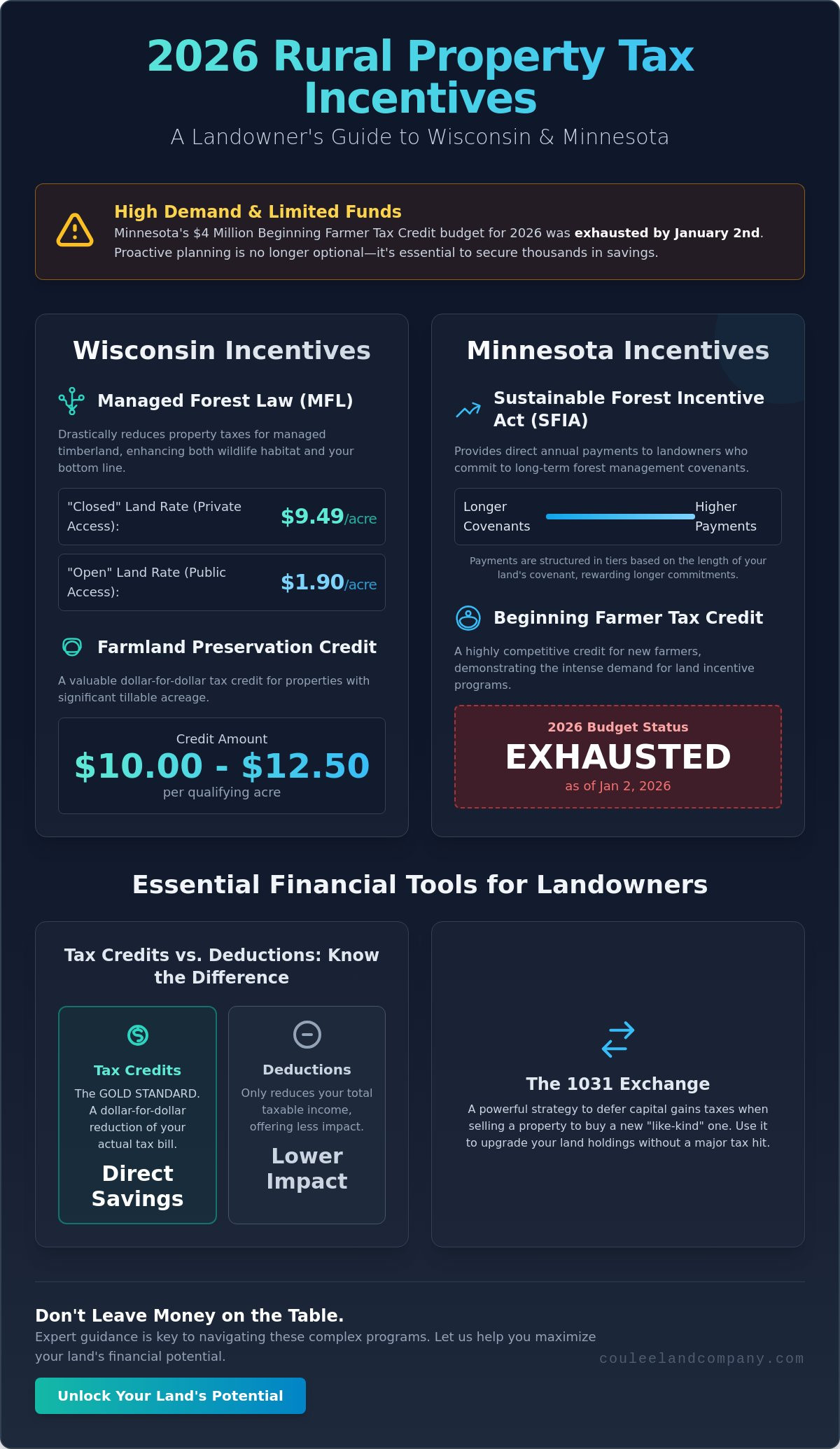
Wisconsin Tax Incentives: Managed Forest Law and Farmland Credits
Wisconsin remains the premier destination for land investors who want to balance elite hunting with fiscal responsibility. The centerpiece of this strategy is Wisconsin’s Managed Forest Law (MFL). It isn’t just a tax break. It’s a land management blueprint. For the 2026 tax year, land entered after 2004 carries an acreage share tax of just $1.90 per acre for “Open” land. Most hunters prefer “Closed” status to maintain privacy. This carries a rate of $9.49 per acre. While higher than open land, it’s a fraction of standard property tax rates. This is a core component of the 2026 Tax Incentives for Rural Properties: WI and MN Breakdowns.
Managed Forest Law (MFL) 2026 Updates
Choosing between open and closed acreage designations is a strategic decision. Open land allows public access for hunting and fishing. Closed land keeps your ridges private. You can close up to 320 acres per municipality. Participation requires a mandatory timber harvest schedule. These harvests are often misunderstood. A well-timed cut creates thick bedding cover and browse. This is exactly what holds trophy whitetails on your property during the late season. If you’re looking for land that already has these plans in place, browse our current hunting properties to see what’s available.
Farmland Preservation and Agricultural Credits
For properties with significant tillable acreage, the Farmland Preservation Program offers a powerful tax credit. As of 2026, credits range from $10.00 to $12.50 per acre depending on your zoning and agreements. To qualify, your land must have produced at least $6,000 in gross farm revenue in the preceding year. This program is particularly effective in areas like Buffalo County, where high-quality ag land often borders steep timber. You can lease the dirt to a local farmer for income and still collect the tax credit. This double-dip strategy significantly offsets the cost of owning world-class hunting ground. If you have questions about specific parcels, our team can help you analyze the potential savings through a property evaluation.
Minnesota Tax Incentives: Navigating SFIA and Beginning Farmer Credits
Minnesota’s approach to land incentives differs significantly from Wisconsin’s tax-bill-offset model. Instead of just lowering a bill, programs like Minnesota’s Sustainable Forest Incentive Act (SFIA) provide direct incentive payments to landowners. This is a critical distinction in the 2026 Tax Incentives for Rural Properties: WI and MN Breakdowns. While Wisconsin focuses on reducing the tax rate per acre, Minnesota pays you to keep your forest land intact and managed. It’s a proactive way to build equity while your timber matures.
The Sustainable Forest Incentive Act (SFIA) Explained
SFIA requires at least 20 contiguous acres of forest land that isn’t used for residential or agricultural purposes. You must choose a covenant length: 8, 20, or 50 years. For 2026, payments for an 8-year covenant start at $12.13 per acre, while a 50-year commitment can reach as high as $26.12 per acre for parcels under 1,920 acres. These payments are taxable income, but they provide a massive boost for your land management budget. Many hunters use these annual checks to fund high-quality food plots or timber stand improvements that attract and hold mature bucks. Keep in mind that 2027 will bring changes to these calculation methods, so locking in your strategy now is vital.
Strategic Planning for 2027 and Beyond
The 2026 cycle proved that timing is everything in the Upper Midwest. The Minnesota Beginning Farmer Tax Credit saw its entire $4 million budget exhausted by January 2, 2026. If you were hoping to sell or lease land to a new farmer this year, you’re likely on a waitlist. This highlights why you can’t wait until tax season to start your planning. You need to prepare your 2027 applications months in advance. Working with a specialist like Mike Law ensures your property is positioned for maximum efficiency before the next funding rush. If you’re considering a move, review our guide on selling hunting land to understand how these incentives affect your property’s market value. Conservation easements also offer a permanent path to tax relief for those protecting Minnesota’s rugged blufflands, ensuring your legacy remains as solid as the land itself.
Secure Your Financial Future in the Bluff Country
Owning a legacy property in the heart of the Coulee Region is a dream that requires sharp financial execution. The 2026 Tax Incentives for Rural Properties: WI and MN Breakdowns. prove that whether you’re managing timber in Wisconsin or enrolling in Minnesota’s SFIA, the window for maximum savings is narrow. You’ve seen how quickly programs like the Beginning Farmer Tax Credit hit their $4 million limit in early January. Don’t let your land’s potential be sidelined by missed deadlines or overlooked credits.
As Western Wisconsin’s Bluff Country specialists, we understand how to position a property to attract the right buyers while maximizing your ROI. Our expertise in Buffalo County trophy whitetail properties is backed by years of results and endorsements from leaders in the outdoor television industry. We aren’t just agents; we’re land managers who live this lifestyle every day. Maximize Your Land’s Value—Contact Coulee Land Company Today. Taking control of your property’s future starts with an expert evaluation. We look forward to helping you build your legacy on the land.
Landowner Tax Incentive FAQs
Is the Minnesota Beginning Farmer Tax Credit still available for 2026?
No, the $4 million in funding for 2026 was completely exhausted by January 2, 2026. Any applications received after that date are currently on a waitlist. This high demand shows why early planning is essential for the 2027 cycle. If you missed the window, focus on preparing your documentation now to be first in line when the next round of funding opens.
How much can I save on property taxes with the Wisconsin Managed Forest Law?
Landowners can save over 80% on their annual property tax bill compared to standard residential or recreational rates. For land entered after 2004, the 2026 “Closed” rate is $9.49 per acre, while “Open” land is just $1.90 per acre. These rates are locked in through 2027. It’s a cornerstone of the 2026 Tax Incentives for Rural Properties: WI and MN Breakdowns. because it allows you to reinvest those savings into your property.
Can I hunt on land enrolled in the Sustainable Forest Incentive Act (SFIA)?
Yes, you retain full hunting rights on your property under the SFIA program. Unlike Wisconsin’s MFL “Open” designation, the Minnesota SFIA does not require you to allow public access for hunting or recreation. This makes it an ideal choice for owners who want to maintain privacy while receiving incentive payments ranging from $12.13 to $26.12 per acre in 2026. It’s a win for both your privacy and your pocketbook.
What is the difference between a tax credit and a tax deduction for landowners?
A tax credit is a dollar-for-dollar reduction of your final tax bill, while a deduction only lowers the amount of income you are taxed on. Credits are generally much more valuable. For example, a $1,000 credit reduces your payment by exactly $1,000. A $1,000 deduction might only save you $250 depending on your tax bracket. Understanding this distinction is key to navigating the 2026 Tax Incentives for Rural Properties: WI and MN Breakdowns.
Do conservation easements reduce the resale value of my hunting land?
Conservation easements may reduce the appraisal value for developers by limiting building rights, but they often preserve or increase value for hunting enthusiasts. Buyers in the Coulee Region prioritize habitat quality and wildlife capabilities. An easement that protects a world-class whitetail corridor can be a massive selling point for the right buyer. We’ve seen properties maintain high market demand because their recreational integrity is legally protected for the future.
How do I apply for the Wisconsin Farmland Preservation Credit in 2026?
You claim this credit directly on your Wisconsin income tax return using Schedule FC-A. To qualify, your land must be in a designated preservation area or under a specific agreement and have produced $6,000 in gross farm revenue in 2025. You’ll also need a certificate of compliance from your county land conservation department. Current 2026 rates provide up to $12.50 per acre for eligible landowners who meet all program requirements.