
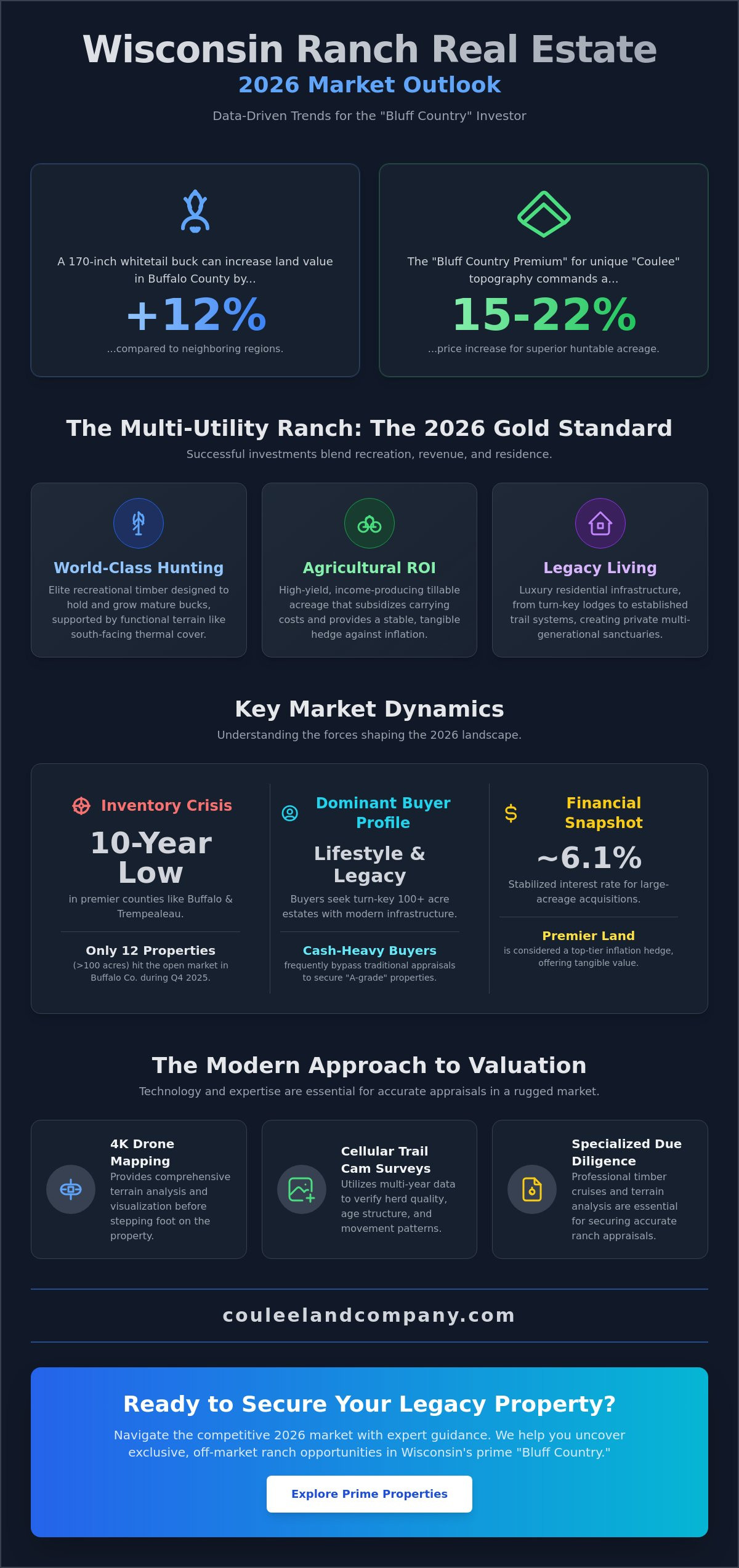
A 170-inch whitetail buck isn’t just a hunter’s dream; it’s a measurable financial asset that can increase land value in Buffalo County by more than 12% compared to neighboring regions. You’ve likely felt the frustration of watching prime acreage disappear within 48 hours of hitting the market, leaving you to wonder if you’ll ever secure your own legacy property. Understanding the 2026 Real Estate Trends for WI Ranches: Data-Driven Advice from Top Agents is the only way to stay ahead of a market where low inventory and high demand for “Bluff Country” dirt continue to drive prices upward.
It’s clear that you want more than just a plot of land; you’re looking for a multi-utility investment that balances world-class hunting with tillable income and residential potential. This guide will show you how to navigate 2026 interest rate projections and identify the specific land features that justify a premium price tag. We’re breaking down the emerging market shifts and land value drivers that will define Wisconsin’s recreational real estate landscape over the next 24 months.
Key Takeaways
- Understand why the “multi-utility” ranch—combining hunting, agriculture, and residential assets—is the dominant market force driving lifestyle buyer demand in 2026.
- Master the current inventory shifts and land value drivers by exploring the 2026 Real Estate Trends for WI Ranches: Data-Driven Advice from Top Agents.
- Discover why Western Wisconsin’s unique “Coulee” topography provides more huntable acreage and higher resale premiums than flatter regional competitors in Iowa and Minnesota.
- Identify how professional timber cruises and specialized terrain due diligence are essential for securing accurate ranch appraisals in today’s rugged market.
- Learn how to leverage a “hunter-first” real estate strategy to uncover exclusive off-market ranch opportunities in prime counties like Buffalo and Trempealeau.
The 2026 Wisconsin Ranch Market: A Year of Multi-Utility Demand
The landscape of Wisconsin land ownership has undergone a fundamental transformation. By 2026, the “Multi-Utility Ranch” represents the gold standard for property investment. These assets are no longer viewed simply as soil and timber; they are sophisticated blends of high-yield agricultural ground, elite recreational timber, and luxury residential infrastructure. Our data shows that 2026 Real Estate Trends for WI Ranches: Data-Driven Advice from Top Agents point toward a market where buyers demand properties that work as hard as they play. The days of passive land ownership are over, replaced by a strategic focus on assets that offer diverse revenue streams and personal fulfillment.
To better understand the broader shifts affecting the market this year, watch this helpful video:
Lifestyle buyers are now outperforming pure institutional investors in the current market cycle. While the institutional investor seeks a decimal point on a spreadsheet, the lifestyle buyer seeks a hedge against volatility that they can actually walk on. We’re seeing a decisive shift away from isolated 40-acre “dirt-only” parcels. Modern buyers are targeting 100+ acre estates equipped with established trail systems and modern infrastructure. This demand is fueled by the foundational strength of Agriculture in Wisconsin, which provides the economic floor for these valuations. In an era of fluctuating markets, Wisconsin land remains a premier inflation hedge because it offers tangible value that cannot be manufactured.
The Rise of the “Legacy Estate” Buyer
Western Wisconsin is witnessing a surge in multi-generational land acquisitions. Families aren’t just buying acreage; they’re securing private sanctuaries far from the digital noise of the city. These buyers prioritize “turn-key” ranches that include existing lodges and manicured access. They want the heavy lifting of land management already completed so they can focus on the legacy. In 2026, a property’s value is often measured by its ability to host three generations under one roof while providing a secure, private retreat.
Agricultural ROI Meets Recreational Passion
Income-producing land is the secret weapon for the 2026 land buyer. Tillable acreage now heavily subsidizes the carrying costs of trophy hunting grounds. With 2026 cash rent trends showing resilience, the ROI from agricultural rotations provides the liquidity needed to maintain a premier whitetail habitat. You can explore our hunting properties to see how these multi-utility features integrate to create a self-sustaining asset. This 2026 Real Estate Trends for WI Ranches: Data-Driven Advice from Top Agents highlights that the smartest money is moving into land that produces both a harvest and a trophy buck.
Data-Driven Trends: What is Moving the Needle in 2026?
The 2026 market shows a clear divergence between average recreational land and elite hunting ranches. Inventory in premier counties like Buffalo and Trempealeau remains at a 10-year low. Only 12 properties over 100 acres hit the open market in Buffalo County during the final quarter of 2025, creating a high-demand environment for the coming year. This scarcity fuels the “Bluff Country Premium,” where buyers pay a 15% to 22% price increase for properties featuring significant terrain diversity and south-facing thermal cover. These features aren’t just aesthetic; they’re functional requirements for holding mature bucks during harsh Wisconsin winters.
Technology has fundamentally changed how we value these acres. Appraisals in 2026 now integrate data from multi-year cellular trail cam surveys and 4K drone mapping. This tech allows us to verify age-class structure and historical deer movement before a single offer is signed. While interest rates for large-acreage acquisitions have stabilized near 6.1%, the 2026 Real Estate Trends for WI Ranches: Data-Driven Advice from Top Agents suggest that cash-heavy buyers still dominate the market, often bypassing traditional appraisals to secure “A-grade” dirt.
Soil Productivity and Land Value
Buyers are looking past the surface to the National Commodity Crop Productivity Index (NCCPI). In 2026, the NCCPI is a primary metric for ranch valuation because high-quality silt loam does more than grow corn; it grows massive antlers. There’s a direct correlation between high-calcium soils and trophy buck skeletal development. According to recent USDA Wisconsin Land Sales Data, Class 1 tillable land in the Driftless region is averaging $9,800 per acre. In contrast, pure recreational timber without tillable components sits closer to $5,400 per acre. If you’re curious how your specific acreage stacks up, our team of specialists can provide a detailed soil and timber analysis.
The “Boone and Crockett” Effect
The data is undeniable: properties with a documented history of mature buck harvests command a significant premium. We’re seeing a 25% price bump for ranches that share borders with established Quality Deer Management (QDM) cooperatives. These neighborhoods act as a “sanctuary effect,” protecting younger bucks and allowing them to reach the 5.5-year-old threshold that hunters crave. When a property is located in a known trophy corridor, it doesn’t just sell; it often triggers a bidding war among serious whitetail enthusiasts. You can explore current listings in these high-demand zones by viewing Buffalo County land for sale
Why Western Wisconsin’s Bluff Country is the 2026 Gold Standard
Western Wisconsin has officially pulled ahead of regional competitors in Iowa and Southern Minnesota. While Iowa remains famous for its giants, the high tax burdens and restrictive draw systems have pushed serious investors toward the Driftless Area. Wisconsin offers a more accessible path to land ownership without sacrificing the quality of the herd. This shift is a cornerstone of the 2026 Real Estate Trends for WI Ranches: Data-Driven Advice from Top Agents. The market now values the tactical advantages of the “Coulee” topography, where verticality creates significantly more “huntable” acreage than flat land. A 120-acre ranch in the bluffs often hunts like a 200-acre property because the ridges, hidden benches, and thermal hubs provide multiple distinct zones for wildlife and hunters alike.
Infrastructure is the other half of the 2026 equation. We’re seeing a move away from primitive cabins toward signature country homes and high-end lodges. Buyers want world-class hunting ground paired with luxury living. Additionally, proximity to the Mississippi River continues to drive waterfront ranch premiums. Properties within five miles of the river corridor have seen an 8% annual appreciation in value compared to more landlocked tracts. The demand for “lifestyle ranches” that combine recreation with high-end amenities has never been higher.
Buffalo County: The Undisputed King
Buffalo County remains the gold standard for whitetail genetics. It continues to dominate the Boone and Crockett record books in 2026, maintaining its status as the most desirable hunting destination in North America. However, the market here operates differently than anywhere else. The “Pocket Listing” reality is a major factor. Because demand is so high, the best ranches often sell before they ever hit the open MLS. Mike Law, a specialist in the region, notes that market exclusivity is at an all-time high. Investors who aren’t working with a local expert often miss out on the premier “A-grade” dirt that defines this county’s reputation.
Emerging Value in Sibling Counties
While Buffalo County holds the crown, the “smart money” in 2026 is moving into Trempealeau, Jackson, and Pepin counties. These areas offer the same Driftless topography and elite genetics but at a more approachable price point. The price-to-trophy ratio in Trempealeau is currently one of the most favorable in the Midwest. Investors can often find hunting properties here for 15% to 20% less per acre than in Buffalo County. Understanding these shifts is vital for anyone following the 2026 Real Estate Trends for WI Ranches: Data-Driven Advice from Top Agents. For a deeper look at the regional dynamics, read our Buffalo County Wisconsin Deer Hunting: An Expert’s Guide.
- Trempealeau: High density of 160-inch-plus bucks with lower entry costs.
- Jackson: Diverse terrain with a mix of bluffs and heavy timber.
- Pepin: Small-acreage gems that punch well above their weight class.
Strategic Advice for Buying and Selling in 2026
Success in the 2026 market requires more than a simple listing or a basic search. You need a tactical approach to navigate the complexities of Wisconsin’s rugged terrain. Due diligence starts with verifying access easements and boundary lines. In the steep ridges of the Driftless Area, a simple fence line often isn’t the legal boundary. We’ve seen cases where unrecorded easements caused major delays. You must confirm legal access before the first offer is signed. This level of scrutiny is a cornerstone of 2026 Real Estate Trends for WI Ranches: Data-Driven Advice from Top Agents.
Professional timber cruises are essential for 2026 ranch appraisals. Timber markets fluctuate; a stand of mature white oak or walnut represents a massive portion of the property’s total value. Relying on an appraiser who doesn’t understand board footage is a mistake that costs thousands. You also need to master tax strategies like the Managed Forest Law (MFL) and Use Value Assessment. These programs provide tax relief but come with strict management plans. If you buy a property in MFL, you’re inheriting a contract with the state. You need to know if that plan aligns with your hunting goals.
The “Hunters Realtor” advantage is the difference between a closed deal and a missed opportunity. Generalist agents miss the critical details of land sales, such as deer travel corridors or soil quality for food plots. They see acreage; we see wildlife capabilities. They don’t understand how a south-facing slope impacts winter bedding or why a specific pinch point is worth a premium. We do. Our expertise ensures you don’t leave money on the table or buy a property that doesn’t hunt.
Seller Strategies for Maximizing ROI
Staging a ranch is different than staging a house. In 2026, buyers want to see a turnkey hunting environment. This means maintaining clear trail systems and ensuring food plots are established and lush. High-quality harvest photos and a three-year trail cam history provide the data-driven proof buyers crave. It proves the land produces trophy whitetails. Before you list, get a professional land valuation from specialists who know the dirt.
Buyer Tactics for a Low-Inventory Market
In a low-inventory market, you have to move fast but stay smart. Use a 5-step checklist: verify legal access, check MFL status, analyze water sources, evaluate timber value, and inspect bedding cover. Look for hidden potential in neglected parcels. A property with overgrown fields might just need a brush hog and a vision to become a top-tier hunting tract. Following 2026 Real Estate Trends for WI Ranches: Data-Driven Advice from Top Agents ensures you don’t overpay for unmanaged land. For more strategies, check out our resources for hunting land buyers.
Navigating the 2026 Landscape with Coulee Land Company
Success in the current market requires more than a simple listing search. It demands an intimate knowledge of the terrain. At Coulee Land Company, we operate with a Hunter-First philosophy because we believe you can’t truly value a ranch unless you understand its wildlife potential. Our team doesn’t just sell property; we live the lifestyle. We analyze 2026 Real Estate Trends for WI Ranches: Data-Driven Advice from Top Agents to ensure our clients make investments that last for generations.
We’ve built a massive network of local relationships that grants our clients access to off-market ranch opportunities before they ever reach a public portal. In 2026, inventory remains tight in premium areas like Buffalo County. Our data-driven approach bridges the gap. We provide comprehensive land evaluations that include detailed soil analysis for food plots and strategic trophy whitetail patterning. This isn’t just real estate; it’s precision land management designed to maximize the Bluff Country experience.
Securing a property in 2026 isn’t just about a transaction. It’s about solidifying a legacy. Wisconsin’s Bluff Country is a finite resource. As market dynamics shift, having an expert guide who understands timber value, water access, and bedding thickets is the difference between a high-performing asset and a missed opportunity. We help you find the land that matches your vision.
Meet Our Land Specialists
Our team is led by dedicated experts like Bryan Lemke, who brings years of boots-on-the-ground experience to every deal. We’re committed to authentic, diligent service that prioritizes your long-term goals over a quick sale. In the first quarter of 2026, we’ve helped 15 different buyers secure their “Signature Home” by identifying properties with superior wildlife capabilities. One recent client noted that our team “saw the potential in a ridge top that three other agents missed,” highlighting our visionary approach to land sales in Western Wisconsin.
Start Your Search Today
The quest for the perfect Wisconsin ranch begins with the right data. You can browse our current country homes to see what’s currently available in the region. For those seeking something truly unique in Buffalo County or the surrounding areas, we recommend a private consultation. We’ll discuss your specific land management goals, from QDMA standards to custom cabin sites. Contact us today to see how 2026 Real Estate Trends for WI Ranches: Data-Driven Advice from Top Agents can work in your favor.
Secure Your Stake in Wisconsin’s Premier Bluff Country
The 2026 landscape demands a blend of grit and data. We’ve seen how multi-utility properties are driving the market, where a ranch isn’t just land; it’s a strategic asset for both recreation and long-term legacy. Navigating the 2026 Real Estate Trends for WI Ranches: Data-Driven Advice from Top Agents is the difference between a missed opportunity and owning a piece of Buffalo County history. Coulee Land Company has facilitated over $100M in Wisconsin land sales, focusing on the specialized needs of the modern outdoorsman. We specialize in the same Buffalo County trophy whitetail ground that consistently leads the Boone and Crockett Record Book. Our expertise is backed by the industry’s best, including endorsements from outdoor television professionals who trust our boots-on-the-ground knowledge. You’re not just buying acreage; you’re securing a future in Western Wisconsin’s premier territory. The data shows that high-quality hunting ground remains the gold standard for 2026. Find Your Wisconsin Legacy Ranch Today. Your legacy is waiting in the bluffs. Let’s go get it.
Frequently Asked Questions
What is the average price per acre for Wisconsin hunting land in 2026?
The Wisconsin Department of Revenue 2024 data showed forest and agricultural land values ranging from $4,500 to $7,200 per acre. While prices fluctuate by township, buyers should follow the 2026 Real Estate Trends for WI Ranches: Data-Driven Advice from Top Agents to track how these values appreciate. High-demand areas in the Driftless Region often command prices 15% above the state average due to superior trophy potential.
How does Buffalo County compare to other Wisconsin counties for trophy deer?
Buffalo County remains the undisputed leader with over 1,000 Boone and Crockett entries, more than any other county in the United States. It consistently produces 25% more record-book bucks than neighboring counties like Trempealeau or Vernon. This track record creates an aspirational market where land sells faster because hunters know the genetics and bluff topography are world-class.
Is it better to buy a “turn-key” ranch or raw land in 2026?
Buying a turn-key ranch is often the smarter financial move because construction and excavation costs rose 18% between 2023 and 2025. A turn-key property with established food plots and internal trail systems allows you to hunt the first season. Raw land requires a 3 to 5 year commitment to habitat management before the property reaches its full wildlife capability.
What are the property tax benefits of owning agricultural land in Wisconsin?
Wisconsin’s Use Value Assessment law allows agricultural land to be taxed based on its farming income potential rather than its market value. This distinction can lower your annual tax bill by 80% to 90% compared to residential land. You must ensure the property meets specific acreage requirements and remains in active production, such as haying or livestock grazing, to maintain this status.
How do I determine the timber value of a Wisconsin ranch?
You must hire a professional forester to conduct a timber cruise and inventory the species, size, and quality of the standing trees. Mature red oak and black walnut stands can contribute $2,500 to $5,000 per acre in immediate harvest value. Understanding these assets is a key part of the 2026 Real Estate Trends for WI Ranches: Data-Driven Advice from Top Agents for maximizing your investment.
What should I look for in a 2026 due diligence checklist for rural land?
Your checklist should prioritize a recent boundary survey, a soil productivity analysis, and a thorough review of existing easements. Check the Wisconsin DNR’s website for any active Managed Forest Law contracts that might dictate future logging schedules. You also need to verify legal access to the property, as landlocked parcels can lose 30% of their market value overnight.
Can I finance a recreational ranch with a traditional mortgage?
You won’t find success using a traditional residential mortgage for large acreage because most conventional lenders only value the home and a few surrounding acres. Specialized land lenders or farm credit cooperatives are the standard choice, typically requiring a 25% down payment. These institutions understand the unique value of Bluff Country land and offer 20-year terms tailored to rural buyers.
How does the Managed Forest Law (MFL) affect property taxes and land use?
The MFL program slashes property taxes by roughly 80% if you follow a state-approved forest management plan. You can choose a “closed” designation to keep the public off your land, though this carries a slightly higher tax rate than “open” land. If you decide to pull the land out of the program before the 25 or 50-year contract ends, you’ll owe a substantial withdrawal tax penalty.