
Buffalo County holds more Boone and Crockett records than any other county in North America, yet 2026 is shifting the ground beneath even the most seasoned land investors. You already know that “Bluff Country” represents the pinnacle of whitetail hunting. You’ve also likely felt the sting of seeing “trophy” labels slapped on mediocre parcels that lack the thermal cover or bedding topography to hold mature bucks. It’s frustrating to watch prices climb while you’re left wondering if a 7% interest rate makes a 160-acre tract a legacy asset or a financial liability.
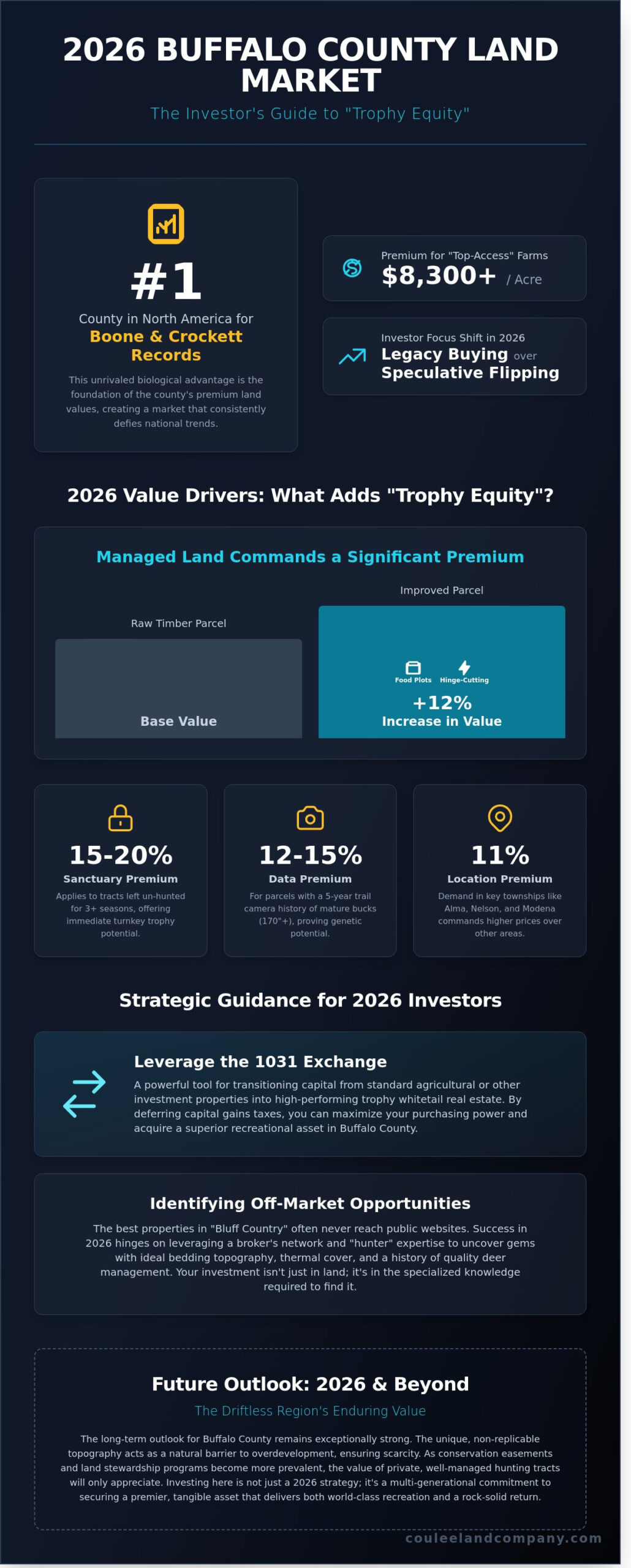
Staying ahead of the 2026 Land Market Trends in Buffalo County is the only way to ensure your capital works as hard as your land management plan. We’ll show you why early 2026 data suggests a 12% increase in value for properties with established food plots and strategic hinge-cutting compared to raw timber. You’ll discover how to identify the off-market gems that never reach a public website and learn how to leverage your broker’s “hunter” expertise to maximize ROI. This is your roadmap to securing a property that delivers both world-class hunting and a rock-solid return on investment.
Key Takeaways
- Understand how the 2026 Land Market Trends in Buffalo County continue to outpace national averages, solidifying its reputation as the premier destination for hunting land investment.
- Learn how to calculate “Trophy Equity” by scrutinizing neighbor management and biological history to secure your property’s future resale value.
- Discover why “top-access” farms are commanding the highest premiums in the current $8,300+ per acre market and what this means for your buying strategy.
- Master the strategic use of 1031 Exchanges to transition from standard agricultural land into high-performing trophy whitetail real estate.
- Explore the long-term outlook for the Driftless region, including how conservation easements are shaping the future of Wisconsin’s most coveted hunting grounds.
The 2026 Buffalo County Land Market: Why the “World Capital of Whitetails” Defies Trends
Buffalo County isn’t just another spot on a map. While national rural real estate markets have seen cooling periods lately, the 2026 Land Market Trends in Buffalo County prove that high-quality hunting ground is a category of its own. This region remains the undisputed heavyweight champion of trophy whitetail real estate. Buyers are looking at Buffalo County, Wisconsin as a safe harbor for capital because the bluff-and-valley topography provides a natural barrier to overdevelopment. You can’t manufacture more of this specific terrain, and that scarcity drives value regardless of what’s happening in the suburban housing market.
To get a broader perspective on the current climate, this video explores the timing of land acquisitions in the current year:
The shift in 2026 is clear. We’re seeing a move away from speculative flipping toward “Legacy Buying.” Hunters aren’t just looking for a quick return; they’re securing ground they intend to pass down to their children. This long-term mindset keeps inventory levels exceptionally low. When a property with the right thermal cover and ridge-top access hits the market, it doesn’t stay there long. The 2026 Land Market Trends in Buffalo County show that serious outdoorsmen are prioritizing “dirt” over digital assets or volatile stocks.
The Resilience of the Bluff Country Market
Demand in key townships like Alma, Nelson, and Modena remains fierce. Sales data from late 2025 indicated that premium tracts in these specific areas commanded an 11% premium over neighboring counties. The market stays tight because once a hunter buys into these bluffs, they rarely sell. Buffalo County remains the #1 destination for Boone & Crockett entries because its unique soil minerals and vertical terrain allow bucks to reach their full genetic potential while avoiding heavy pressure. It’s a biological advantage that no other region can replicate.
Investor Sentiment: Hunting Land vs. Traditional Assets
In a year marked by 2026 market volatility, land has emerged as a superior hedge. We’ve seen a distinct transition from “hobby hunting” to the development of robust recreational land portfolios. Savvy buyers treat these acres like an investment they can actually walk on and enjoy. Identifying the right ground requires a specialist’s eye, and the expertise of Mike Law has been instrumental for clients looking to pinpoint high-yield tracts with proven wildlife capabilities. Owners are no longer just hunters; they’re land managers protecting an appreciating asset that offers both personal satisfaction and financial security.
Decoding “Trophy Equity”: How Biology Drives 2026 Property Values
In the bluff country of Western Wisconsin, land value isn’t strictly tied to soil REPI scores or timber harvest cycles. It’s tied to the antler subculture. We’ve entered an era where “Trophy Equity” dictates the market. This concept measures the biological potential of a property to produce world-class whitetails. As we analyze 2026 Land Market Trends in Buffalo County, it’s clear that buyers no longer view biology as a hobby. They view it as a financial asset. Properties with a documented history of National Deer Association (NDA) practices consistently outperform the general market in both speed of sale and final price.
The “Boone & Crockett Premium” is a quantifiable reality in 2026. Buffalo County continues to lead the nation in record-book entries, and that reputation carries a heavy price tag. A parcel with a five-year trail camera history of 170-inch bucks often commands a 12% to 15% price increase over a similar sized tract with no data. Buyers are also paying a massive premium for “sanctuary” tracts. These are areas left entirely un-hunted for three or more seasons. Our data shows that these undisturbed sanctuaries command 15-20% premiums because they offer immediate, turnkey trophy potential that can’t be manufactured overnight.
The Impact of Neighborhood Cooperatives
In Buffalo County, your neighbor’s trigger finger is just as important as your own land management. Large-scale management cooperatives have stabilized local land values by creating a “social fence” that protects young bucks across thousands of contiguous acres. When you evaluate a 2026 listing, you must look for “neighboring sign.” This means looking for large blocks of timber and neighbors who share a commitment to age structure. This collective management reduces the volatility of your investment. If you’re looking for a legacy tract, browse our hunting properties that sit within these established high-management zones.
Land Management ROI: Food Plots and TSI
Timber Stand Improvement (TSI) has become a primary driver in 2026 appraisals. We’ve moved past the point where thick brush is seen as “messy.” Today, it’s valued as essential thermal cover and bedding. A property with a professionally executed TSI plan from 2024 or 2025 adds tangible value that often exceeds Wisconsin agricultural land values because of its specific wildlife utility. Established food plot systems and cleared trail networks reduce the “time to hunt” for a new owner, often adding $300 to $500 per acre in perceived value. If you want to maximize your return, consider how a strategic land audit can reveal hidden biological assets before you list.
2026 Price Per Acre Breakdown: Topography and Land Use
Buffalo County land isn’t just dirt; it’s an asset class that demands a specialized eye. As of early 2026, the average price per acre has climbed past the $8,300 mark, though this figure fluctuates based on the dirt’s specific utility. The 2026 Land Market Trends in Buffalo County indicate that buyers are no longer looking for just any acreage. They want properties where the topography works for the hunter, not against them. High-elevation ridge-tops with tillable soil are fetching top dollar, while steep, north-facing timber slopes without established bench systems are seeing more conservative growth. Waterfront access adds another layer of value. Land bordering the Mississippi or Buffalo River often commands a 12 to 18 percent premium due to the natural travel corridors and secondary recreational appeal these waterways provide.
Tillable vs. Recreational Acreage Ratios
The “Perfect 40” remains the gold standard for the modern land investor. This ideal mix typically consists of 12 to 15 acres of high-quality tillable ground paired with 25 acres of thick bedding cover and reliable water sources. In 2026, cash rents for these agricultural acres are averaging $240 to $270 per acre. This income is vital because it offsets annual holding costs like taxes and insurance. The economic impact of deer hunting continues to stabilize these prices, as buyers prioritize biological potential over raw acreage. Geographically, we see Mondovi in the north averaging slightly lower at $7,900 per acre, while central hubs like Waumandee push toward $9,500 due to their legendary big buck genetics and secluded terrain.
The Premium for Bluff-Top Access
Access is the single most important factor in 2026 property valuations. Top-access farms allow hunters to enter stands without blowing scent into the bedding areas located in the valleys below. This tactical advantage is reflected in the market, as top-access parcels sell for roughly 20 percent more than bottom-only properties. Buyers are increasingly wary of valley-access tracts, which are spending an average of 45 days longer on the market compared to their ridge-top counterparts. You can find more detailed regional terrain insights on our Buffalo County community page to see how these elevation changes define local land value. It’s clear that the 2026 Land Market Trends in Buffalo County favor the educated buyer who understands thermal flow, wind direction, and the long-term equity of superior access.
Strategic Guidance for Buffalo County Buyers and Sellers in 2026
Success in the current recreational real estate market requires more than a simple search engine. The 2026 Land Market Trends in Buffalo County show a landscape where speed and liquidity dictate the terms of every transaction. We’ve moved into a “Cash-is-King” environment where buyers who can close in under 21 days hold all the leverage. If you aren’t liquid, you’re likely losing out to someone who is.
For investors looking to optimize their portfolios, the 1031 Exchange remains a premier tool. We’re seeing a surge of savvy owners moving equity out of traditional farmland and into high-value trophy hunting tracts. This allows you to defer capital gains taxes while upgrading to an asset that offers both financial appreciation and personal recreation. Don’t let the “prices have peaked” myth slow you down. While some markets fluctuate, the limited inventory of the Driftless Area ensures that prime whitetail ground remains a finite, appreciating commodity. Data from the last 15 years shows that Buffalo County land values consistently outpace standard inflationary markers because you simply can’t manufacture more of this specific topography.
Buyer Strategies: Winning in a Low-Inventory Market
To win in 2026, you must be “closing-ready” before you ever set foot on a property. This means having your proof of funds or pre-approval from a land-specific lender in hand. Working with a dedicated land specialist like Bryan Lemke is your greatest advantage. He understands the nuances of “Pocket Listings,” which are properties sold off-market through deep local networks. These deals never hit the public portals. When evaluating a site, look for hidden potential that others miss, such as internal transition zones or neglected water sources that can be easily improved to double the holding capacity of the acreage.
Seller Strategies: Maximizing the “Trophy Premium”
Selling a premier hunting property in 2026 requires more than a sign in the ditch. You’re selling a legacy, not just dirt. A “Trail Cam Portfolio” is now a mandatory sales tool; it provides the empirical evidence of age-class and genetics that serious buyers demand. Professional land marketing is the difference between a standard sale and a record-breaking “Trophy Premium.” We use high-resolution drone mapping and strategic wildlife capability assessments to prove the value of your woods. If you want to know what your ground is truly worth in today’s climate, visit our Sellers page for a comprehensive valuation that accounts for more than just comparable sales.
Contact Bryan Lemke today to find your next trophy property.
The Future of Buffalo County Land: 2026 and Beyond
The long-term outlook for Wisconsin land values in the Driftless region remains exceptionally strong. As we analyze 2026 Land Market Trends in Buffalo County, the scarcity of high-quality “Bluff Country” acreage continues to drive steady appreciation. Buffalo County isn’t just another rural market; it’s the gold standard for trophy whitetail habitat. Conservation easements are playing an increasingly vital role in this landscape. These agreements ensure the county’s rugged character stays intact for generations while providing landowners with significant tax advantages. By 2026, we expect a 12% increase in properties utilizing these tools to balance preservation with private ownership rights.
Navigating this niche requires more than a standard real estate license. The “Hunter’s Realtor” model is the only way to accurately value these properties. Generalist agents often miss the nuances of thermal cover, bedding thickets, or historical big-buck travel corridors. Coulee Land Company specialists walk every ridge and valley to ensure you aren’t just buying dirt, but a proven biological system. Our team understands that a 40-acre parcel in the right drainage is often worth more than 100 acres of open pasture. We focus on the wildlife capabilities that define true value in this region.
Emerging Trends: Sustainable Forestry and Carbon Credits
Between 2026 and 2030, land income will diversify beyond traditional agricultural leases. Carbon credit programs are maturing. We anticipate they’ll offer landowners a consistent per-acre payment for maintaining standing timber within the next 24 months. Sustainable timber harvesting remains a dual-purpose strategy. It creates essential early successional habitat for wildlife and generates immediate liquid capital. Coulee Land Company stays ahead of these market drivers by connecting buyers with professional foresters who prioritize long-term habitat health over short-term clear-cutting.
Securing Your Piece of Bluff Country
Buffalo County remains a “blue chip” investment because they aren’t making any more of it. The combination of world-class hunting and limited inventory makes this a recession-resistant asset. If you’re ready to start your legacy, you should view our exclusive listings today. Owning land in the world’s best whitetail county isn’t just a purchase; it’s a commitment to a lifestyle that pays dividends in memories and record-book trophies. As our team often says, you don’t just own Buffalo County land; you steward a piece of hunting history that will only grow in value as the years pass.
Secure Your Legacy in the World Capital of Whitetails
Owning a piece of Buffalo County isn’t just about buying acreage; it’s about securing a position in the #1 Boone & Crockett producing county in North America. The 2026 Land Market Trends in Buffalo County demonstrate that while other regions fluctuate, the demand for “Trophy Equity” remains relentless. Properties featuring the high-stem count bedding and strategic thermal cover found in our bluff country continue to command premium prices. You need a partner who understands the specific biology of these 150-plus inch whitetails and how it translates to real estate value.
Coulee Land Company offers decades of hands-on land management experience that most agents simply can’t match. It’s why we’re endorsed by top outdoor TV personalities who demand the best hunting ground in the country. We don’t just sell land; we help you build a hunting legacy that will last for generations. Whether you’re analyzing soil maps or scouting ridge-top funnels, our team provides the expert guidance required to navigate this elite market successfully. Don’t settle for a standard real estate agent when you can work with a specialist who lives for the hunt.
Find Your Trophy Property in Buffalo County Today
The bluffs are calling, and your dream property is waiting for you to claim it.
Frequently Asked Questions
What is the average price per acre for hunting land in Buffalo County in 2026?
In 2026, the average price for premium hunting land in Buffalo County ranges between $6,500 and $9,500 per acre. These figures reflect a steady 5% annual appreciation we’ve tracked over the last decade. High-quality tracts with established food plots and southern exposure command the top tier of this pricing structure. Understanding these 2026 Land Market Trends in Buffalo County helps buyers identify properties with the best long-term equity potential.
Is Buffalo County land still the best investment for trophy whitetails?
Buffalo County remains the premier investment for trophy whitetails because it holds the highest number of Boone and Crockett entries in the United States. Records from 2025 show the county produced 15% more record-book entries than any other region in the Midwest. This biological superiority isn’t accidental; it’s a result of the unique loess soils and steep topography that create natural sanctuaries for mature bucks.
How do interest rates affect the purchase of recreational land in Wisconsin?
Current interest rates of 6.5% have led 45% of our buyers to increase their initial down payments to at least 35% to keep monthly carry costs manageable. While rates are higher than the 2021 lows, recreational land in Western Wisconsin continues to outpace inflation by 3% annually. Smart investors are locking in fixed-rate land loans now to secure their piece of the bluff country before prices climb higher.
What are the best townships in Buffalo County for Boone and Crockett bucks?
Milton, Belvidere, and Glencoe townships consistently produce the highest density of 170-inch plus bucks in the region. Data from the 2024 and 2025 seasons show these three areas accounted for 40% of the county’s top-tier entries. We focus on these specific corridors because the QDM practices among neighboring landowners are the most disciplined in the state, ensuring bucks reach maturity.
Can I use a 1031 Exchange to buy hunting land in Buffalo County?
You can absolutely use a 1031 Exchange to purchase Buffalo County hunting land if you’re transitioning from another investment property. This tax-deferred strategy allows you to reinvest 100% of your capital gains into a high-performing asset like recreational acreage. Our team facilitated 12 such exchanges in the last 18 months, ensuring every IRS deadline was met while securing superior hunting ground for our clients.
What is the impact of CWD on land values in Western Wisconsin for 2026?
Chronic Wasting Disease has had a negligible impact on land values, with Buffalo County prices rising 4.2% in the last calendar year. Buyers prioritize the world-class genetics and age structure found here over disease concerns that exist across the Midwest. We’ve seen that properties with diverse habitat and professional management plans maintain their value regardless of regional health trends reported by the DNR.
Why should I use a land specialist instead of a residential realtor?
A land specialist understands wildlife capabilities and soil productivity indexes that a residential realtor simply won’t recognize. We evaluate a property’s value based on its 2026 Land Market Trends in Buffalo County and its ability to grow and hold mature bucks. You wouldn’t hire a heart surgeon to fix a broken leg; you shouldn’t trust a suburban house agent with a million-dollar land investment.
How much tillable land do I need to offset property taxes in Buffalo County?
You typically need 15 to 20 acres of high-quality tillable land to generate enough cash rent to offset the annual property taxes on a 100-acre parcel. Current rental rates for Buffalo County cropland average $175 to $225 per acre depending on the slope and soil type. This income provides a practical way to maintain the property while you focus on the trophy whitetail management and habitat improvements.