
You worked decades to build equity in your Wisconsin acreage, so why would you hand over 15% to 20% of that hard-earned legacy to the IRS just to upgrade your hunting grounds? Selling a legacy property often triggers deep-seated anxiety about tax bills that can easily reach six figures, especially when you are eyeing a premier ridge-top in Buffalo County. It is a common frustration for landowners who want to grow their portfolio but feel trapped by the complexity of 1031 exchange rules for land wisconsin. You deserve to keep your capital working for you in the soil, not sitting in a government account.
We understand that the fear of missing the strict 45-day identification window or choosing the wrong like-kind property can be paralyzing. This guide provides the strategic roadmap you need to navigate both federal requirements and state-specific nuances so you can consolidate smaller parcels into one superior Bluff Country trophy property. We will explain how to manage the 180-day closing deadline and why selecting a Qualified Intermediary is the most critical move you’ll make this year. By the end of this article, you’ll have the confidence to execute a tax-deferred exchange that secures your outdoor legacy for the next generation.
Key Takeaways
- Learn how to defer both federal capital gains and Wisconsin state income taxes by strategically reinvesting your land equity into higher-performing properties.
- Discover the flexibility of “like-kind” rules that allow you to swap raw hunting land for diverse assets like multi-family rentals or commercial holdings.
- Master the critical 45-day identification and 180-day closing windows required by the 1031 exchange rules for land wisconsin to keep your tax-deferred status intact.
- Understand the “equal or greater value” requirement to achieve 100% tax deferral and avoid the common pitfalls of taxable “boot.”
- Identify why partnering with a specialized land expert provides essential access to off-market Bluff Country inventory that traditional residential realtors often miss.
What is a 1031 Exchange for Wisconsin Landowners?
A 1031 exchange is a powerful tax-deferred strategy that allows you to swap one investment property for another. If you own a parcel in Buffalo County or the surrounding Coulee Region, understanding What is a 1031 Exchange? is vital for protecting your hard-earned equity. This provision of the IRS code lets you sell your current acreage and reinvest the proceeds into a new property without triggered immediate capital gains taxes. It’s a tool used by savvy investors to upgrade their land holdings or consolidate smaller parcels into a premier trophy property.
For Wisconsin landowners, this matters because it defers both federal capital gains and state-level income tax. Your primary home doesn’t qualify for this treatment. However, your "hunting 40" or a timber tract used for investment certainly does. The IRS requires "investment intent," which means you hold the land for profit or productive use in a trade or business. Wisconsin follows federal guidelines, which simplifies the process when looking at 1031 exchange rules for land wisconsin. This alignment allows for interstate swaps; you can trade Wisconsin dirt for land in another state if that fits your portfolio.
To better understand this concept, watch this helpful video:
Relinquished vs. Replacement Property
You’ll deal with two primary assets in this transaction. The Relinquished Property is the land you currently own and want to sell. The Replacement Property is the new acreage you intend to acquire. To keep the IRS satisfied, you can’t touch the cash from the sale. A Qualified Intermediary (QI) must hold the funds in a dedicated account to avoid "constructive receipt." If the money hits your personal bank account for even a second, the tax deferral fails. Our team often works with sellers to ensure their properties are positioned correctly for these specific buyer requirements.
Tax Savings: What You Are Actually Deferring
The savings are substantial for high-net-worth landowners. Federal capital gains rates are usually 15% or 20% depending on your taxable income. You also face the Net Investment Income Tax (NIIT) of 3.8% if your modified adjusted gross income exceeds $200,000 for individuals or $250,000 for married couples filing jointly.
Wisconsin’s state tax treatment adds another layer. While Wisconsin taxes capital gains as regular income, the state currently offers a 30% exclusion for most long-term capital gains. Even with that exclusion, the remaining 70% of your gain is taxed at your top marginal rate, which can reach 7.65%. By following the 1031 exchange rules for land wisconsin, you keep 100% of your equity working for you in the field rather than writing a six-figure check to the government.
The ‘Like-Kind’ Rule: What Land Qualifies in Wisconsin?
A common misconception among Wisconsin landowners is that “like-kind” requires swapping a property for one that’s identical in use. Many believe they must trade a dairy farm for a dairy farm or timberland for timberland. This is a myth. Under the 1031 Like-Kind Exchange Rules, the term refers to the nature or character of the property, not its grade or quality. In the eyes of the IRS, almost all real property held for investment or business use is like-kind to other real property.
This flexibility allows for strategic portfolio shifts. You can trade a rugged ridge in the Driftless Area for a high-yield tillable farm in the Central Sands. You could even swap raw hunting land for a multi-family rental unit in a growing town or a commercial lot in a high-traffic corridor. The 1031 exchange rules for land wisconsin are designed to encourage reinvestment, provided you meet the “Business or Investment” test. This means the property cannot be held primarily for resale, such as a “fix-and-flip” project where you intend to sell immediately after improvements. Since the 1921 inception of this tax code, the focus has remained on continuing your investment rather than cashing out.
Common Land Exchange Scenarios
- Swapping a 40-acre starter hunting parcel for a larger Buffalo County trophy property to target world-class whitetails.
- Exchanging low-yield agricultural land for waterfront property that offers both recreational value and long-term appreciation.
- Trading a country home, provided it has been used strictly as a rental for at least 24 months, for managed timberland.
What Does NOT Qualify as Like-Kind
While the 1031 exchange rules for land wisconsin are broad, they aren’t universal. Personal use property is the most frequent disqualifier. If you own a cabin used only for family weekends, it won’t qualify. Similarly, property held as “inventory” by developers, such as lots in a subdivision meant for immediate sale, fails the investment test. Finally, you cannot exchange interests in partnerships or LLCs. You must own the real property itself to move forward with a valid exchange. If you’re unsure if your current acreage qualifies, our team of land specialists can help evaluate your property’s status.
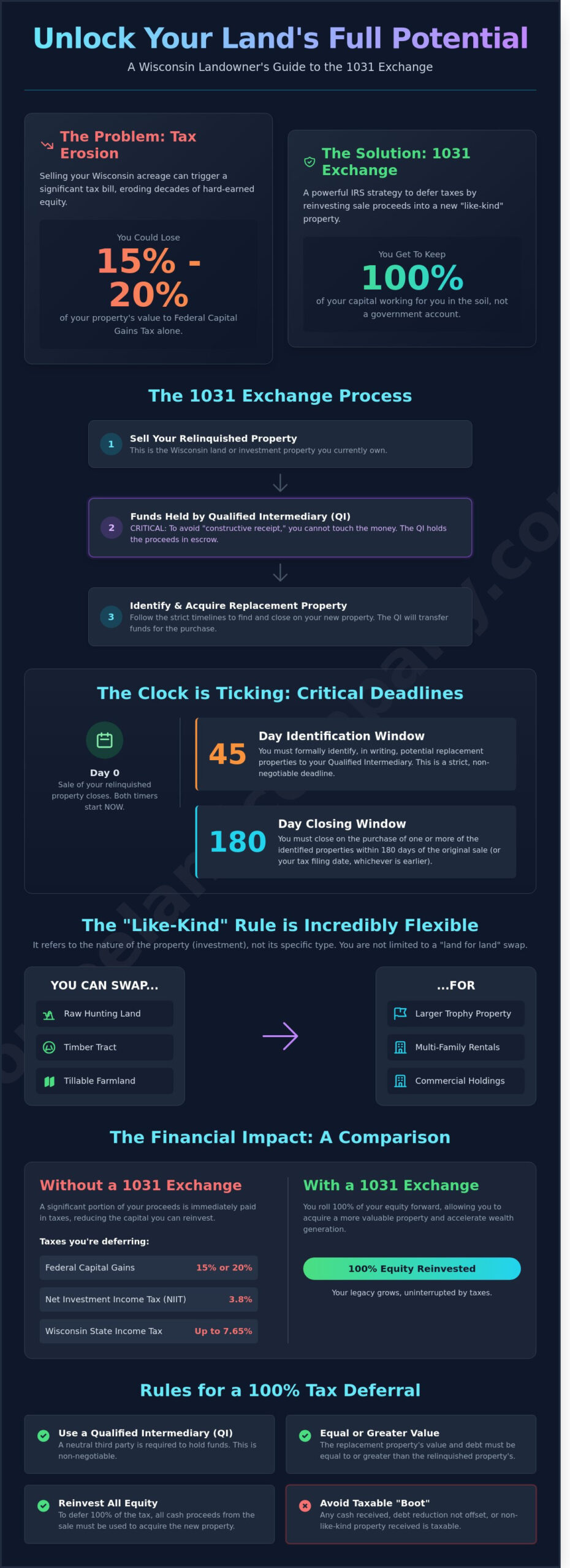
The 1031 Exchange Timeline: Navigating the 45 and 180-Day Rules
The 1031 exchange timeline is a rigid framework that leaves zero room for error. Day 0 begins the moment the deed for your sold parcel is recorded at the county office. From that midnight, you have exactly 45 calendar days to identify your next investment. This identification window is often the most stressful period for landowners because Wisconsin’s land market moves fast. You must complete the entire transaction within 180 days of the initial sale. Land deals in the Driftless Area often require additional due diligence that can eat into this time. A standard timber cruise might take 14 days to schedule; a boundary survey in rugged terrain could take 3 to 6 weeks depending on the season. Following the 1031 exchange rules for land wisconsin means accounting for these logistical hurdles before you even list your property.
How to Correctly Identify Replacement Land
The IRS provides three specific pathways for identifying your next property. Most Wisconsin hunters use the Three-Property Rule, which allows you to list up to three potential parcels regardless of their total market value. If you need a larger portfolio, the 200% Rule allows you to identify any number of properties, provided their combined fair market value does not exceed 200% of the land you sold. The 95% Exception is a technical fallback where you can identify more than three properties with a total value exceeding the 200% limit, but only if you actually acquire 95% of the total value identified. This is rare in standard recreational land deals but useful for complex portfolios.
Managing Deadlines in a Low-Inventory Market
Inventory for prime ridge-top acreage is often tight. You should begin scouting hunting properties months before your own land goes under contract. If you find the perfect 80-acre tract in Buffalo County before your current land sells, a “Reverse Exchange” allows a qualified intermediary to hold title to the new land until your sale closes. This prevents you from losing a “once-in-a-lifetime” property to a competing buyer. Common pitfalls that kill exchanges include 10-day delays in title searches or unexpected financing hitches. Working with a specialist who understands the 1031 exchange rules for land wisconsin ensures these deadlines don’t derail your tax strategy. Success in this market requires a proactive approach to property identification:
- Identify target counties like Buffalo, Trempealeau, or La Crosse early.
- Secure a Qualified Intermediary (QI) before closing your sale.
- Schedule soil tests and surveys immediately after the 45-day identification.
- Keep a backup property on your identification list in case the primary deal fails.
The 180-day completion window is not an extension of the 45-day window; it runs concurrently. If you take the full 45 days to identify a property, you have only 135 days remaining to close. In a region where trophy whitetail bucks drive land value, missing a deadline can result in a massive capital gains tax bill that could have been used to improve your new acreage.
Strategic Reinvestment: Upgrading Your Wisconsin Land Holdings
Executing a successful trade requires a firm grasp of the “Equal or Greater Value” rule. To defer 100% of your capital gains taxes, you must reinvest the entirety of your net sale proceeds into a replacement property of equal or higher market value. If you walk away from the closing table with cash or fail to replace the mortgage debt from your previous property, the IRS identifies this as “boot.” Any boot received is treated as taxable income, which can quickly erode the financial benefits of your trade. Smart investors use these 1031 exchange rules for land wisconsin to consolidate assets, such as trading three disconnected 40-acre parcels for one 150-acre contiguous estate in the heart of the Coulee Region.
Consolidating your holdings into a single “Bluff Country” tract isn’t just about convenience; it’s a strategic move to enhance wildlife capability. Large, contiguous blocks of timber and ridge-top fields allow for superior deer herd management and more controlled hunting pressure. By utilizing a 1031 exchange, you’re effectively shifting your equity from stagnant or high-maintenance lots into a high-performing legacy property that offers both recreational joy and long-term appreciation.
Maximizing ROI in Buffalo County
Buffalo County remains the gold standard for land investment across the Midwest because it consistently dominates the whitetail entries in the Boone and Crockett Record Book. When evaluating a potential 1031 replacement property here, you’ve got to look beyond the price per acre. We analyze the balance between timber value and recreational appeal. For instance, a property might hold $45,000 in harvestable oak timber, but its true ROI often stems from its location within a proven trophy buck corridor. You should consult with agents like Mike Law to uncover off-market opportunities that provide the specific “wildlife capability” required for a world-class hunting tract.
Debt and Equity Considerations
You must replace the exact mortgage value on your new property to avoid a tax hit. If you sell a working farm with a $250,000 balance, your new recreational tract needs at least $250,000 in debt or an equivalent amount of additional cash injected into the deal. Many landowners use this transition to move from high-maintenance agricultural land to low-maintenance recreational timber. If the replacement property needs work, you can utilize an “improvement exchange.” This allows you to use exchange funds to build a cabin or establish 12-acre food plots before the exchange period closes, ensuring every dollar of your equity is working to improve the land’s value.
Ready to find your next legacy estate? View our current hunting properties to start your search today.
Why a Wisconsin Land Specialist is Critical for a 1031 Exchange
Executing a tax-deferred swap requires more than a standard real estate license. A residential agent focuses on square footage and school districts. A land specialist focuses on timber value, soil productivity, and wildlife potential. When you are navigating 1031 exchange rules for land wisconsin, the technical requirements for “like-kind” property are rigid. We ensure your replacement property aligns with IRS Section 1031 standards while meeting your goals for land appreciation and recreation.
Access to inventory is often the deciding factor in a successful exchange. In regions like Buffalo County, approximately 35% of high-quality tracts never reach the public MLS. Our team provides access to these off-market opportunities, ensuring you aren’t forced into a subpar purchase just because the 45-day identification clock is ticking. We vet every acre for its investment quality, checking easements, access rights, and land-use designations that a generalist might overlook.
Coordination is the final piece of the puzzle. We work directly with your Qualified Intermediary (QI) and CPA to synchronize the sale of your relinquished property and the acquisition of your new land. This seamless communication prevents the technical errors that lead to “boot” or disqualified exchanges. Our role is to manage the timeline so you can focus on the land itself.
Coulee Land Company’s Expertise in Land Swaps
Bryan Lemke and the Coulee Land team specialize in preparing sellers for the high-pressure 45-day identification period. We’ve helped dozens of buyers secure trophy whitetail land in the heart of Bluff Country by identifying replacement properties months before the initial sale even closes. Our deep-rooted network includes the most reliable Qualified Intermediaries and land-use attorneys in Western Wisconsin. This provides you with a veteran support system that understands the specific nuances of rural property law and the 1031 exchange rules for land wisconsin.
Taking the Next Step
You shouldn’t list your property until a comprehensive 1031 strategy is in place. Missing a single deadline can result in a tax liability exceeding 15% to 20% of your gain. We provide specialized land valuations that go beyond simple comps, looking at the biological and topographical value of your acreage to determine your true potential gain. Contact Coulee Land Company to discuss your 1031 exchange strategy today and ensure your legacy remains protected in the soil of Western Wisconsin.
Maximize Your Wisconsin Land Investment Today
Mastering the 1031 exchange rules for land wisconsin allows you to defer capital gains and reinvest in superior acreage without losing 15% to 20% of your equity to taxes. You’ve got exactly 45 days to identify a replacement property and 180 days to finalize the deal. These timelines are strict. Whether you’re trading a small parcel for a sprawling tract in Buffalo County or seeking land with higher wildlife capabilities, the “like-kind” provision is your most powerful tool for growth. Our team specializes in the rugged “Bluff Country” of Western Wisconsin, a region that leads the nation in Boone and Crockett whitetail entries. We’ve built a proven track record navigating these complex rural transactions for landowners who demand results. Endorsed by top outdoor television personalities, we understand that your land is more than a tax ID; it’s a legacy. Don’t leave your reinvestment strategy to chance when you can partner with specialists who know the terrain and the tax code.
Ready to trade up? See how our Land Specialists can guide your 1031 Exchange.
Your next great hunting property is waiting in the coulees.
Frequently Asked Questions
Can I sell a rental house and buy hunting land with a 1031 exchange?
Yes, you can swap a residential rental for hunting land because both are considered “like-kind” investment properties under IRS Section 1031. You’re able to transition from a duplex in town to 80 acres of prime Buffalo County bluff country without an immediate tax bill. The key requirement is that you must hold the new land for a business or investment purpose, such as timber harvesting or leasing the ground to other hunters.
What happens if I miss the 45-day identification deadline in Wisconsin?
If you miss the 45-day identification deadline, your exchange fails and you’ll owe the full capital gains tax on your sale. The IRS provides zero extensions for this timeline, even if the 45th day falls on a Sunday or a holiday. You must identify up to three potential properties in writing to your Qualified Intermediary by midnight on the 45th day to keep your 100 percent tax deferral intact.
Does Wisconsin have its own 1031 exchange tax forms?
Wisconsin follows federal guidelines for tax deferral, but you’re required to report the transaction on your state tax return using Schedule 2K-1 or other entity-specific forms. While the state honors the federal deferral, you’ve got to disclose the sale of any Wisconsin-based property to the Department of Revenue. Following the 1031 exchange rules for land Wisconsin ensures you don’t face unexpected state penalties or audit triggers during tax season.
Can I do a 1031 exchange if I am selling land to a family member?
You can sell your land to a family member, but the IRS requires both you and your relative to hold your respective properties for at least 24 months after the swap. If either party sells before this two-year window closes, the tax deferral is disqualified and all gains become taxable. You must also ensure the transaction happens at a documented fair market value to satisfy Section 1031(f) anti-abuse regulations.
Is a 1031 exchange possible for ‘vacant’ land with no structures?
Yes, vacant land is fully eligible for a 1031 exchange as long as it’s held for investment or use in a trade or business. You don’t need a cabin or a barn to qualify for these tax benefits. Many of our clients trade small commercial parcels for 160 acres of Western Wisconsin timberland to build a legacy. As long as you aren’t a developer holding the land as inventory for sale, it meets the IRS criteria.
How much does a Qualified Intermediary cost for a Wisconsin land deal?
A standard Qualified Intermediary typically charges between $800 and $1,200 for a basic delayed exchange involving one sale and one purchase. If your deal involves multiple properties or a complex “reverse” exchange, fees can increase to $3,000 or more. This is a small price to pay to protect your equity from the 15 percent federal capital gains tax on a $500,000 land sale in the Driftless Area.
Can I live on the land I bought through a 1031 exchange?
You can’t move onto the land immediately because the IRS requires the property to be held for investment rather than personal use. To meet the safe harbor requirements of Revenue Procedure 2008-16, you must own the property for at least 24 months before converting it to a primary residence. During those first two years, you’ve got to rent the land out for at least 14 days annually at a fair market rate.
What is ‘boot’ in a 1031 exchange and how is it taxed?
Boot is any non-like-kind value you receive in the deal, such as leftover cash or a reduction in your mortgage debt. If you sell a property for $400,000 but only reinvest $350,000 into the new land, the $50,000 difference is “cash boot.” This amount is taxed as a capital gain at your applicable tax rate. Mastering the 1031 exchange rules for land Wisconsin helps you reinvest every dollar to avoid these unnecessary tax leaks.